Artwork
Untitled
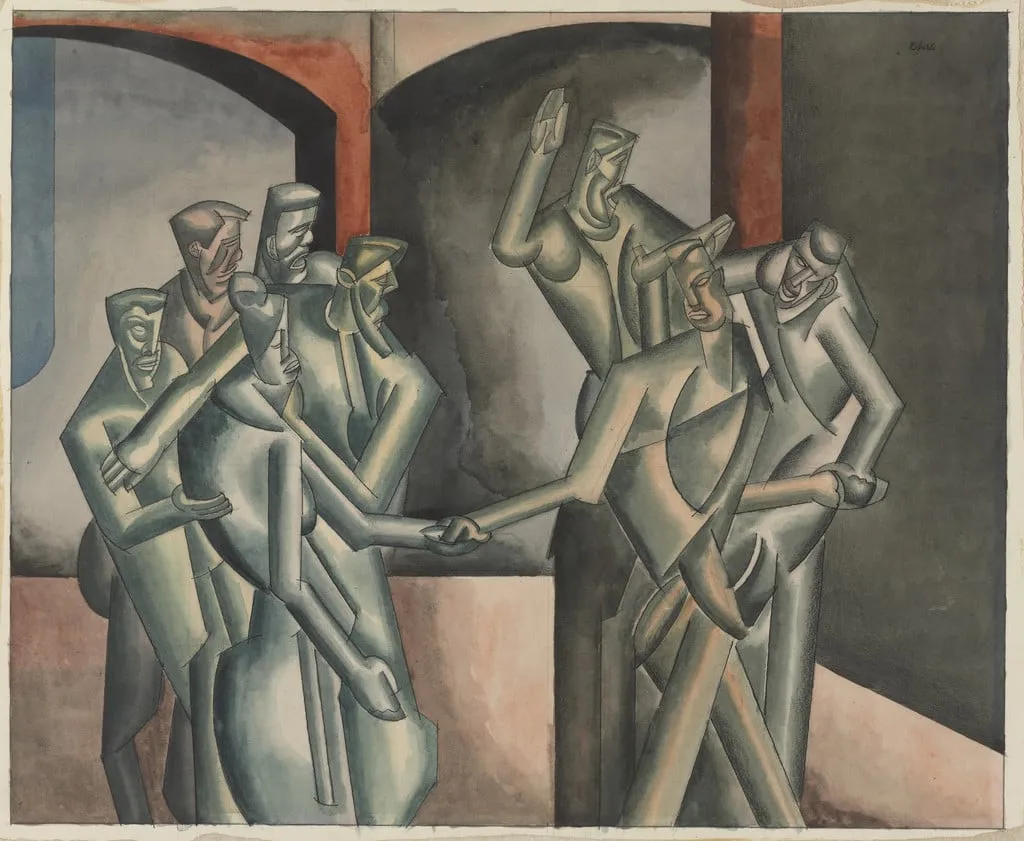
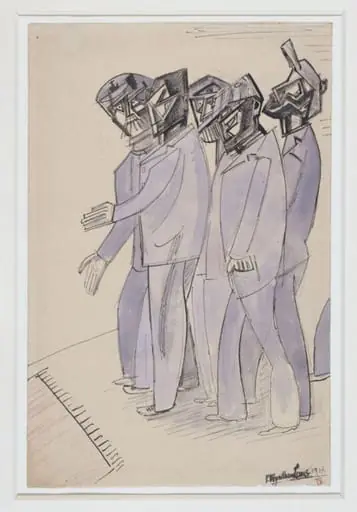
Untitled is a watercolor drawing by William Roberts. It dates from 1920 and is held in the collection of the Museum of Modern Art.
About this work
Overview
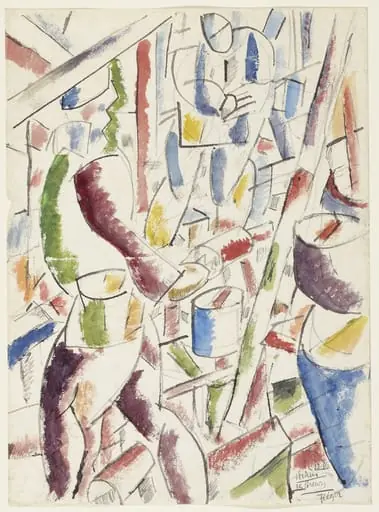
Created around 1920, this drawing by William Roberts combines watercolor, ink, pencil, and crayon on paper to capture a dynamic interior scene.
Created around 1920, this drawing by William Roberts combines watercolor, ink, pencil, and crayon on paper to capture a dynamic interior scene. It reflects the artist’s transition between pre-war abstraction and his later, more defined Cubist-influenced style. The work is part of The Museum of Modern Art’s collection, representing a moment in British modernism when traditional representation gave way to fragmented, expressive forms.
Subject & Meaning
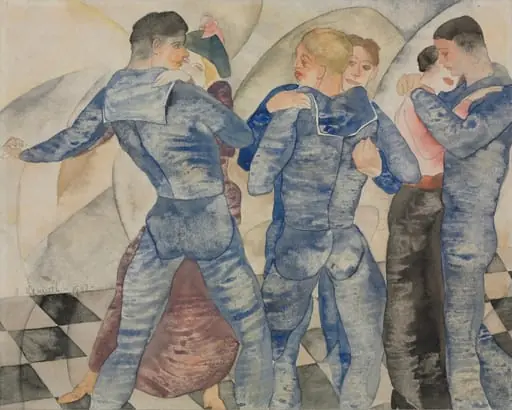
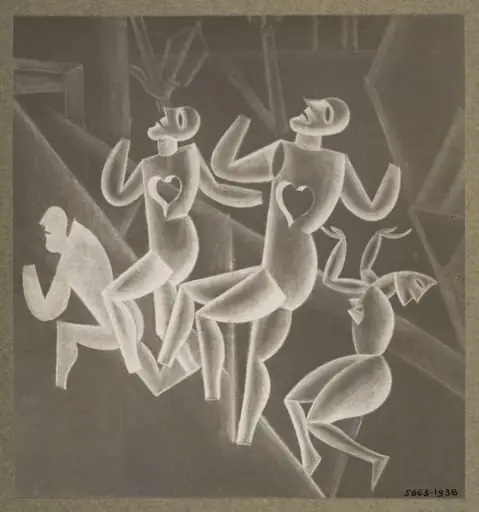
The scene depicts a group of figures engaged in dance within a confined space. Their interlocked limbs and raised arms suggest communal movement, though the rigid geometry of their forms distances the image from naturalism. The lack of detailed narrative or facial expression shifts focus to rhythm and structure, implying an interest in the mechanics of social interaction rather than emotional storytelling.
Technique & Style
Roberts employed sharp, angular lines and flat planes to construct the figures, reducing the human form to interlocking shapes reminiscent of fractured planes. Watercolor washes define areas of shadow and color, while ink and crayon outline forms with crisp precision. The limited palette—dominated by red and blue—enhances the graphic quality, reinforcing the stylized, almost architectural character of the composition.
History & Provenance
Produced shortly after Roberts’s service as a war artist during the First World War, the work emerged from a period of intense formal experimentation. Though he later became associated with English Cubism, this piece predates his fully developed mature style. It entered the collection of The Museum of Modern Art in the 20th century, where it remains as part of a broader survey of early modernist drawing practices.
Context
In early 20th-century Britain, artists were increasingly influenced by continental avant-garde movements, particularly Cubism. Roberts’s work reflects this engagement, though filtered through a distinctly British sensibility. Unlike French Cubists, he retained a connection to observable reality, using fragmentation to convey motion and social energy rather than purely formal analysis.
Legacy
This drawing exemplifies Roberts’s role in bridging British modernism and European abstraction. While not widely known outside specialist circles, his approach to form and movement influenced later generations of British artists exploring non-naturalistic representation. The work stands as a quiet but significant document of how wartime experience reshaped artistic priorities in the interwar period.
Artist & collection
Artist
William Patrick Roberts (5 June 1895 – 20 January 1980) was a British artist. In the years before the First World War Roberts was a pioneer, among English artists, in his use of abstract images. In later years he…