Artwork
Easterly Coming
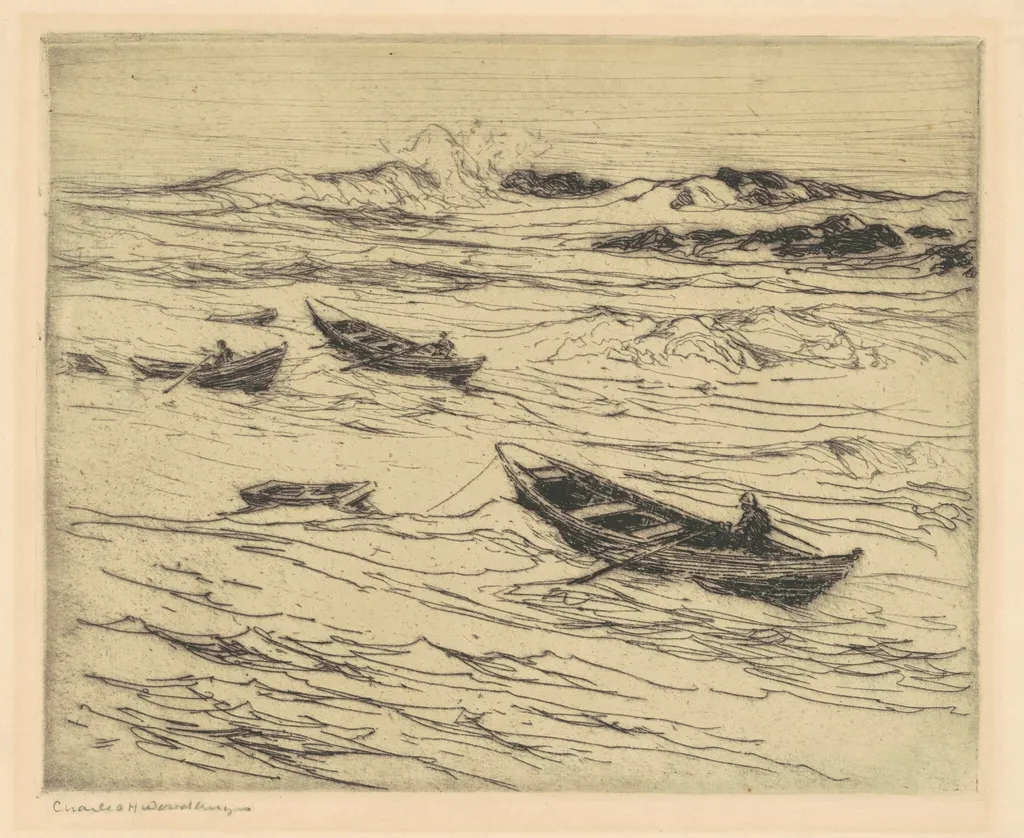
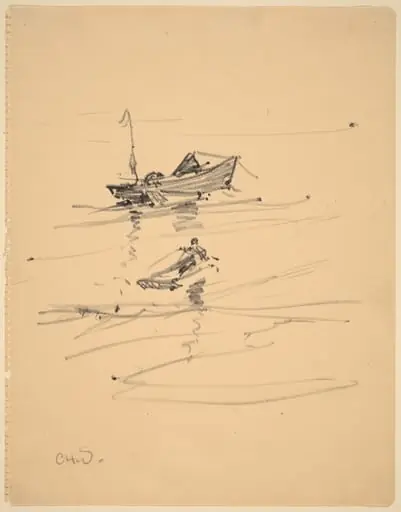
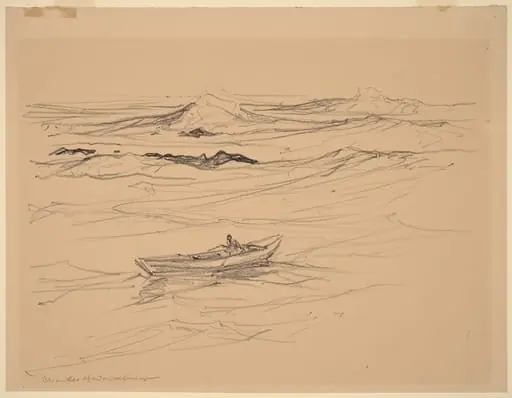
Easterly Coming is an ink print by Charles H. Woodbury. It dates from 1925 and is held in the collection of the National Gallery of Art.
About this work
Overview
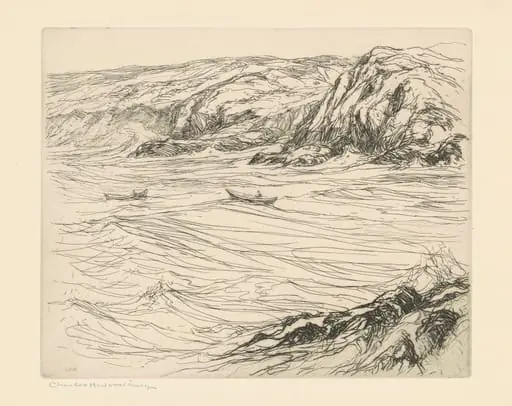
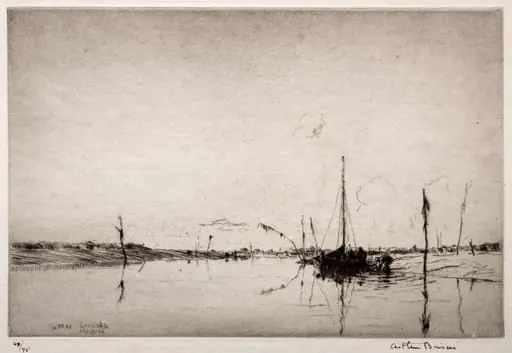
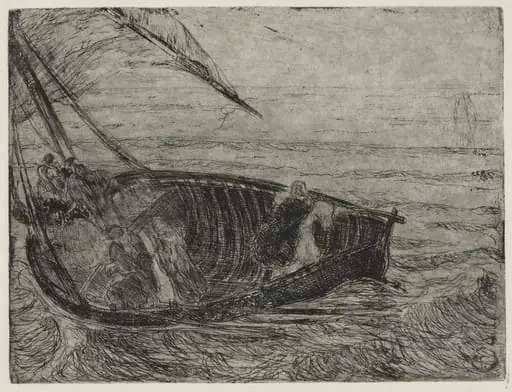
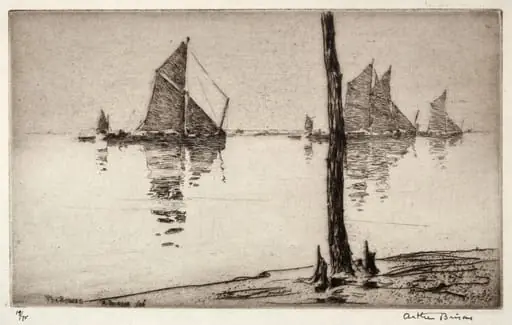
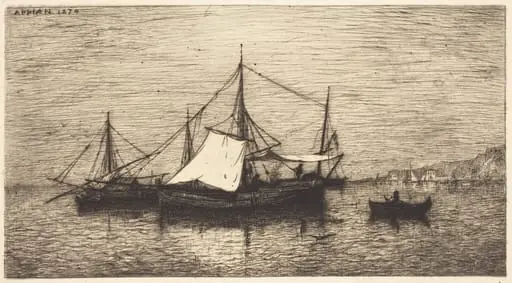
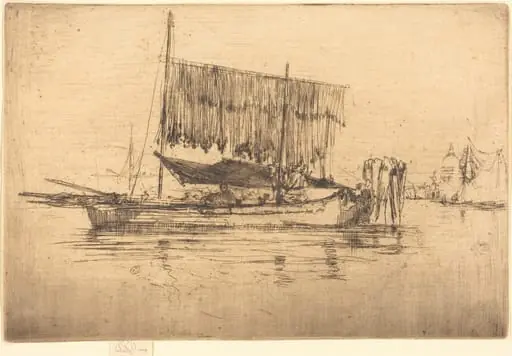
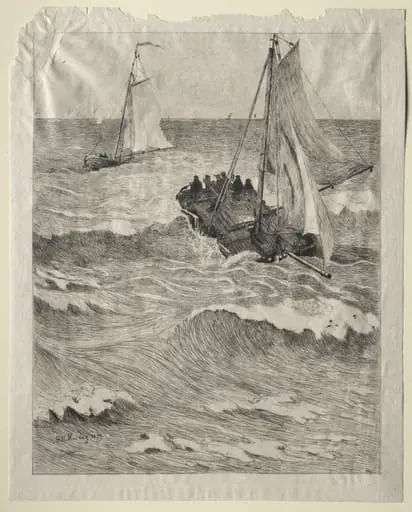
The composition captures three modest vessels adrift on undulating water, their forms reduced to minimal silhouettes.
Easterly Coming is a 1925 etching by Charles H. Woodbury, rendered in black ink on laid paper. The composition captures three modest vessels adrift on undulating water, their forms reduced to minimal silhouettes. The print’s monochromatic palette and sparse line work evoke a sense of stillness and solitude, characteristic of Woodbury’s interest in atmospheric marine scenes. As an etching, the image was produced by incising lines into a metal plate, allowing for multiple impressions.
Subject & Meaning
The three boats, devoid of detail or crew, suggest absence and quiet motion rather than narrative action. Their placement on turbulent water implies a transient moment—perhaps the onset of a wind shift or the quiet aftermath of a storm. The absence of horizon or land emphasizes isolation, inviting contemplation of nature’s rhythms over human presence. The title hints at an approaching weather system, reinforcing the mood of anticipation.
Technique & Style
Woodbury employed etching to achieve fine, fluid lines that mimic the movement of water. The waves are composed of rapid, curved incisions, creating a sense of texture and motion without realism. The boats appear as negative shapes, barely defined, contrasting with the dense ink of the sea. The use of laid paper enhances the tactile quality, while the limited tonal range reinforces the work’s sketchlike immediacy and restraint.
History & Provenance
Created in 1925, Easterly Coming belongs to Woodbury’s later period, when he focused on marine subjects through printmaking. It was likely produced during his time at the Boston School of Art, where he taught and promoted etching as a medium for capturing transient natural effects. The work’s survival in multiple impressions suggests it was circulated among collectors and students, reflecting its role in pedagogical and artistic circles of the era.
Context
In the 1920s, American printmakers like Woodbury turned to etching as a means of personal expression, moving away from commercial illustration. His work aligned with broader trends favoring simplicity and direct observation over elaborate detail. The emphasis on mood and atmosphere in Easterly Coming reflects influences from Japanese woodcuts and Impressionist sensibilities, both of which valued suggestion over description.
Legacy
Easterly Coming exemplifies Woodbury’s contribution to American printmaking through his emphasis on economy of form and emotional resonance. While not widely exhibited during his lifetime, the work remains a representative example of early 20th-century etching’s capacity to convey quiet, observational poetry. Its influence is seen in later artists who prioritized minimalism and atmospheric tone in maritime subjects.
Own this work as a print
Artist & collection