Artwork
Ogunquit Fisherman
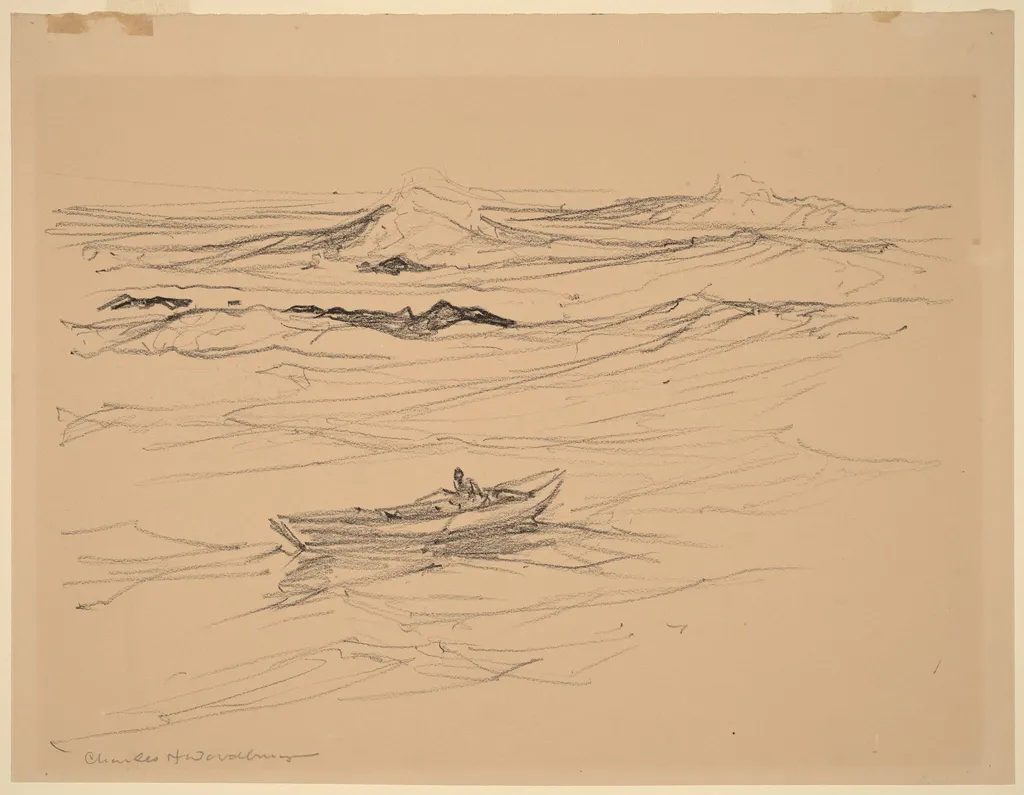
Ogunquit Fisherman is a crayon drawing by the Impressionist artist Charles H. Woodbury. It dates from 1902 and is held in the collection of the National Gallery of Art. Created in 1902, this drawing by Charles H.
About this work
Overview
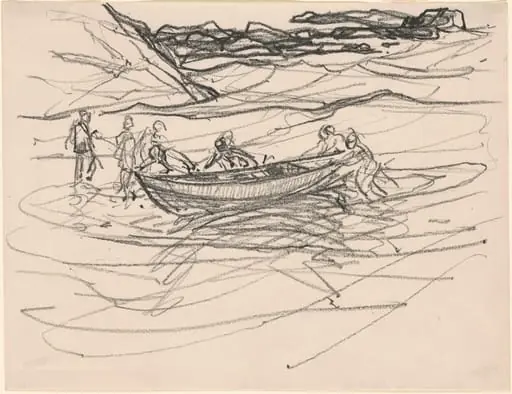
Created in 1902, this drawing by Charles H. Woodbury captures a solitary fisherman in a small vessel on open water. Executed in black crayon on light wove paper, the work is a spontaneous study, emphasizing motion and atmosphere over detail. The absence of hard outlines and the fluid, gestural marks suggest immediacy, as if the scene was observed and recorded in real time.
Subject & Meaning
The figure is reduced to minimal contours, barely distinguishable from the boat and waves, underscoring the fisherman’s integration with the sea. There is no narrative or emotional cue—only presence. The subject reflects the quiet labor of coastal life, rendered without idealization, focusing on the rhythm of work and environment rather than human drama.
Technique & Style
Woodbury employed loose, rapid strokes of black crayon to suggest form and movement. The paper’s texture interacts with the medium, allowing some areas to remain untouched, implying light and sky. Edges dissolve into smudges and pressure variations, creating a sense of wind and water without definition. The technique prioritizes perception over precision.
History & Provenance
Made during Woodbury’s time in Ogunquit, Maine, the drawing belongs to a series of on-site sketches he produced while teaching and observing the coastal landscape. These works were not intended for public display but served as personal records of light, motion, and form. Their survival reflects their value to the artist’s pedagogical practice.
Context
This drawing aligns with late 19th- and early 20th-century shifts toward direct observation in American art. While not part of a formal movement, it resonates with Realist tendencies that valued everyday subjects and unembellished representation. Woodbury’s approach echoes the broader interest in capturing transient moments, akin to plein air painting practices.
Legacy
Though modest in scale and finish, the drawing exemplifies Woodbury’s influence on art education, particularly in teaching students to see structure through gesture. Its unpolished quality became a model for observational drawing, emphasizing the expressive potential of simplicity and the value of the sketch as a vital artistic act.
Artist & collection


![Rocks Along a Lakeshore [recto], by John William Casilear](https://artifactworldgallery.com/img/john-william-casilear--rocks-along-a-lakeshore-recto--b93b7ece126b330b-w320.webp)