Artwork
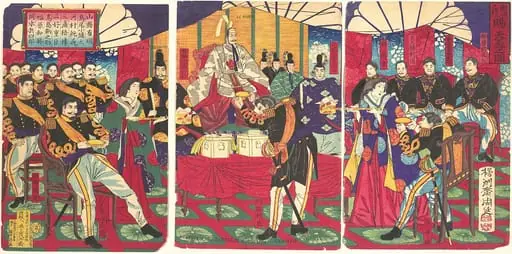
Saigo Ryusei Kubi jitsu ken|Presentation of the Head of Saigo to the Prince Arisogawa
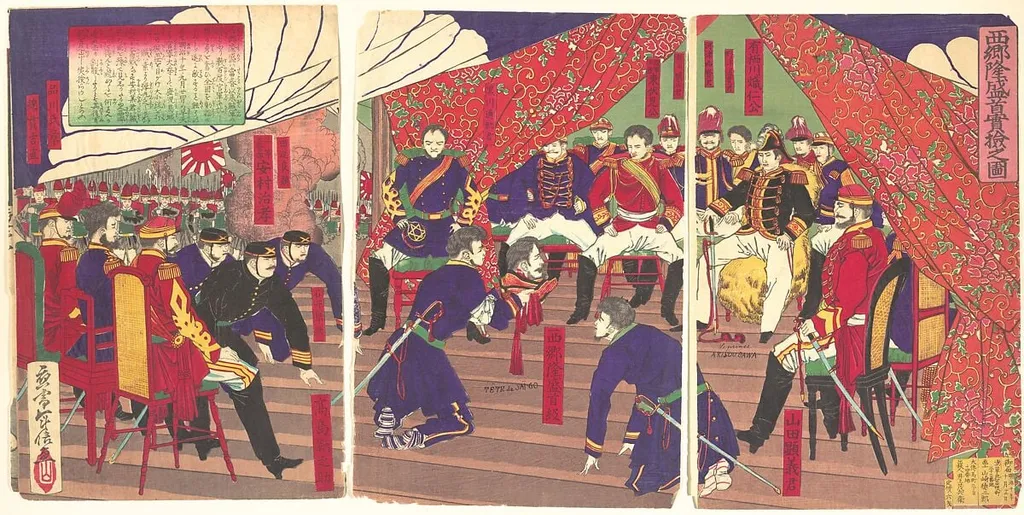
Saigo Ryusei Kubi jitsu ken|Presentation of the Head of Saigo to the Prince Arisogawa is an ink print by the Impressionist artist Yamazaki Toshinobu. It dates from 16 and is held in the collection of the Metropolitan Museum of Art.
About this work
Overview
This woodblock print is one panel from a triptych created by Yamazaki Toshinobu in 1877, depicting a violent episode from the Satsuma Rebellion.
This woodblock print is one panel from a triptych created by Yamazaki Toshinobu in 1877, depicting a violent episode from the Satsuma Rebellion. Executed in ink and color on paper, it belongs to the ukiyo-e tradition but adopts a more sensational, reportorial tone. The Metropolitan Museum of Art holds the single sheet, which captures a moment of political retribution with heightened theatricality, typical of late 19th-century Japanese print culture.
Subject & Meaning
The scene illustrates the presentation of Saigo Takamori’s severed head to Prince Arisugawa Taruhito, a symbolic act marking the end of the rebellion. Soldiers in contrasting red and blue uniforms surround the grim tableau, some dragging the body, others observing with grim formality. The seated nobleman, elevated on a chair, embodies imperial authority. Above, bold text functions as a headline, framing the event as public spectacle and political closure.
Technique & Style
The print employs sharp black outlines and saturated hues—crimson, violet, and gold—to heighten emotional intensity. Composition is deliberately crowded, with figures arranged in dynamic, overlapping planes to convey chaos. Background architecture, including red gates and banners, anchors the scene in a recognizable setting. The style merges traditional ukiyo-e techniques with emerging journalistic realism, reflecting the era’s shifting visual language.
History & Provenance
Produced shortly after the suppression of the Satsuma Rebellion in 1877, the print was part of a series documenting the conflict’s key moments. Such prints were widely circulated as news imagery, capitalizing on public fascination with the rebellion’s dramatic end. The Metropolitan Museum of Art acquired the sheet as part of its broader collection of Japanese prints, preserving it as a record of Meiji-era visual culture.
Context
The Satsuma Rebellion, led by former samurai Saigo Takamori, was the last major armed challenge to the Meiji government’s modernization policies. Its defeat signaled the end of the samurai class’s political power. Prints like this one served both as entertainment and propaganda, reinforcing state narratives of order and loyalty while exploiting public appetite for sensationalized imagery of violence and defeat.
Legacy
This print exemplifies the transition in Japanese printmaking from idealized narratives to contemporary event reporting. Though produced for mass consumption, it remains a significant artifact of Meiji-era visual politics. Its raw depiction of execution and authority reflects the tensions between tradition and modernity, offering insight into how the state used imagery to legitimize its authority during a period of rapid social change.
Artist & collection


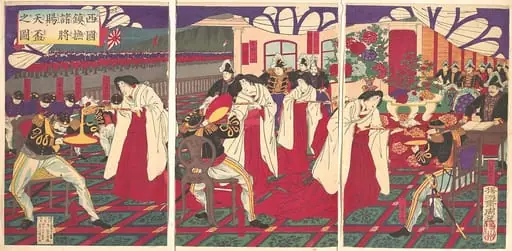 西国鎮静撫諸将天杯賜之図|Illustration of the Commanders who Pacified Western Japan, Receiving the Emperor's Gift Cups (Saigoku chinbu shoshō tenpai o tamau no zu)
 Untitled
 Untitled
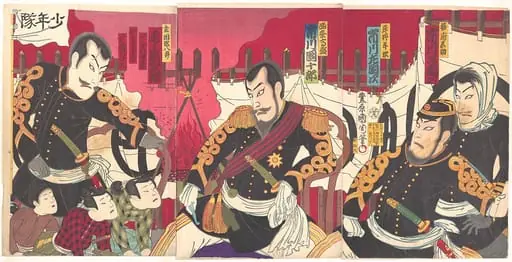 「摂府真助」「市川子團次」「岸野年秋 市川左團次」 「西条高盛 市川團十郎」 「倉田進八郎 尾上菊五郎」「正太郎 中村仲太郎」「孫市 尾上菊之介」「徳丸 市川幸作」西南雲晴朝東風|Ichikawa Kodanji as Seppu Shinsuke, Ichikawa Sadanji as Kishino Toshiaki, Ichikawa Danjūrō as Saijō Takamori, Onoe Kikugorō as Kurata Shinpachirō, Nakamura Chūtarō as Shōtarō, Onoe Kikunosuke as Magoichi, and Ichikawa Kōsaku as Tokumaru in the play Okige no kumo harau asa gochi
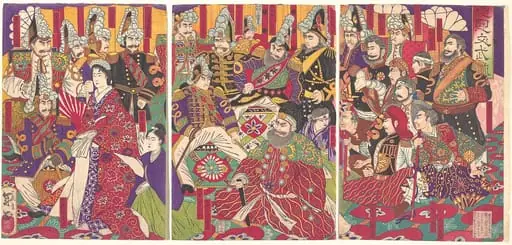 Untitled
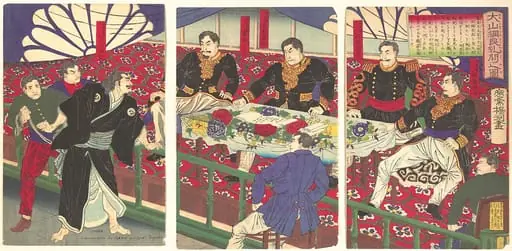 大山綱良糾問の図|Illustration of the Inquisition of Ōyama Tsunayoshi (Ōyama Tsunayoshi kyūmon no zu)
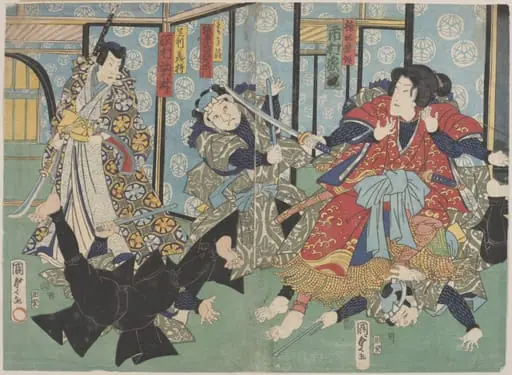 H Beard Print Collection
 Untitled
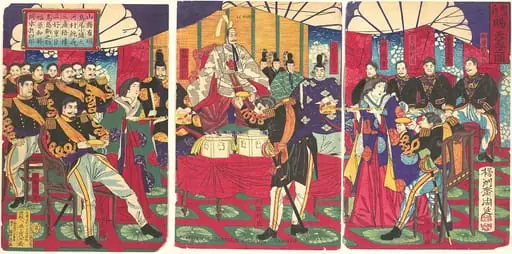 勲功之将天杯賜之図|Illustration of the Honored Commanders, Receiving the Emperor's Gift Cup (Kunkō no shō tenpai o tamau no zu)
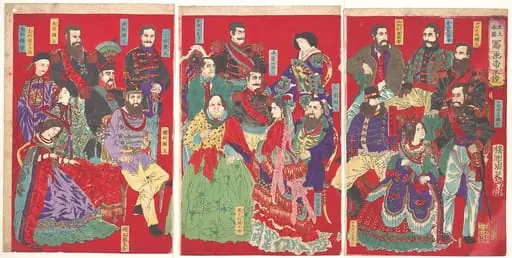 世上各国写画帝王鏡|Mirror of Portraits of All Sovereigns in the World (Sejō kakkoku shaga teiō kagami)