Artwork
Ornament Panel: Triton Ridden by a Child

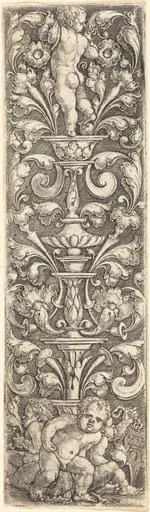
Ornament Panel: Triton Ridden by a Child is an ink print by the Renaissance artist Andrea Zoan. It dates from 1510 and is held in the collection of the National Gallery of Art.
About this work
Overview
Andrea Zoan’s engraving titled *Ornament Panel: Triton Ridden by a Child* dates to around 1510.
Andrea Zoan’s engraving titled *Ornament Panel: Triton Ridden by a Child* dates to around 1510. The print is a narrow, vertical composition executed in black ink on paper. It features a decorative vase flanked by two partially visible faces at the top, while a plump infant is shown astride a mythological sea creature with a fish‑like tail. The surrounding space is filled with intricate swirls and foliage motifs.
Subject & Meaning
The central figure—a chubby child riding a Triton—draws on classical mythology, where Tritons are half‑human, half‑fish beings associated with the sea. By placing a youthful rider on the creature, the image may allude to themes of innocence navigating the unknown or the playful merging of human and marine realms, a common decorative motif in Renaissance ornamentation.
Technique & Style
Zoan employed the engraving method, incising fine lines into a metal plate to create a dense network of hatching and cross‑hatching. This technique allows for precise, lace‑like detailing and a range of tonal values despite the monochrome medium. The crisp, linear quality and ornamental flourishes reflect the decorative aesthetic typical of early sixteenth‑century prints used for architectural and jewelry designs.
History & Provenance
The work originates from the early sixteenth century, a period when prints served both as artistic objects and as pattern books for craftsmen. While specific ownership records are scarce, the engraving’s style and subject align with the broader circulation of ornamental designs in Italy during the Renaissance, suggesting it may have been used as a reference for decorative arts.
Context
Produced in the wake of the Italian Renaissance’s revival of classical motifs, the panel exemplifies the era’s fascination with mythological figures rendered in a decorative framework. Such prints were often disseminated among artisans to inspire ornamental schemes for façades, metalwork, and textiles, bridging fine art and applied design.
Legacy
Although not widely cited in major art historical surveys, Zoan’s engraving contributes to our understanding of how Renaissance artists translated classical iconography into portable, reproducible formats. It illustrates the role of printmaking in spreading ornamental vocabulary across Europe, influencing decorative practices well beyond its original context.
Artist & collection


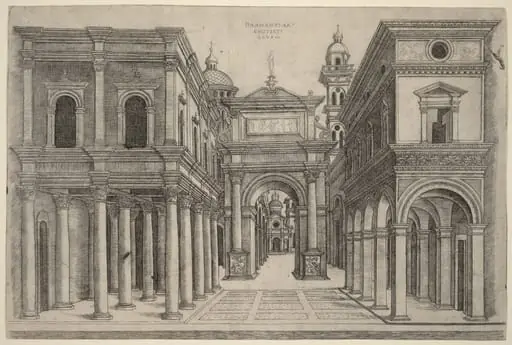 A Street with Various Buildings, Colonnades and an Arch
 Ornament Panel: Griffins and Two Cupids Crossing Halberds
 Ornament Panel: Three Children Blowing Horns
 Ornament Panel: Two Sphinxes Supporting Shields
 Page from Livius Historiabum Libri
 Ornament Panel with Dragons, Masks, and Instruments of War
 Ornament Panel: Satyr Holding a Violin
 Fountain with Statue of Neptune