Artwork
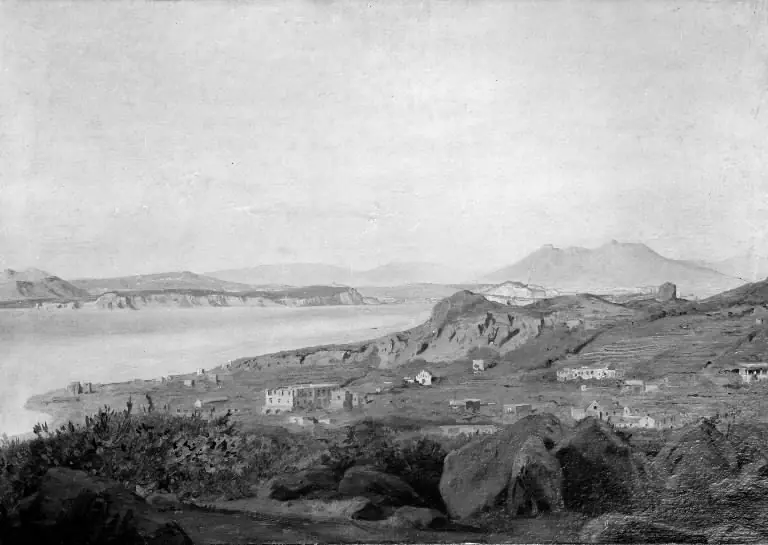
A View of Casamicciola, Ischia
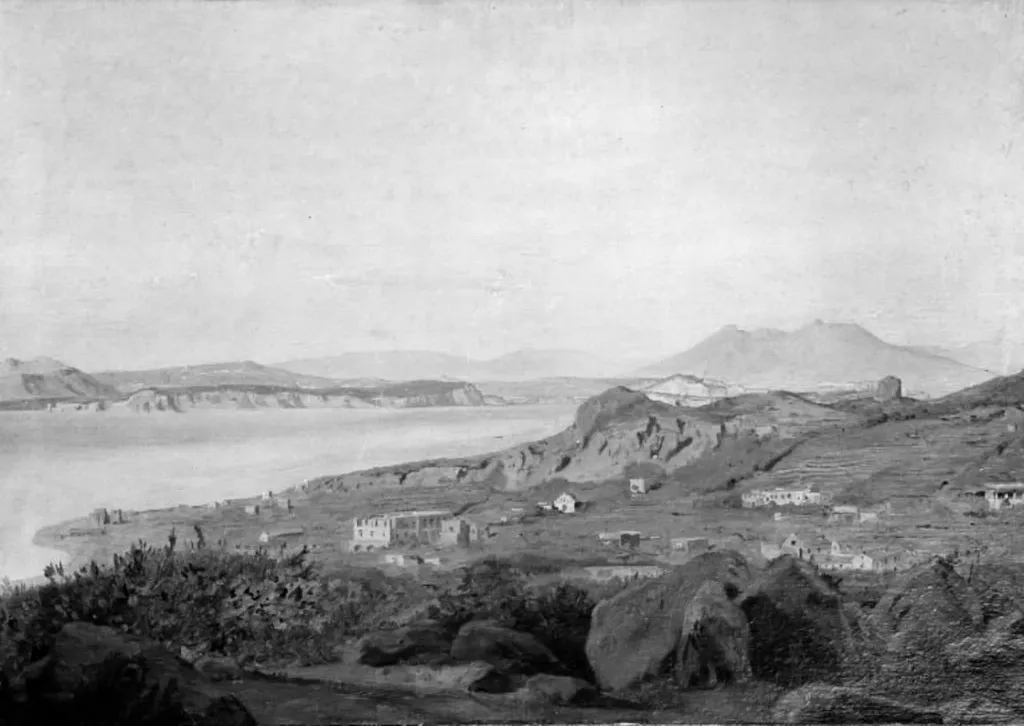
A View of Casamicciola, Ischia is a photography by the Romanticist artist Unknown. It dates from 1838 and is held in the collection of the Statens Museum for Kunst. Created in 1838, this black-and-white image captures the coastal town of Casamicciola on the island of Ischia.
About this work
In the distance, mountains fade into a hazy sky, while the foreground has scrubby plants and a few large boulders.
This black-and-white image shows a quiet coastal town nestled between rocky hills and the sea. The buildings are small and spread out, with some clustered near the water’s edge. In the distance, mountains fade into a hazy sky, while the foreground has scrubby plants and a few large boulders.
The scene looks calm and untouched, almost like a snapshot from a long time ago. This is one of the earliest photos ever made—it’s from 1838, when photography was brand new.
Next, check out the technique: chiaroscuro to see how light and shadow create depth in art.
Overview
Created in 1838, this black-and-white image captures the coastal town of Casamicciola on the island of Ischia. One of the earliest known photographic landscapes, it reflects the nascent possibilities of the medium. The composition presents a tranquil, unpopulated scene with modest architecture nestled against rugged terrain, emphasizing the quiet relationship between settlement and natural environment.
Subject & Meaning
The image depicts a small, scattered settlement clinging to the shoreline, surrounded by barren hills and the open sea. There is no human presence, suggesting a focus on place rather than activity. The stillness and simplicity convey a sense of isolation and timelessness, aligning with early photographic attempts to document the world with objectivity rather than idealization.
Technique & Style
The photograph relies on natural light and tonal gradation to define form, with shadows deepening the contours of rocks and buildings. The hazy horizon and muted contrasts suggest early photographic limitations, yet these constraints enhance the atmospheric quality. The arrangement of foreground boulders and sparse vegetation guides the eye toward the distant mountains, creating subtle depth without artificial staging.
History & Provenance
Made in 1838, the image predates widespread photographic practice and was likely produced using a daguerreotype or early calotype process. It entered the collection of the Museum of Ethnography, where it is preserved as a significant artifact of visual documentation from photography’s earliest years. Its origin and photographer remain undocumented, adding to its historical mystery.
Context
In 1838, photography was an experimental science, not yet an art form. This image emerged during a period when European travelers and scientists sought to record distant places with mechanical precision. Casamicciola, a modest fishing village, was chosen not for its grandeur but for its unaltered landscape—reflecting a broader interest in documenting the world as it existed, before industrialization transformed it.
Legacy
As one of the first photographic records of an Italian coastal town, it stands as an early example of landscape documentation through the camera. Its quiet realism influenced later documentary practices and contributed to the recognition of photography as a tool for preserving cultural and geographical memory. It remains a quiet testament to the medium’s beginnings.
Artist & collection

 Domestic Scene
 Giacomo and Cardinal Marco, investing Andrea, Abbot of San Zeno, with his Benefice
 The Nymph of Fontainebleau
 Portrait of a Woman
 Madonna and Child with Saints in the Enclosed Garden
 Venus and Minerva
 Family Group of Four on Sofa
 Wall painting from Room H of the Villa of P. Fannius Synistor at Boscoreale
 Klipper ved Götaelven
 Klipper ved Götaelven
 Sketch from Parish in Norway
 Tappan Zee, from Glenwood
 The Nile, Gray Morning, Gebelain
 Hyde Park
 Rocky Coast with Light House
 View of the Whampoa Anchorage
 Shepherd and his flock by Lake Nemi
 The Avon Gorge and Hotwell
 Islands Khalxi and Prinkipos, Sea of Marmora
 A View of Casamicciola, Ischia