Artwork
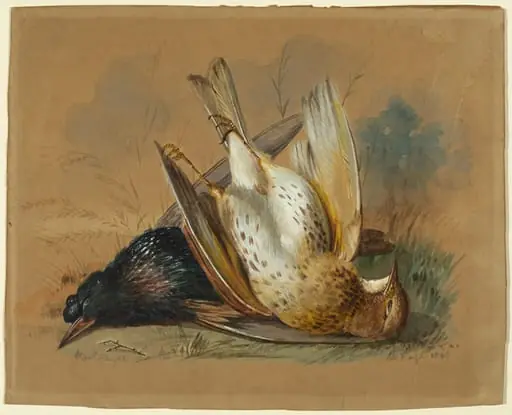
Studie af to døde sangdrosler?
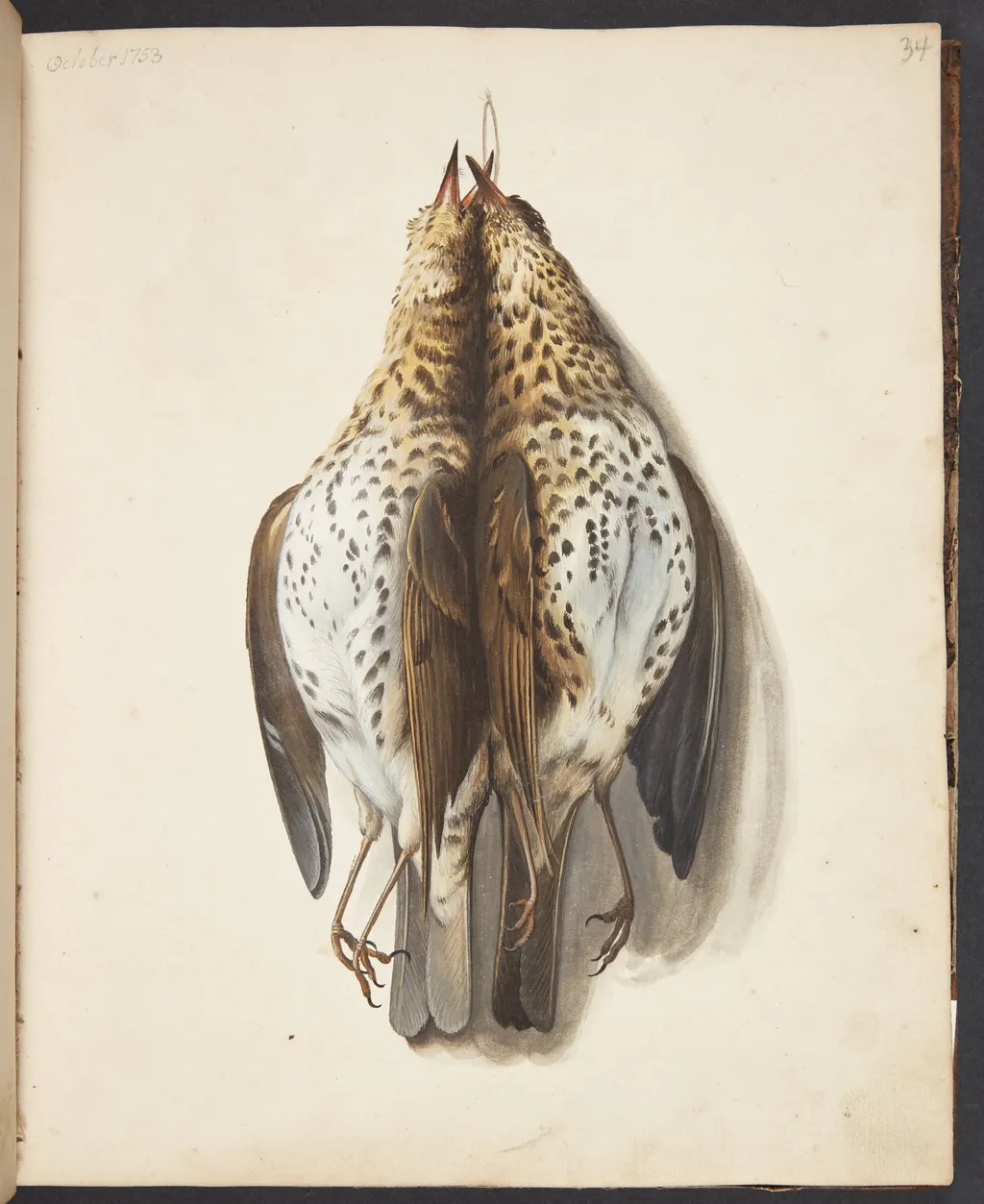
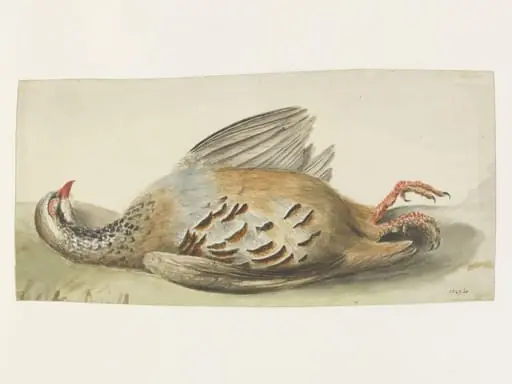
Studie af to døde sangdrosler? is an unspecified work on paper by the Rococo painting artist Unknown. It dates from 1753 and is held in the collection of the Statens Museum for Kunst. This watercolor, dated October 1753, depicts two deceased songbirds arranged for anatomical observation.
About this work
The bird on the left has brown and white speckled feathers, while the one on the right is mostly dark brown with lighter edges.
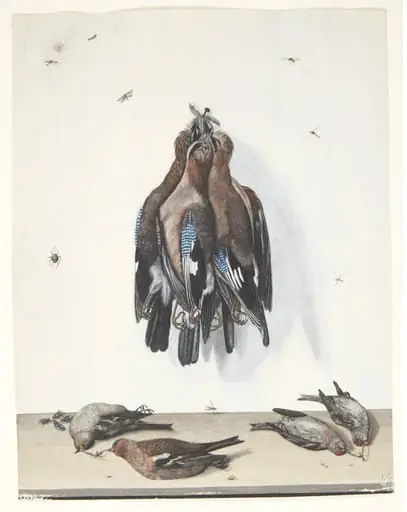
This is a watercolor of two dead birds, pinned by their legs and spread open to show their feathers. The bird on the left has brown and white speckled feathers, while the one on the right is mostly dark brown with lighter edges. The background is plain, and the focus is entirely on the birds’ details.
The date "October 1753" is written in the corner, suggesting this was made over 250 years ago. These kinds of drawings were often used to study nature closely.
Next, look up watercolor to see how artists used this technique to capture fine details like these.
Overview
This watercolor, dated October 1753, depicts two deceased songbirds arranged for anatomical observation. Created by an artist identified as 1342_person, the work is part of the Museum of Ethnography’s collection. The birds are suspended by their legs, wings spread to reveal plumage structure. The plain background eliminates distraction, emphasizing precision in rendering feather patterns and texture.
Subject & Meaning
The two birds, likely common European species, are presented not as specimens of beauty but as objects of scientific inquiry. Their stillness and positioning reflect an 18th-century practice of natural history documentation. The drawing serves as a record of physical detail, possibly for classification or educational use, aligning with broader Enlightenment efforts to systematize knowledge of the natural world.
Technique & Style
Watercolor was chosen for its capacity to render subtle gradations of color and fine feather textures. The artist applied thin, layered washes to capture the speckled brown-and-white plumage of the left bird and the darker, edged feathers of the right. Delicate linework defines individual barbs, while the absence of shading or perspective keeps focus strictly on ornithological accuracy.
History & Provenance
The work bears a clear date and was likely part of a private or institutional collection of naturalist studies. It entered the Museum of Ethnography’s holdings at some point after its creation, possibly through donation or acquisition of scientific archives. Its survival over two and a half centuries suggests it was valued as a reference object rather than a decorative piece.
Context
In mid-18th-century Europe, detailed illustrations of flora and fauna were essential tools for naturalists before photography. Artists often collaborated with scientists to produce accurate visual records. This drawing fits within a tradition of specimen-based observation, where dead birds were pinned and studied to understand species variation, migration, and anatomy.
Legacy
Though unsigned and unattributed beyond a catalog number, the work endures as an example of pre-modern scientific illustration. It reflects a time when visual precision was the primary means of documenting biological diversity. Today, it offers insight into how natural knowledge was gathered and preserved through careful, patient observation.
Artist & collection

 Domestic Scene
 Giacomo and Cardinal Marco, investing Andrea, Abbot of San Zeno, with his Benefice
 The Nymph of Fontainebleau
 Portrait of a Woman
 Madonna and Child with Saints in the Enclosed Garden
 Venus and Minerva
 Family Group of Four on Sofa
 Wall painting from Room H of the Villa of P. Fannius Synistor at Boscoreale