Artwork
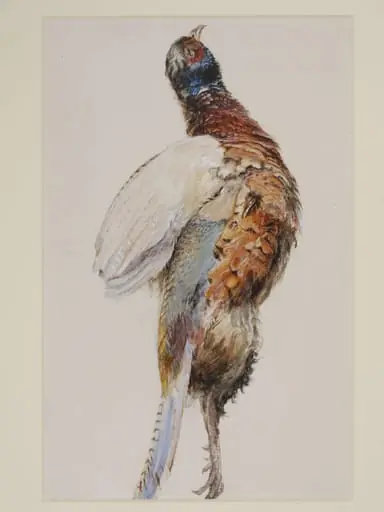
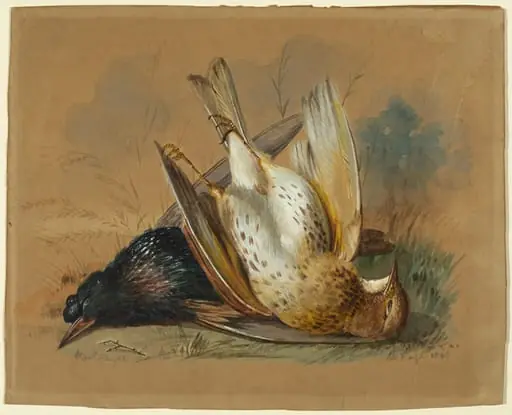
Study of a dead French partridge
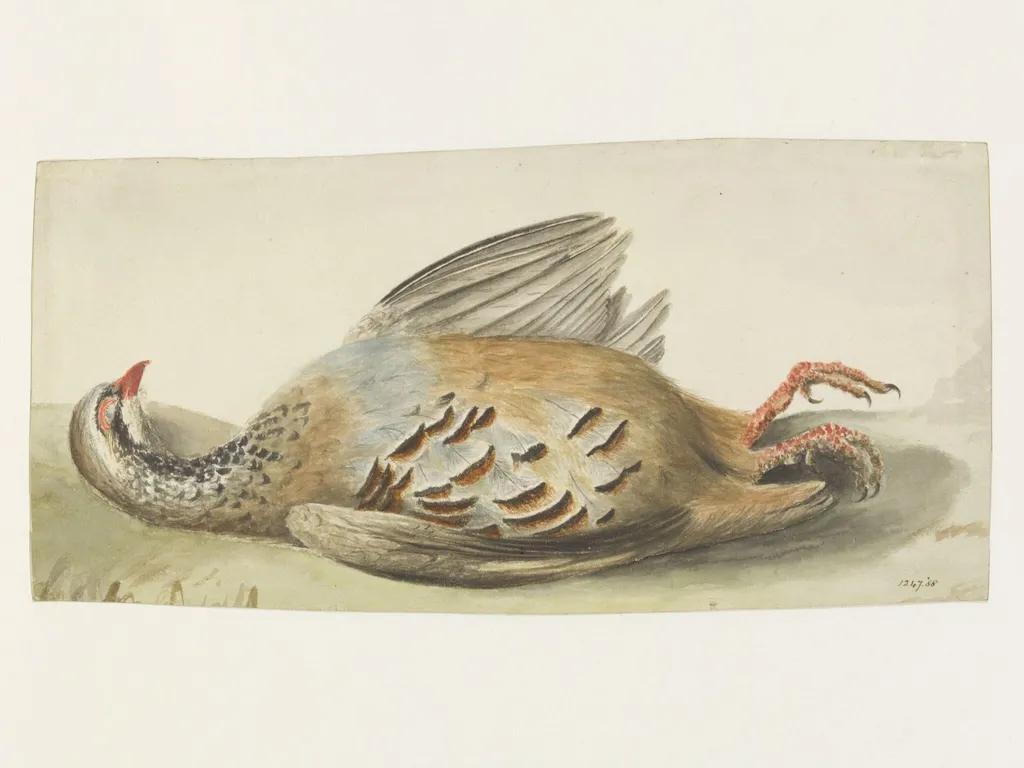
Study of a dead French partridge is a watercolor work on paper by the Romanticist artist John Constable. It dates from 1833 and is held in the collection of the Victoria and Albert Museum.
About this work
Overview
This watercolour study by John Constable presents a dead French partridge arranged on its side, rendered with quiet precision. The bird’s form is captured in muted tones—browns, greys, and soft blues—with minimal use of red to highlight subtle features. The composition focuses entirely on the animal, isolating it from any landscape or context, emphasizing observation over narrative.
Subject & Meaning
The partridge, a common game bird, is depicted not as a trophy but as a specimen of natural form. Its stillness suggests a moment after death, observed with neutrality. Constable’s choice to render the bird with such care implies an interest in biological detail rather than symbolism, aligning with his broader commitment to studying the natural world in its unadorned state.
Technique & Style
Constable employed light, layered washes to suggest the texture of feathers, allowing the paper’s surface to contribute to the effect of volume and softness.
Constable employed light, layered washes to suggest the texture of feathers, allowing the paper’s surface to contribute to the effect of volume and softness. Delicate strokes define individual plumage, while faint red accents on the legs and around the eye add localized contrast without distraction. The technique reflects a direct, empirical approach, prioritizing tactile realism over decorative flourish.
History & Provenance
Created during Constable’s period of intense natural study, likely in the 1820s, this work was part of a series of animal and sky studies made for personal exploration. It remained in the artist’s possession until his death, later passing to family members before entering public collections. Its modest scale and private function distinguish it from his larger landscape commissions.
Context
Constable’s interest in birds and natural forms grew alongside his scientific curiosity and his belief in direct observation. While best known for landscapes, he produced numerous small-scale studies of animals, insects, and clouds, treating them as worthy subjects in their own right. This piece reflects a broader 19th-century shift toward empirical naturalism in British art.
Legacy
Though not widely exhibited during his lifetime, this study exemplifies Constable’s dedication to close-looking and his rejection of idealized forms. It has since become a reference point for understanding his methodological rigor and his quiet expansion of watercolour’s potential beyond traditional landscape conventions.
Artist & collection
Artist
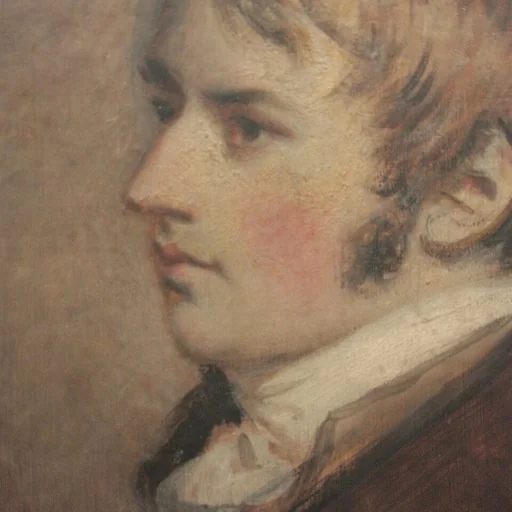
John Constable (; 11 June 1776 – 31 March 1837) was an English landscape painter in the Romantic tradition.