Artwork
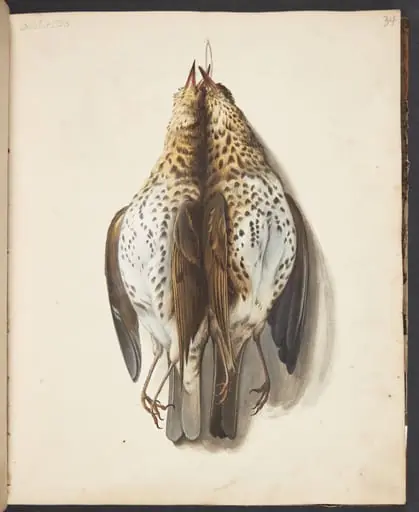
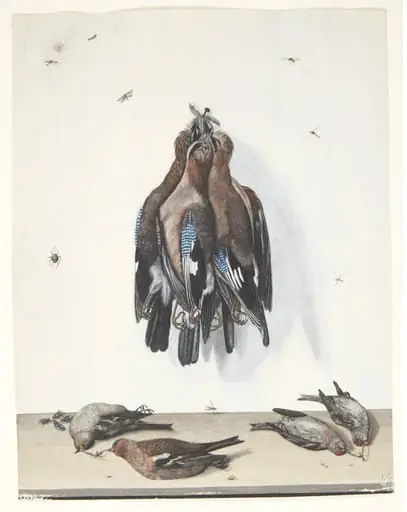
Studie af to døde solsorte, han og hun, ophængt i snor på en på en krog
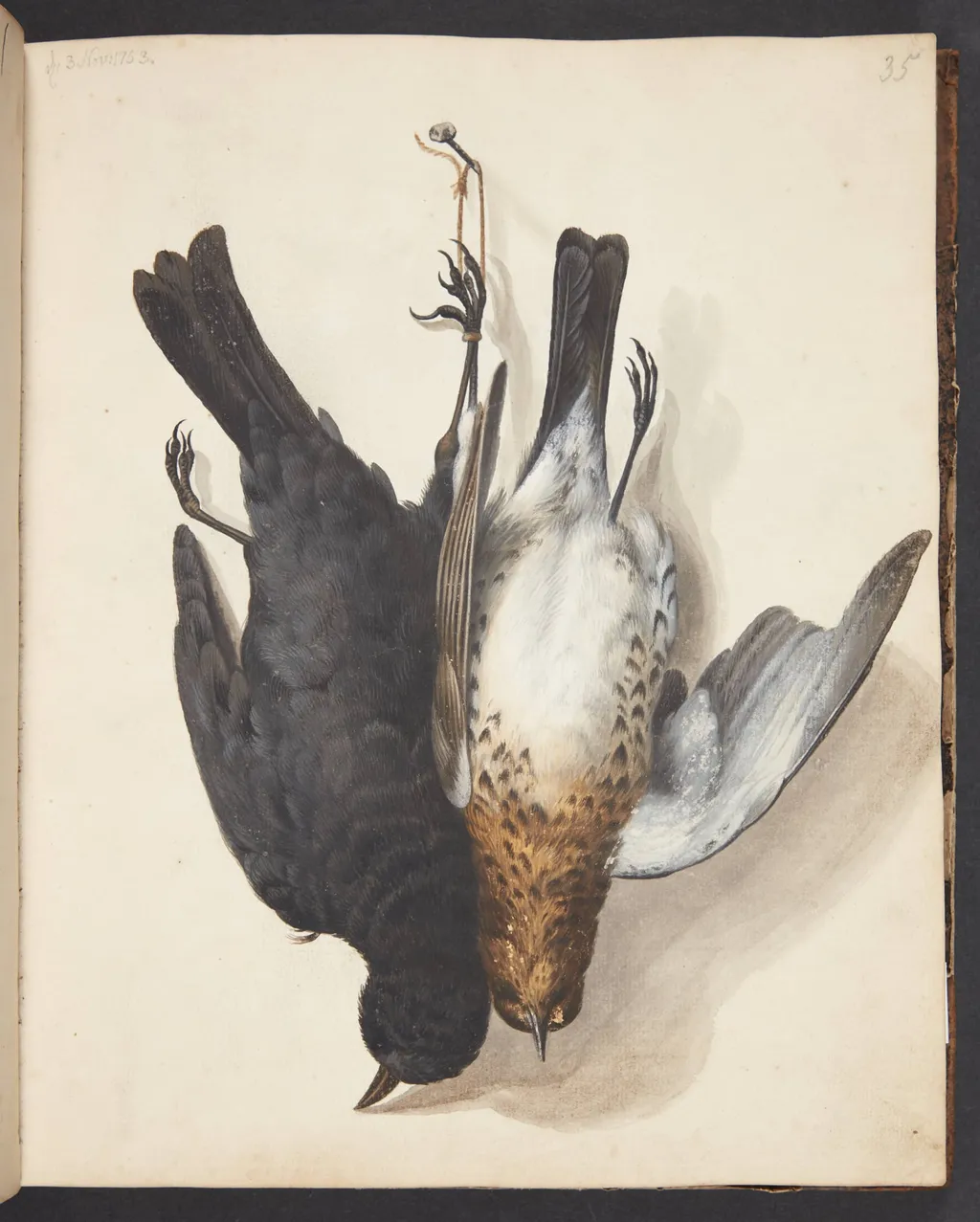
Studie af to døde solsorte, han og hun, ophængt i snor på en på en krog is an unspecified work on paper by the Rococo painting artist Unknown. It dates from 1753 and is held in the collection of the Statens Museum for Kunst. Created in 1753 by 1342_person, this work depicts two deceased sunbirds, male and female, suspended by a cord from a hook.
About this work
Overview
Rendered in precise detail, the birds are shown against a neutral background, their bodies rigid and arranged for observation.
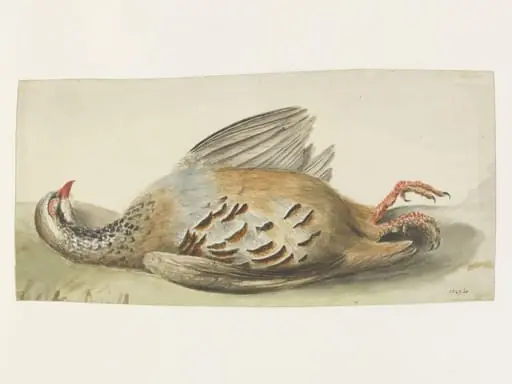
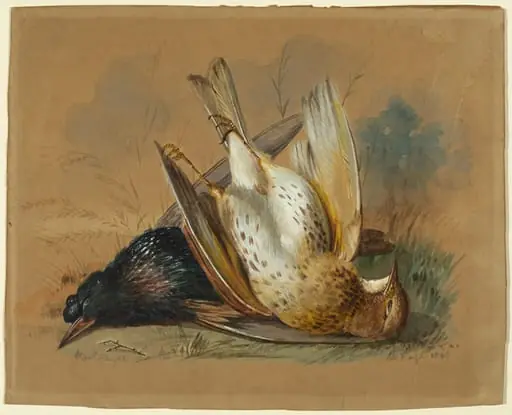
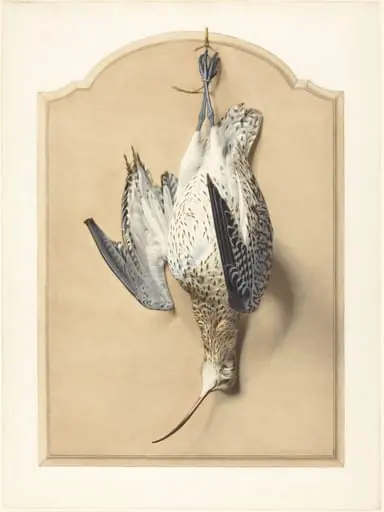
Created in 1753 by 1342_person, this work depicts two deceased sunbirds, male and female, suspended by a cord from a hook. Rendered in precise detail, the birds are shown against a neutral background, their bodies rigid and arranged for observation. The piece functions as a naturalistic study, reflecting an 18th-century practice of documenting wildlife through careful visual recording rather than decorative intent.
Subject & Meaning
The two birds, distinguished by plumage differences, represent a paired specimen—likely collected for scientific or educational purposes. Their stillness and suspension suggest an anatomical examination, common in natural history studies of the period. The absence of landscape or context emphasizes their role as specimens, not symbols, underscoring a focus on biological accuracy over narrative or emotional expression.
Technique & Style
The artist employed fine, controlled lines to render individual feathers and the subtle gradations of color across the birds' bodies. The wings are extended in a natural, albeit static, pose, revealing structural detail. The medium, though unspecified, suggests a dry or water-based technique suited to delicate observation. The flat, unadorned background directs attention entirely to the forms, reinforcing the study’s empirical purpose.
History & Provenance
The work resides in the Museum of Ethnography, indicating its inclusion in a collection tied to anthropological or natural history inquiry. Its survival since 1753 suggests it was preserved as part of a broader archive of specimens or visual records, possibly linked to European scientific expeditions or private collections of the Enlightenment era that valued systematic documentation of the natural world.
Context
In mid-18th-century Europe, detailed illustrations of flora and fauna were integral to emerging scientific disciplines. Artists often collaborated with naturalists to produce accurate depictions for classification. This study aligns with that tradition, where visual precision replaced textual description as a tool for knowledge, reflecting a broader cultural shift toward empirical observation over artistic idealization.
Legacy
Though not widely exhibited, the work contributes to a quiet lineage of scientific illustration that prioritized fidelity over aesthetics. It exemplifies how art served as a bridge between observation and taxonomy, influencing later biological documentation. Its preservation underscores the value placed on such studies as foundational records of biodiversity, even when devoid of overt artistic ambition.
Artist & collection

 Domestic Scene
 Giacomo and Cardinal Marco, investing Andrea, Abbot of San Zeno, with his Benefice
 The Nymph of Fontainebleau
 Portrait of a Woman
 Madonna and Child with Saints in the Enclosed Garden
 Venus and Minerva
 Family Group of Four on Sofa
 Wall painting from Room H of the Villa of P. Fannius Synistor at Boscoreale