Artwork
În piața...comună
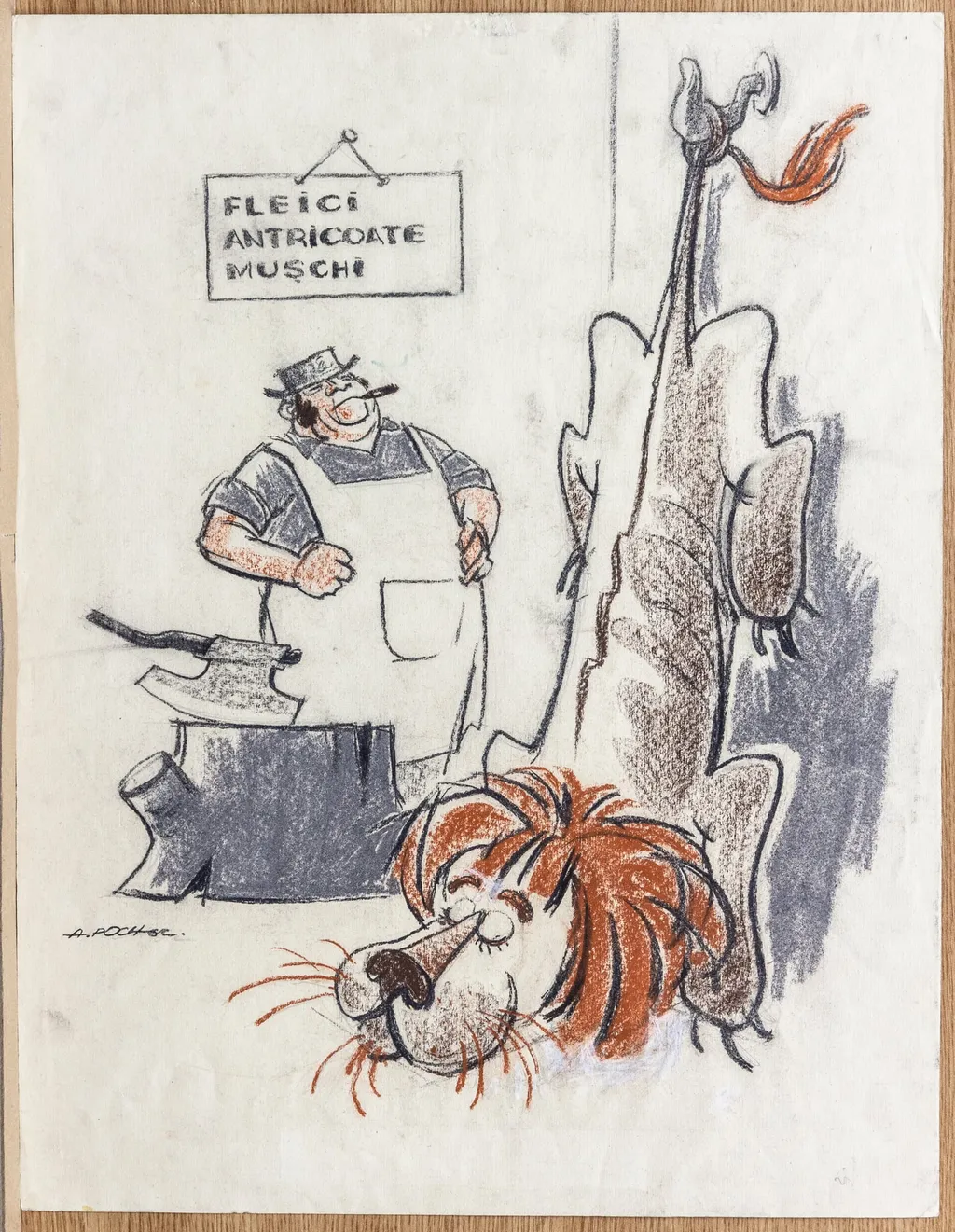
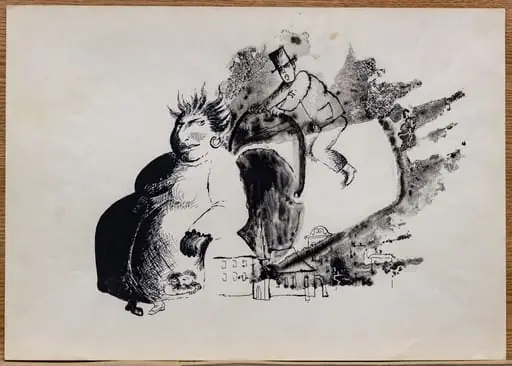
În piața...comună is a drawing by Poch Albert. It dates from 1950 and is held in the collection of the Gavrila Simion Eco-Museum Research Institute Tulcea.
About this work
Overview
Created around 1950 by Poch Albert, this ink drawing captures a moment in a rural Romanian butcher shop.
Created around 1950 by Poch Albert, this ink drawing captures a moment in a rural Romanian butcher shop. Executed with swift, confident lines, the work belongs to the collection of the Museum of Ethnography. It presents a single figure engaged in labor, surrounded by the tools and signs of his trade. The composition avoids embellishment, focusing instead on the physicality and rhythm of daily work.
Subject & Meaning
The scene centers on a butcher, aproned and hatted, smoking a cigarette as he prepares a hanging pig carcass. The shop’s sign, 'Fleici Antricoate Muschi,' anchors the setting in local commerce. The figure’s focused posture and the carcass’s weight suggest routine labor, not spectacle. The image conveys dignity in work, reflecting the unglamorous but essential role of butchers in community life during the mid-20th century.
Technique & Style
Rendered in loose, bold ink lines with minimal shading, the drawing emphasizes motion over detail. Contours are fluid and energetic, defining form through gesture rather than precision. The absence of heavy cross-hatching or tonal gradation heightens immediacy. The cigarette’s curl and the carcass’s sway imply movement, as if the scene were captured mid-action, reinforcing the spontaneity of the artist’s hand.
History & Provenance
The drawing entered the Museum of Ethnography’s collection in the decades following its creation, likely acquired as part of a broader effort to document rural Romanian life. Its origin as a private sketch or preparatory study is unknown, but its preservation suggests recognition of its ethnographic value. No record of public exhibition prior to museum acquisition exists, indicating its initial role as observational documentation.
Context
In postwar Romania, rural economies remained central, and butchery was a skilled, localized trade. Such scenes were common in folk art and documentary sketches, often used to preserve cultural practices amid rapid modernization. Poch Albert’s work aligns with regional efforts to record everyday life, offering a visual archive of labor that resisted idealization in favor of direct observation.
Legacy
Though not widely reproduced, the drawing remains a quiet testament to mid-century Romanian artisan life. Its preservation in a national ethnographic institution underscores its role as a record of social practice rather than aesthetic innovation. It continues to inform studies of rural labor, offering a raw, unfiltered glimpse into a vanishing way of work.
Artist & collection
Artist
Poch Albert left behind a small group of drawings and one sculpture made during Romania’s communist years.
Museum
Gavrila Simion Eco-Museum Research Institute Tulcea
Continue through works from the same source collection.