Artwork
Untitled
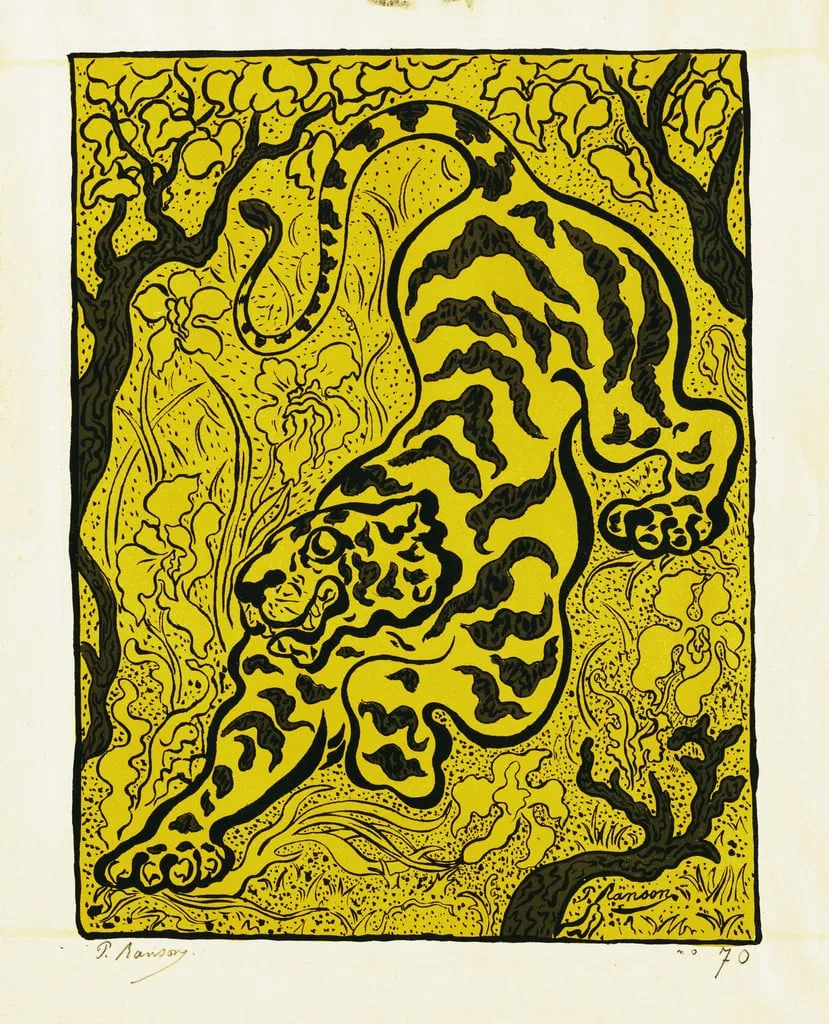
Untitled is an ink print by the Impressionist artist Paul Ranson. It dates from 1893 and is held in the collection of the Museum of Modern Art.
About this work
Overview
Paul Ranson created this lithograph in 1893 as part of a portfolio containing eight lithographs and three woodcuts. It is currently held in the collection of The Museum of Modern Art. The work is a single print from a limited series, reflecting Ranson’s engagement with printmaking during the height of the Nabis movement in France.
Subject & Meaning
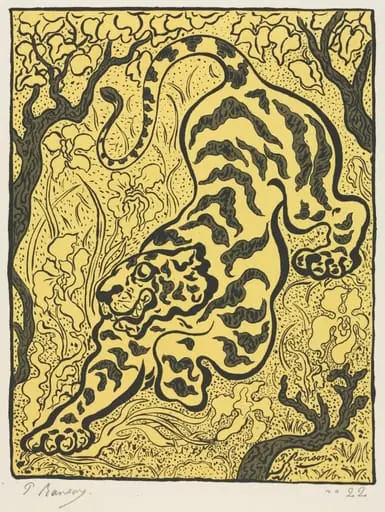
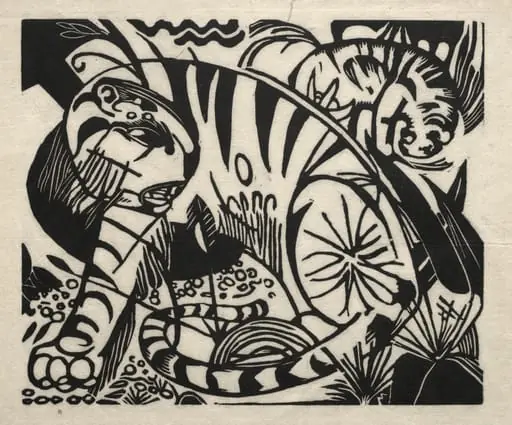
The animal’s form is rendered with rhythmic stripes and a curved tail, suggesting motion rather than static observation.
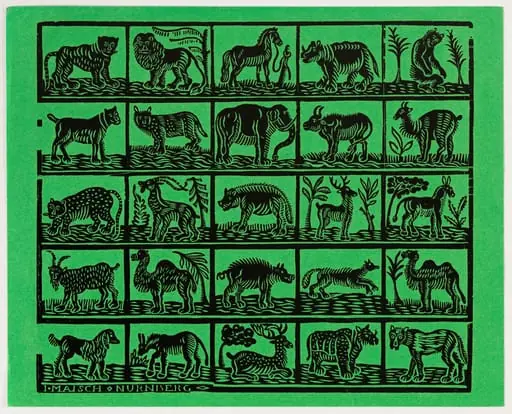
The image depicts a tiger oriented to the left, its body elongated and poised within a dense, abstracted forest. The animal’s form is rendered with rhythmic stripes and a curved tail, suggesting motion rather than static observation. The environment, composed of interwoven black lines on a yellow ground, blurs the boundary between creature and foliage, evoking a symbolic, almost mystical unity with nature.
Technique & Style
Executed in lithography, the print employs flat planes of color and bold, linear contours characteristic of the Nabis style. The yellow background and black linear elements create a decorative, two-dimensional space, minimizing depth in favor of pattern and rhythm. The tiger’s form is stylized, not naturalistic, aligning with Symbolist tendencies to prioritize emotional resonance over realistic depiction.
History & Provenance
The work was produced in 1893 during Ranson’s active involvement with the Nabis group, a collective of post-Impressionist artists influenced by Gauguin and Japanese prints. It entered the Museum of Modern Art’s collection through documented acquisition, though its early exhibition history remains limited. The portfolio’s original context as a cohesive artistic statement is preserved in institutional records.
Context
Ranson’s print emerged alongside other Nabis works that sought to merge decorative arts with fine art, rejecting academic realism. The tiger motif, while uncommon in European art of the period, reflects broader Symbolist interests in exoticism and primal energy. The composition’s abstraction and flattened space echo contemporary Japanese woodblock prints, which were widely studied by Parisian artists at the time.
Legacy
Though not among Ranson’s most widely reproduced works, this lithograph exemplifies his contribution to the Nabis’ experimental printmaking. It stands as a quiet testament to the group’s interest in mythic subjects rendered through simplified form and expressive line. The piece continues to inform scholarly discussions on the intersection of Symbolism and decorative aesthetics in late 19th-century France.
Artist & collection