Artwork
Luna
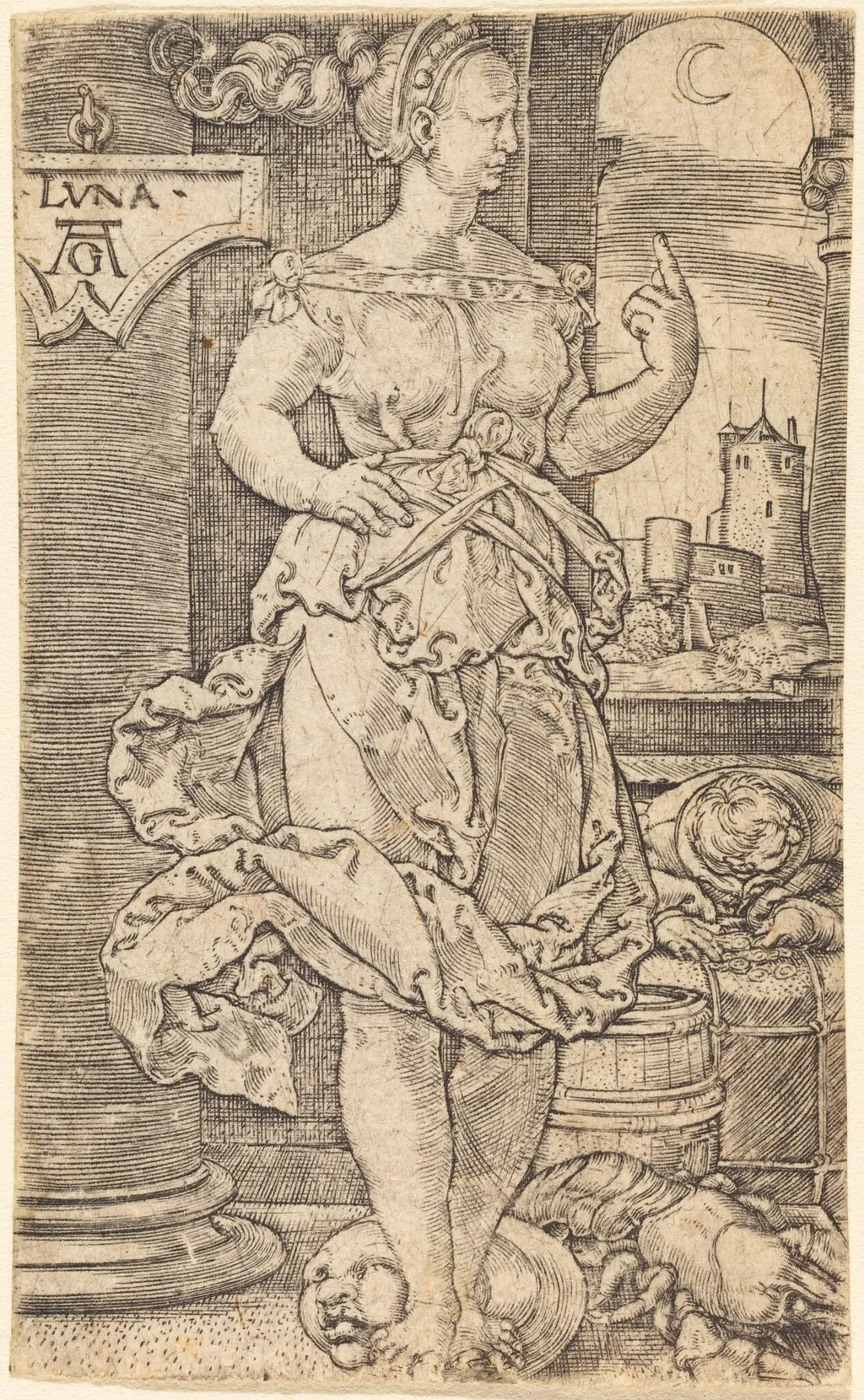
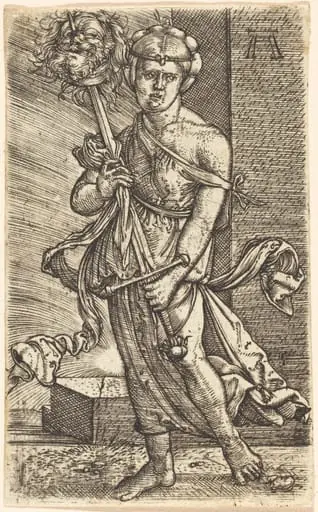
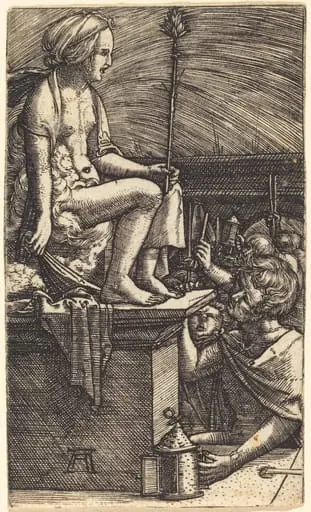
Luna is an ink print by the Northern Renaissance artist Heinrich Aldegrever. It dates from 1532 and is held in the collection of the National Gallery of Art.
About this work
Overview
Heinrich Aldegrever’s 1532 engraving *Luna* presents a compact, detailed composition typical of the German “Little Masters.” The print portrays a female figure, likely the moon goddess, holding a crescent above her head, set against a dark sky and a distant town with a tower and church.
Subject & Meaning
The central woman, crowned by a lunar crescent, embodies the classical deity of the moon. A small child clings to her side, while diminutive faces emerge from the rocky base, suggesting a protective or nurturing aspect associated with lunar symbolism.
Technique & Style
Executed in fine-line engraving, Aldegrever employs precise incisions and cross‑hatching to model volume and atmosphere. The sharp contours and subtle gradations of tone create depth within the limited scale, reflecting the meticulous approach of the Northern Renaissance printmakers.
History & Provenance
Aldegrever, a pupil of the generation after Albrecht Dürer, worked primarily in the early sixteenth century. *Luna* belongs to his series of small prints that circulated among collectors, illustrating his role within the “Little Masters” movement of German engraving.
Context
The work reflects the Northern Renaissance’s fascination with mythological subjects rendered in a highly detailed, intimate format. By integrating a nocturnal landscape with architectural elements, Aldegrever aligns the piece with contemporary interests in combining classical allegory and everyday settings.
Artist & collection

Artist
Heinrich Aldegrever or Aldegraf was a German painter and engraver. He was one of the "Little Masters", the group of German artists making small old master prints in the generation after Albrecht Dürer.