Artwork
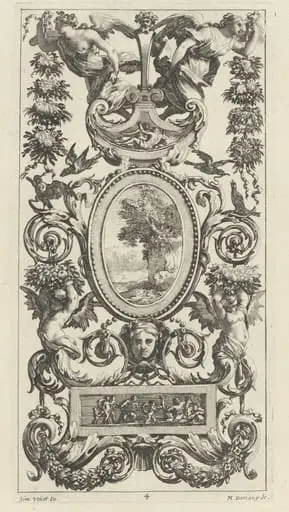
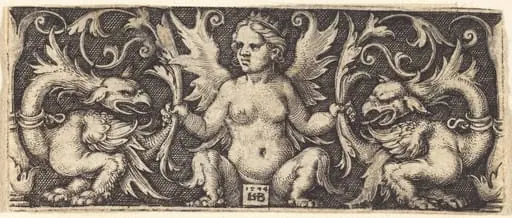
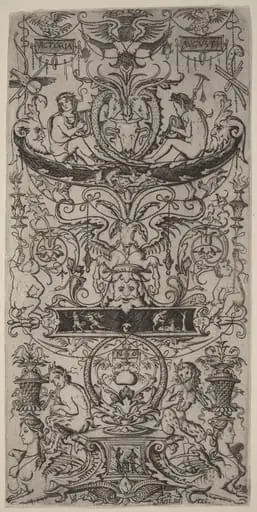
Panel of Ornament with Candelabra Supported by Two Blindfolded Women

Panel of Ornament with Candelabra Supported by Two Blindfolded Women is an ink print by the Renaissance artist Sebald Beham. It dates from 1527 and is held in the collection of the National Gallery of Art.
About this work
Overview
Beham, a key figure among the German Little Masters, specialized in finely detailed prints that balanced ornamentation with symbolic undertones.
Created in 1527 by Sebald Beham, this engraving is a small-scale decorative panel featuring two blindfolded women supporting a candelabrum. Beham, a key figure among the German Little Masters, specialized in finely detailed prints that balanced ornamentation with symbolic undertones. Executed in black ink on a dark ground, the work exemplifies his mastery of minute line work and compositional density, typical of Nuremberg printmaking traditions of the early 16th century.
Subject & Meaning
The blindfolded women, their postures tense and strained, may allude to themes of justice, ignorance, or the burdens of authority. Their isolation within an elaborate floral frame suggests a tension between human vulnerability and ornamental excess. The candelabrum, a symbol of light or divine guidance, is rendered unstable by their condition, inviting interpretation as a metaphor for flawed leadership or the fragility of reason.
Technique & Style
Beham employed fine, precise engraving lines to model form and texture, creating depth through cross-hatching and delicate tonal gradations. The background is densely packed with scrolling foliage, contrasting with the stark, simplified figures. The dark ground enhances the luminosity of the engraved lines, a technique common among German printmakers to heighten visual contrast and detail. The scale and intricacy reflect the Little Masters’ focus on miniature artistry suited for private contemplation.
History & Provenance
Produced during Beham’s time in Nuremberg, this engraving belongs to a series of ornamental prints he designed for collectors and craftsmen. Though no early ownership records are documented, such works circulated widely among German and Dutch elites as decorative models. Beham’s prolific output—over a thousand prints—ensured his designs influenced domestic and architectural ornamentation well into the late 16th century.
Context
In early 16th-century Germany, engraved ornaments were used as templates for metalwork, textiles, and architecture. Beham’s work emerged alongside the Reformation, a period when religious imagery declined and secular, decorative art gained prominence. His prints catered to a growing urban middle class seeking refined, non-religious objects, blending classical motifs with Northern European precision and subtle allegory.
Legacy
Beham’s ornamental engravings, including this piece, became reference points for later designers in Central Europe. His ability to merge symbolic ambiguity with technical precision influenced generations of printmakers and decorative artists. Though less celebrated than Dürer, his contributions helped define the aesthetic language of Northern Mannerism, embedding intricate, enigmatic imagery into the visual culture of the period.
Artist & collection
Artist
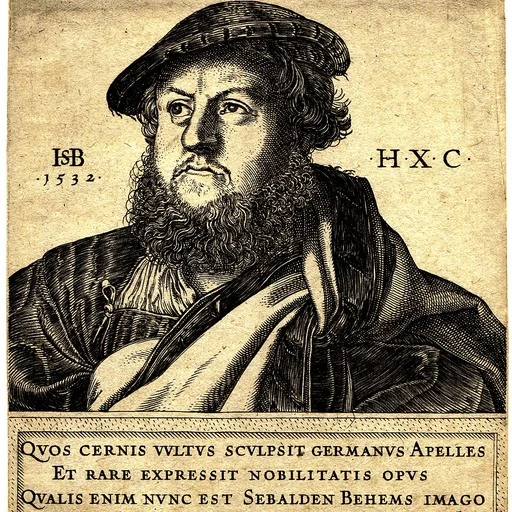
Sebald Beham (1500–1550) was a German painter and printmaker, mainly known for his very small engravings.