Artwork
Ornament with Mask
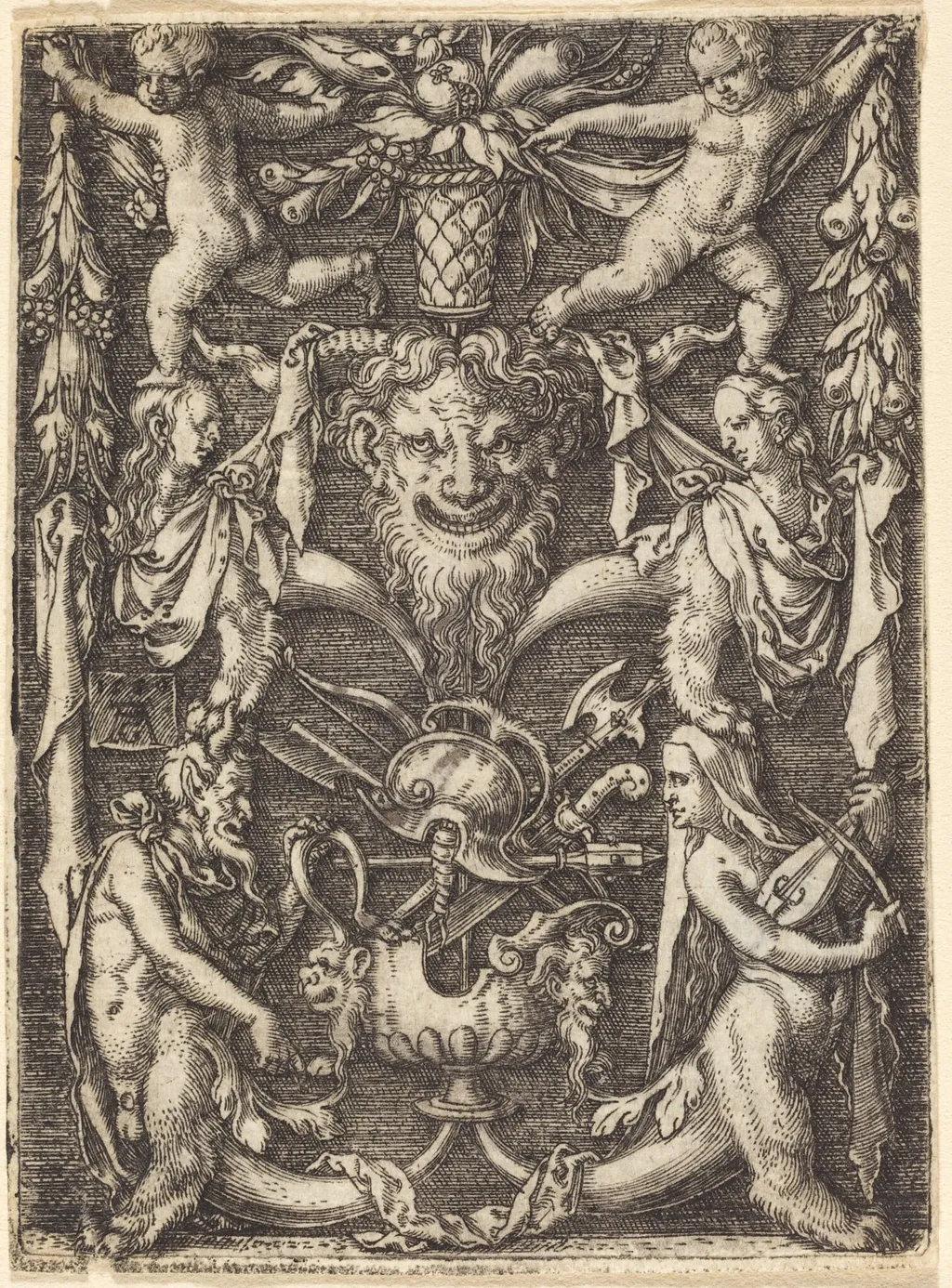
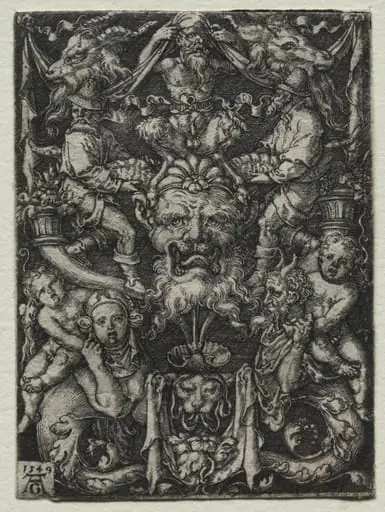
Ornament with Mask is an ink print by the Northern Renaissance artist Heinrich Aldegrever. It dates from 1550 and is held in the collection of the National Gallery of Art.
About this work
Overview
Aldegrever, associated with the group known as the Little Masters, focused on intricate, finely detailed works intended for collectors.
Created around 1550 by the German artist Heinrich Aldegrever, this engraving belongs to a series of small decorative prints produced during the mid-16th century. Aldegrever, associated with the group known as the Little Masters, focused on intricate, finely detailed works intended for collectors. The piece combines ornamental structure with figurative elements, reflecting a trend in Northern European printmaking that blurred the line between utility and artistic expression.
Subject & Meaning
At the center of the composition is a stylized, bearded mask with an intense, almost aggressive expression, crowned like a ruler. Surrounding it, diminutive figures emerge from twisting vines and scrollwork, their gestures suggesting entanglement or struggle. The imagery evokes mythological or allegorical themes, possibly referencing classical motifs of nature’s dominance over humanity or the capriciousness of fate, rendered through symbolic rather than literal narrative.
Technique & Style
Executed in engraving, the image is formed by precise incisions into a copper plate, allowing fine lines to hold ink and produce sharp contrasts. Aldegrever’s hand is evident in the dense, rhythmic patterning of lines that model form and shadow without gradation. The style is meticulous and linear, favoring clarity over atmospheric depth, characteristic of the Little Masters’ approach to small-scale printmaking and their emphasis on craftsmanship over scale.
History & Provenance
The work emerged during Aldegrever’s active years in Paderborn, where he produced numerous engravings for private collections and decorative use. While specific early ownership records are sparse, similar prints by Aldegrever circulated among German and Netherlandish patrons interested in Renaissance ornament. The piece likely served as a model for metalworkers, goldsmiths, or book illustrators, reflecting the period’s demand for portable, repeatable designs.
Context
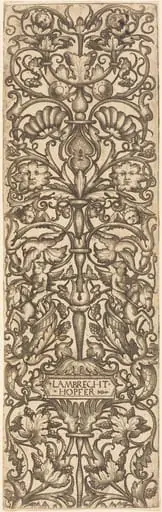
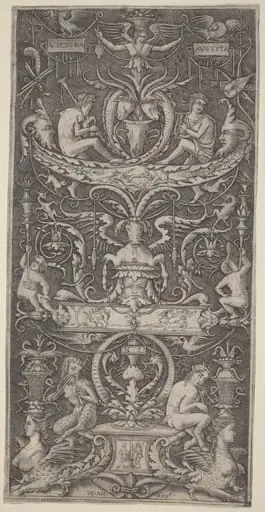
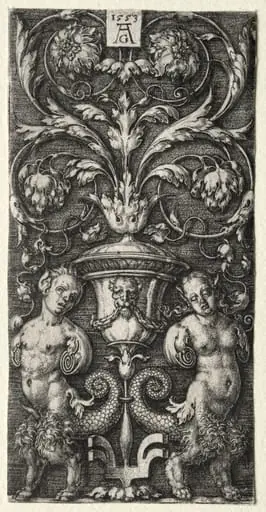
In the decades following Albrecht Dürer, German printmakers turned increasingly toward decorative and allegorical subjects, often drawing from classical antiquity and Mannerist aesthetics. Aldegrever’s work fits within this shift, where prints were no longer solely religious or narrative but also served as sources of visual inspiration for applied arts. The fusion of human figures with ornamental flora and fauna aligns with broader European trends in Mannerist design.
Legacy
Aldegrever’s engravings, including this one, influenced later generations of designers and printmakers through their compact, intricate compositions. Though not widely exhibited in his time, his motifs were absorbed into decorative arts across Northern Europe. Today, such works are valued for their technical precision and as documents of how Renaissance ideals were adapted into intimate, non-monumental forms.
Artist & collection

Artist
Heinrich Aldegrever or Aldegraf was a German painter and engraver. He was one of the "Little Masters", the group of German artists making small old master prints in the generation after Albrecht Dürer.