Artwork
Ornament with Naked Couple
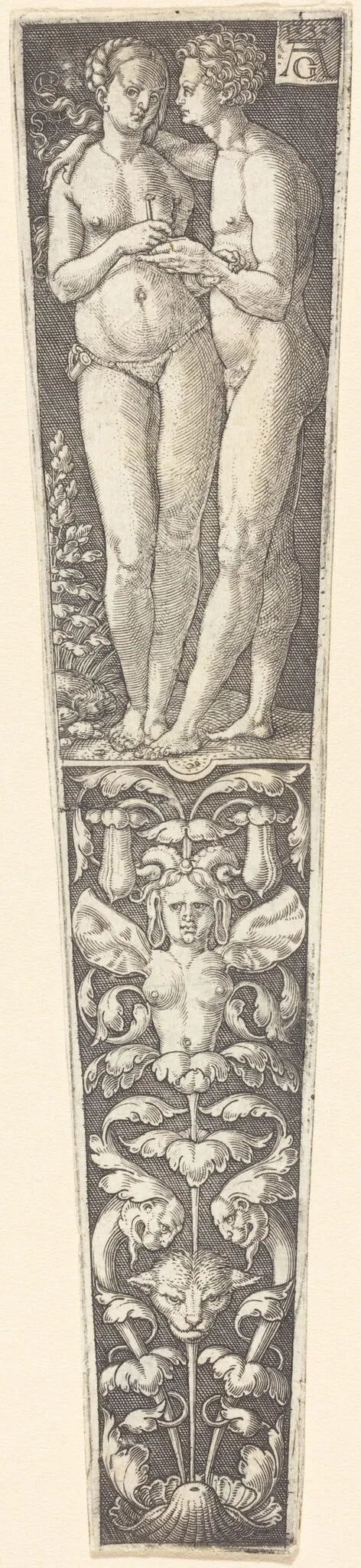
Ornament with Naked Couple is a print by the Northern Renaissance artist Heinrich Aldegrever. It dates from 1532 and is held in the collection of the National Gallery of Art.
About this work
Overview
Heinrich Aldegrever, a German printmaker of the early 16th century, produced this small engraving in 1532 as part of a series of ornamental designs.
Heinrich Aldegrever, a German printmaker of the early 16th century, produced this small engraving in 1532 as part of a series of ornamental designs. Associated with the Little Masters, he specialized in finely detailed works on a modest scale, often drawing from classical antiquity. This piece blends decorative intent with human form, positioning the nude figures not as narrative subjects but as elements within a larger ornamental framework.
Subject & Meaning
The central pair of nude figures—man and woman, hands joined—appear in a stylized, symmetrical arrangement, their bodies turned slightly to suggest movement without narrative action. They are not depicted in a mythological or moral context but serve as formal motifs, echoing classical ideals of harmony and proportion. Surrounding them, a border of leafy scrolls and miniature faces reinforces the work’s function as a pattern for decorative use, possibly for metalwork or textiles.
Technique & Style
Aldegrever employed fine, controlled lines typical of engraving to model the figures with subtle shading, giving volume without heavy contrast. The smooth contours and balanced poses reflect a deliberate aesthetic of restraint, aligning with Renaissance ideals of order. The border’s intricate foliage and tiny visages are rendered with precision, demonstrating his skill in miniaturization and his ability to integrate human form within elaborate, non-narrative compositions.
History & Provenance
Created in 1532, the print was likely produced for circulation among artisans and collectors interested in decorative models. Aldegrever’s prints were widely distributed in Northern Europe, often used as templates by goldsmiths and craftsmen. While no specific early ownership record is documented, its survival in multiple museum collections suggests it was valued for its design utility rather than as a standalone artwork.
Context
In the decades following Albrecht Dürer, German printmakers turned toward smaller, more decorative formats. Aldegrever’s work emerged in this context, responding to demand for patterns that combined classical motifs with Mannerist elegance. His prints, including this one, reflect a shift from religious or allegorical subjects toward secular ornamentation, catering to a growing market of urban elites interested in refined domestic aesthetics.
Legacy
Aldegrever’s ornamental prints influenced later generations of designers and engravers in Northern Europe, particularly in the use of classical nudes as decorative elements. Though less celebrated than his contemporaries, his work contributed to the broader dissemination of Renaissance visual language beyond painting and sculpture, embedding classical forms into everyday craft traditions.
Artist & collection

Artist
Heinrich Aldegrever or Aldegraf was a German painter and engraver. He was one of the "Little Masters", the group of German artists making small old master prints in the generation after Albrecht Dürer.

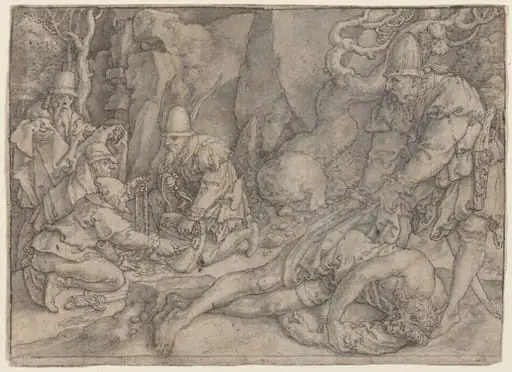
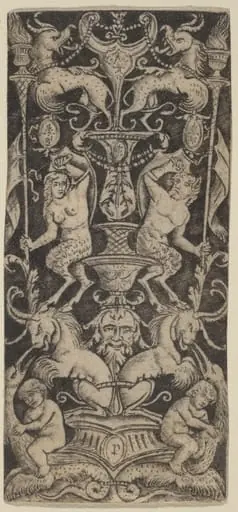 Panel of Ornament with Two Naked Children on Monstrous Beasts
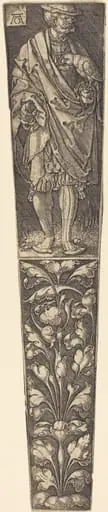 Dagger Sheath with Gentleman Holding a Parrot
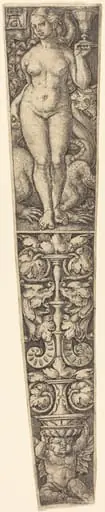 Dagger Sheath with the Whore of Babylon
 Dagger Sheath with Nude Woman
 Ornament Panel: Griffins and Two Cupids Crossing Halberds
 Ornament Panel: Satyr Holding a Violin
 Ornament for Knife Handle
 A Vase between Two Chimeric Figures
 Les divers pourtraicts et figures IV
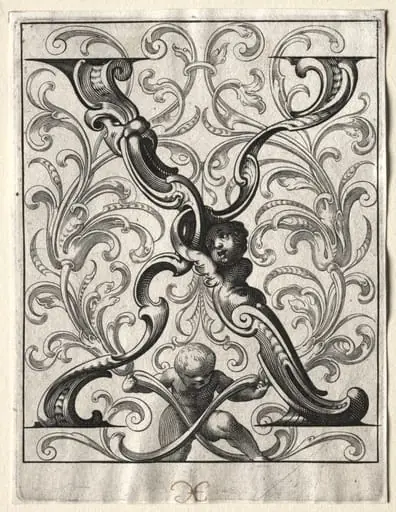 New ABC Booklet: X
 Ornament Panel: Nereid and Two Children Playing Musical Instruments
 Ornament with One Male and Two Female Figures