Artwork
Ornament for Knife Handle
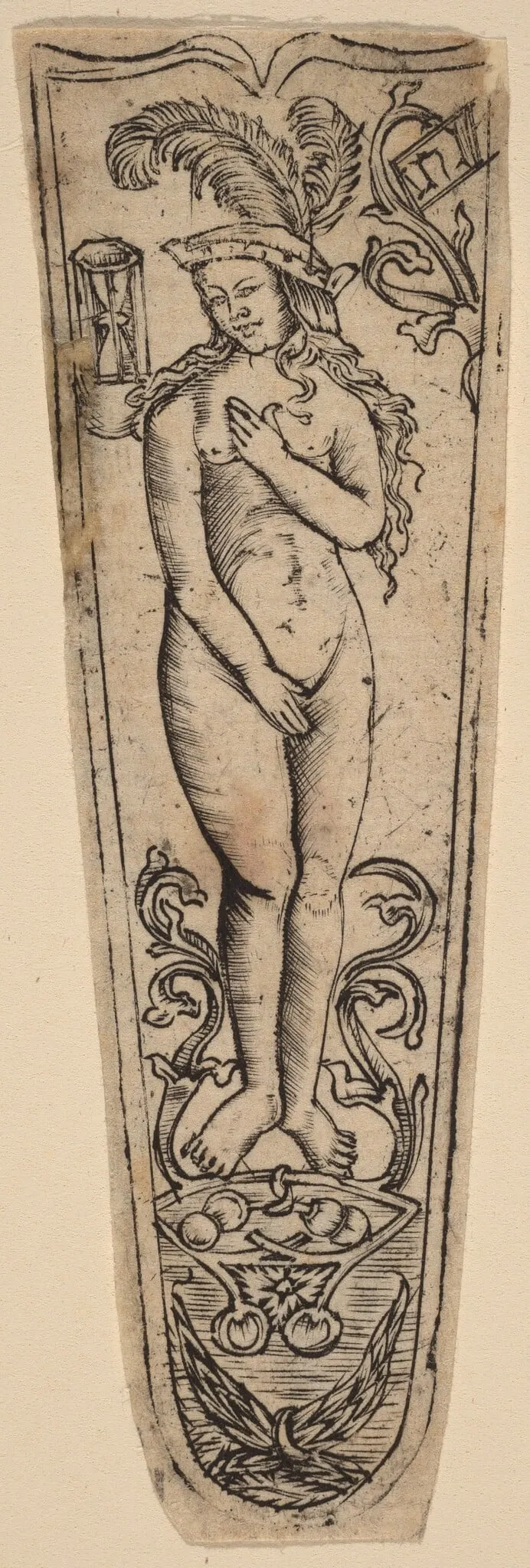
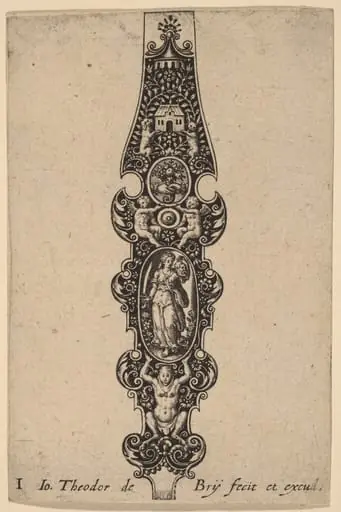
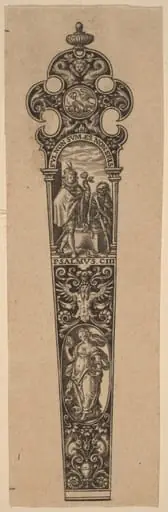
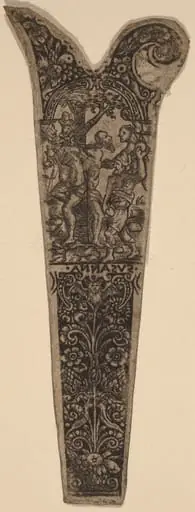
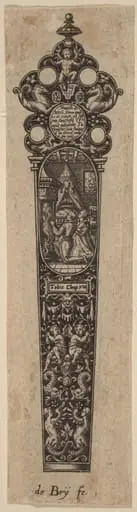
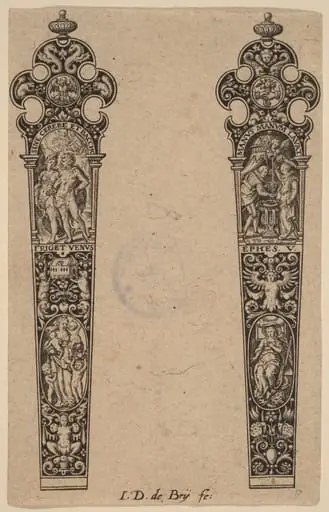
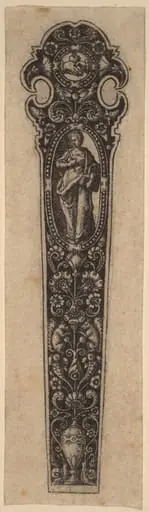
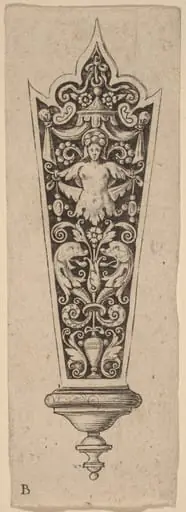
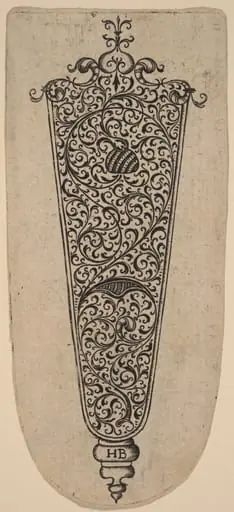
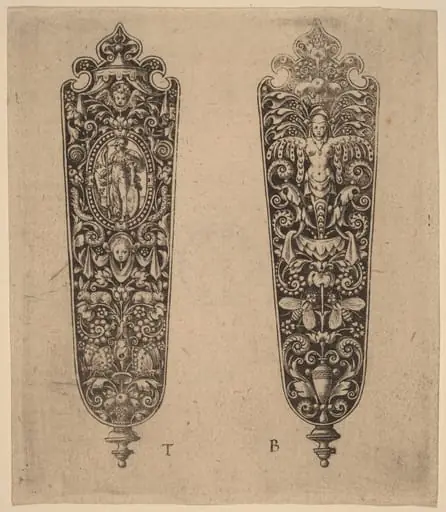
Ornament for Knife Handle is an ink print by the Renaissance artist Theodor de Bry. It dates from 1563 and is held in the collection of the National Gallery of Art.
About this work
Overview
Created in 1563 by Theodor de Bry, this engraving was designed as a decorative motif for a knife handle.
Created in 1563 by Theodor de Bry, this engraving was designed as a decorative motif for a knife handle. De Bry, a Walloon artist trained as a goldsmith, produced this piece during his early career in the Southern Netherlands, before his exile due to religious persecution. Though small in scale, the work reflects his mastery of fine-line engraving and his interest in classical forms, later refined in his more widely known illustrated publications.
Subject & Meaning
The central figure is a nude woman rendered in a contrapposto stance, her head tilted upward and adorned with a feathered hat. Her minimal covering and poised posture evoke classical ideals of beauty, though the context remains ambiguous. The image likely served an ornamental rather than narrative function, possibly symbolizing virtue, nature, or exoticism—themes common in Renaissance decorative arts, but without clear religious or mythological attribution.
Technique & Style
Executed in fine-line engraving, the work demonstrates de Bry’s precision in rendering texture and form. Delicate hatching defines the contours of the body and the feathery details of the headpiece, while the faint background elements suggest spatial depth without distraction. The style aligns with Northern Renaissance engraving traditions, emphasizing clarity and detail over dramatic contrast, reflecting both technical discipline and aesthetic restraint.
History & Provenance
De Bry produced this engraving before his forced departure from the Spanish-controlled Low Countries, a move driven by his Protestant beliefs. It predates his later publications on the Americas and likely originated as part of a series of decorative designs for metalwork. Its survival suggests it was circulated among artisans or collectors in Antwerp or Frankfurt, where de Bry eventually established his print shop and gained broader recognition.
Context
In mid-16th-century Europe, engraved ornamentation was widely used in luxury objects, from weapons to furniture. De Bry’s work fits within a tradition of Mannerist decorative arts that blended classical motifs with emerging interest in the exotic. While this piece lacks overt political or religious content, its creation coincided with broader cultural shifts—religious upheaval, global exploration, and the rise of print culture as a vehicle for artistic dissemination.
Legacy
Though less known than his later illustrated volumes, this engraving exemplifies de Bry’s foundational skill in graphic design and his ability to translate human form into functional art. It reveals the quiet continuity between his early decorative work and his later ethnographic imagery, positioning him as a bridge between Renaissance ornament and early modern visual documentation.
Artist & collection
Artist
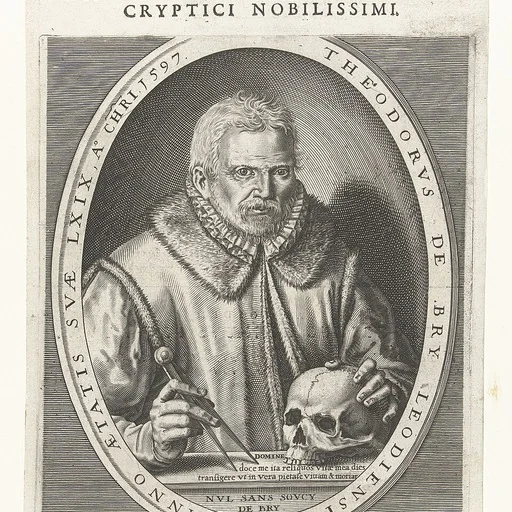
Theodor de Bry (also Theodorus de Bry; 1528 – 27 March 1598) was a Walloon engraver, goldsmith, editor and publisher, famous for his depictions of early European expeditions to the Americas.