Artwork
La Seine à Bougival
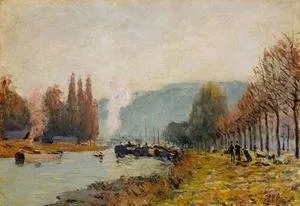
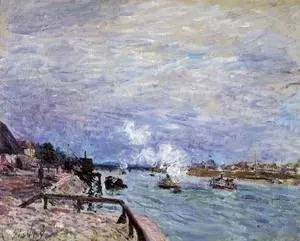
La Seine à Bougival is an oil painting by the Impressionist artist Alfred Sisley. It dates from 1873 and is held in the collection of the Denver Art Museum.
About this work
Overview
Unlike many of his contemporaries, Sisley rarely included human narratives, focusing instead on the quiet rhythms of the countryside.
Painted in 1873, *La Seine à Bougival* is an oil on canvas landscape by Alfred Sisley, a British-born artist active in France. It belongs to a series of works he produced along the Seine near Bougival during the early 1870s, reflecting his commitment to capturing the changing effects of light and atmosphere in natural settings. Unlike many of his contemporaries, Sisley rarely included human narratives, focusing instead on the quiet rhythms of the countryside.
Subject & Meaning
The painting presents a tranquil stretch of the Seine River, framed by wooded banks and a hazy, overcast sky. Distant figures on the shore suggest human presence without drawing attention to it, reinforcing the scene’s meditative quality. Sisley’s choice of subject reflects a broader Impressionist interest in everyday landscapes, elevating ordinary river views into quiet studies of seasonal light and spatial depth, devoid of idealization or dramatic tension.
Technique & Style
Sisley applied paint with loose, varied brushwork, using soft transitions between tones to convey atmosphere rather than defined contours. Earthy greens, muted browns, and pale grays dominate the palette, harmonizing with the diffuse daylight. The surface retains visible strokes that suggest movement in the water and rustling foliage, avoiding smooth finishes. His method prioritized direct observation, with minimal underdrawing, allowing color and texture to build the scene organically.
History & Provenance
Created during Sisley’s most productive period, the painting emerged from his sustained engagement with the Seine valley between 1872 and 1875. It was likely exhibited in early Impressionist circles, though its early ownership records are sparse. The work remained in private collections for much of the 20th century before entering a public institution, where it is now preserved as a representative example of his lyrical approach to landscape.
Context
Painted during the formative years of Impressionism, *La Seine à Bougival* aligns with the group’s rejection of academic conventions. While Monet and Renoir often included social scenes, Sisley’s focus on unpopulated river views set him apart. His work responded to new railway access that made suburban riversides reachable, allowing artists to paint en plein air with greater ease, capturing transient weather and light without studio intervention.
Legacy
Sisley’s dedication to landscape, often overlooked in favor of more narrative-driven Impressionist works, has since been recognized for its subtle consistency and emotional restraint. *La Seine à Bougival* exemplifies his quiet influence on the movement’s atmospheric concerns. Later generations of landscape painters, particularly those interested in tonal harmony and naturalism, have drawn from his restrained yet evocative approach to light and space.
Artist & collection
Artist
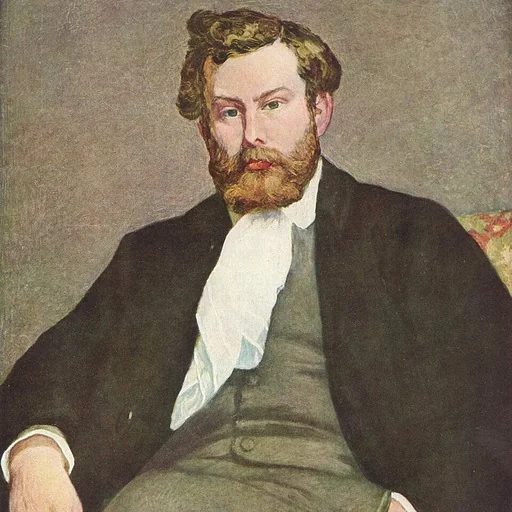
Alfred Sisley (; French: ; 30 October 1839–29 January 1899) was a French-Born British Impressionist landscape painter who was born to British parents, but spent most of his life in France.

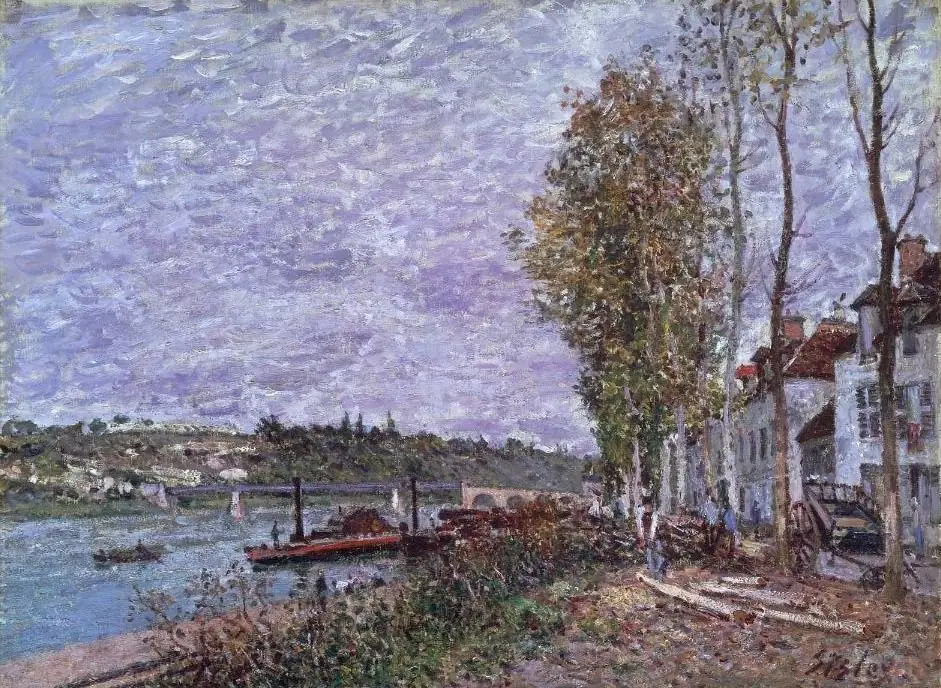 Overcast Day at Saint-Mammès
 La Seine à Port-Marly
 Drying Nets
 Bords de l'Oise près de Pontoise
 La Seine au Point du jour (D. 297)
 Banks of the Seine
 Landscape with river
 Chemin de By au bois des Roches-Courtaut, été de la St Martin
 The Banks of the Oise
 The Seine at Suresnes
 Seine at Grenelle
 Quai Napoléon, Rouen