Artwork
A Griffin Relief
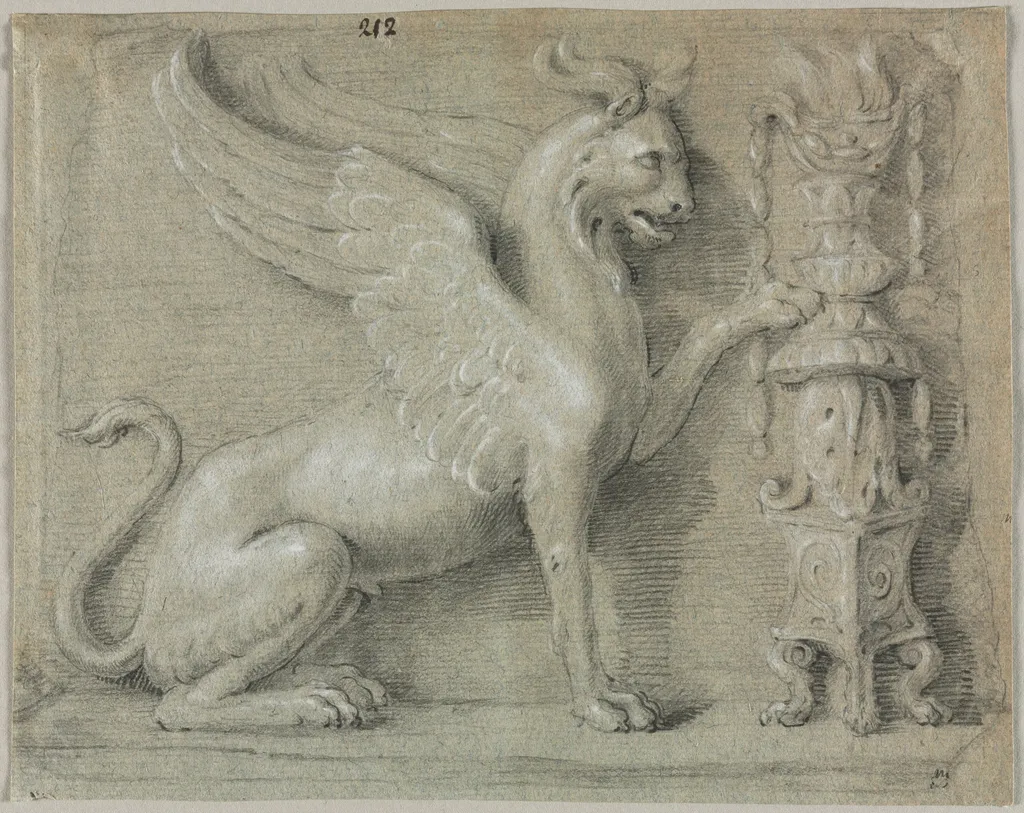
A Griffin Relief is a drawing by the Baroque artist Unknown. It dates from 1704 and is held in the collection of the Cleveland Museum of Art.
About this work
Overview
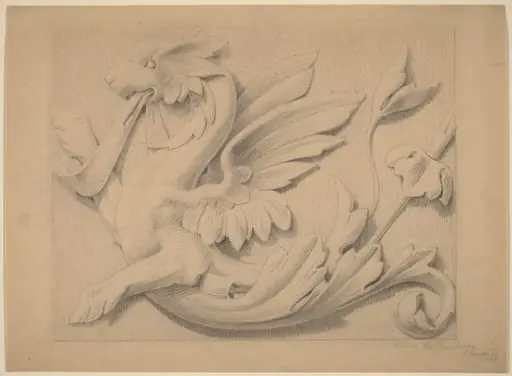
Executed in a three-quarter view facing right, the creature is rendered with careful attention to anatomical texture, suggesting a study from a sculpted source.
This drawing presents a detailed rendering of a griffin relief, a mythological hybrid with the body of a lion and the head and wings of an eagle. Executed in a three-quarter view facing right, the creature is rendered with careful attention to anatomical texture, suggesting a study from a sculpted source. The warm golden background enhances the contrast with the cooler tones of the griffin’s plumage and fur, emphasizing its sculptural presence.
Subject & Meaning
The griffin, a symbol of divine power and vigilance in ancient and medieval traditions, appears here as a static, ornamental form rather than a narrative figure. Its stillness and symmetry suggest it was studied as a decorative motif, possibly drawn from architectural or funerary reliefs. The absence of action or context focuses attention on its symbolic form and craftsmanship.
Technique & Style
The artist employs fine linear precision to differentiate between the griffin’s feathered wings and feline fur, using subtle tonal gradations to suggest volume. The warm, flat background lacks spatial depth, directing focus to the relief-like form. The restrained palette and controlled brushwork reflect a disciplined approach aligned with Baroque draftsmanship, prioritizing clarity over dramatic flourish.
History & Provenance
The drawing likely originates from a period when artists studied classical and medieval motifs for decorative applications. While its exact origin is undocumented, its style suggests it was produced in a studio environment during the 17th century, possibly as a preparatory study for architectural ornamentation or print design. No known exhibition or collection history accompanies the work.
Context
In the Baroque era, artists frequently turned to mythological and heraldic creatures as sources for ornamentation in churches, palaces, and manuscripts. This drawing aligns with a broader practice of collecting and reinterpreting ancient motifs, reflecting a scholarly interest in antiquity even as it served contemporary decorative needs in European artistic circles.
Legacy
As a study of a mythological form, this drawing contributes to the understanding of how Renaissance and Baroque artists engaged with symbolic imagery. Though not widely known, such works formed part of the visual vocabulary used in decorative arts, influencing the design of friezes, metalwork, and printed illustrations well into the 18th century.
Artist & collection

 Domestic Scene
 Giacomo and Cardinal Marco, investing Andrea, Abbot of San Zeno, with his Benefice
 The Nymph of Fontainebleau
 Portrait of a Woman
 Madonna and Child with Saints in the Enclosed Garden
 Venus and Minerva
 Family Group of Four on Sofa
 Wall painting from Room H of the Villa of P. Fannius Synistor at Boscoreale
 Ornament with Two Sphinxes and a Winged Man
 The Capitoline Eagle
 Two Ornamental Bands with Head of a Lion and Woman
 Base and Capital with Figure of Fame and Winged Horses
 Base and Capital with Figure of Fame and Winged Horses (capital)
 Door Knocker with Zeus Vanguishing Giants
 Study from a Cast
 Mask Held by Two Genii
 Ornamental Frieze with Marine Creatures
 Ewer
Ewer Untitled
 Untitled