Artwork
The Raging Barbarian
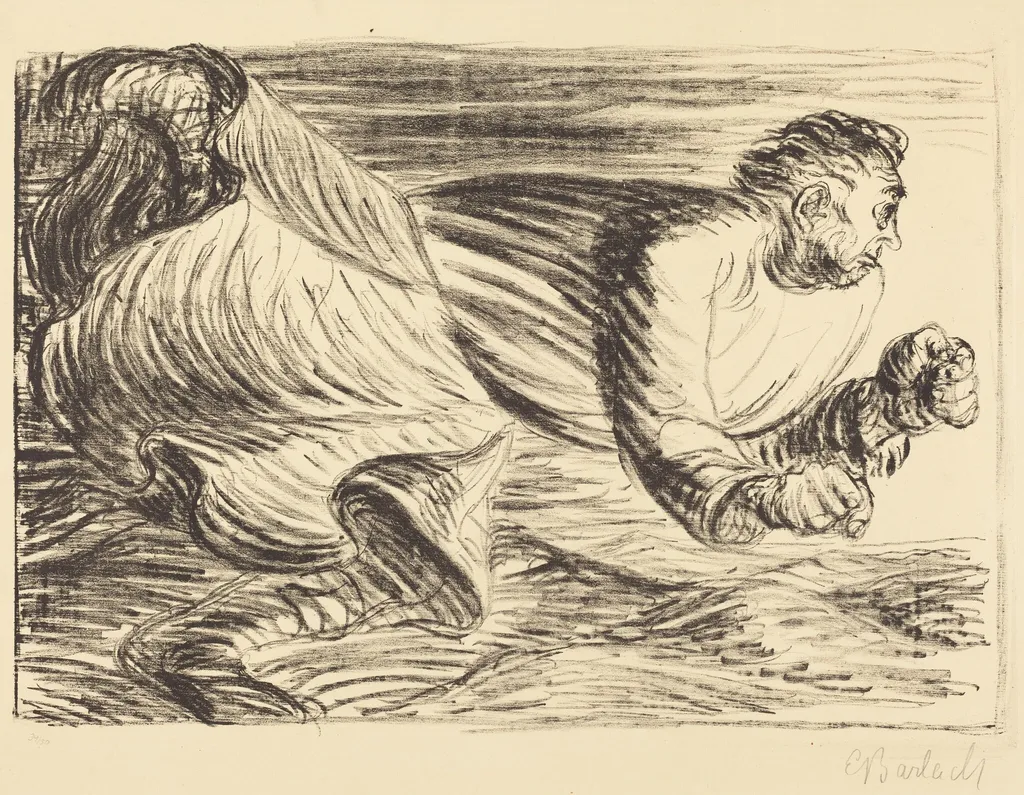
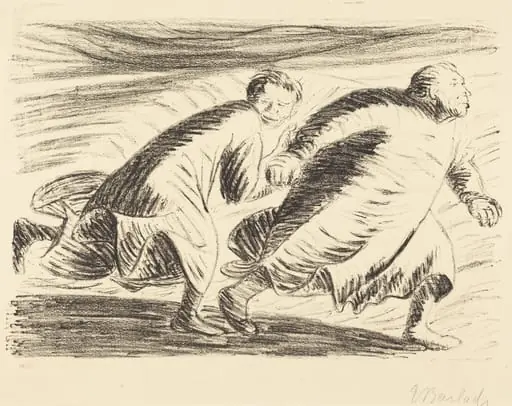
The Raging Barbarian is an ink print by Ernst Barlach. It dates from 1916 and is held in the collection of the National Gallery of Art.
About this work
Overview
As part of his printmaking practice, this work reflects his deepening engagement with the human cost of conflict during World War I.
Created around 1916, *The Raging Barbarian* is a lithograph by German artist Ernst Heinrich Barlach. As part of his printmaking practice, this work reflects his deepening engagement with the human cost of conflict during World War I. Barlach, primarily known for sculpture, turned to print for its accessibility and capacity to convey urgent social themes. The image captures raw physical tension without narrative clarity, emphasizing emotional intensity over detail.
Subject & Meaning
The print depicts two entangled figures locked in violent struggle, one bending forward with a raised fist, the other gripping tightly. Their forms lack individual identity, suggesting archetypal conflict rather than specific persons. The absence of context or setting universalizes the scene, evoking the dehumanizing chaos of war. Barlach’s intent appears to critique violence itself, not any particular side, aligning with his growing pacifism during the war years.
Technique & Style
Barlach employed lithography to achieve a spontaneous, gestural quality. Rough, uneven lines and smudged contours mimic the urgency of a sketch, rejecting polished finish in favor of emotional immediacy. The background dissolves into abstract, swirling strokes, eliminating spatial anchors and amplifying disorientation. Faces are indistinct, reinforcing anonymity and psychological distress. The medium’s capacity for rapid reproduction suited his desire to disseminate critical imagery widely.
History & Provenance
Produced during the height of World War I, the print emerged from Barlach’s personal disillusionment with nationalism and militarism. It belongs to a series of wartime prints he made between 1915 and 1918, many of which were later suppressed under Nazi rule for their anti-war sentiment. While exact early ownership records are sparse, the work entered public collections post-1945 as part of broader recognition of his resistance art.
Context
Barlach worked amid a cultural climate where artists increasingly rejected traditional aesthetics to confront societal trauma. His prints aligned with German Expressionism’s focus on inner experience, yet retained ties to Realism through their unidealized subjects. Unlike propagandistic imagery of the era, *The Raging Barbarian* avoids heroism or blame, instead portraying violence as a universal, destructive force—reflecting a broader shift in postwar artistic conscience.
Legacy
The print remains a key example of Barlach’s commitment to using art as moral witness. Though less known than his sculptures, his graphic works influenced later generations of artists addressing conflict and human suffering. Its raw aesthetic and anti-war stance contributed to postwar reassessments of German art’s role in confronting historical violence, securing its place in collections focused on 20th-century social commentary.
Artist & collection
Artist
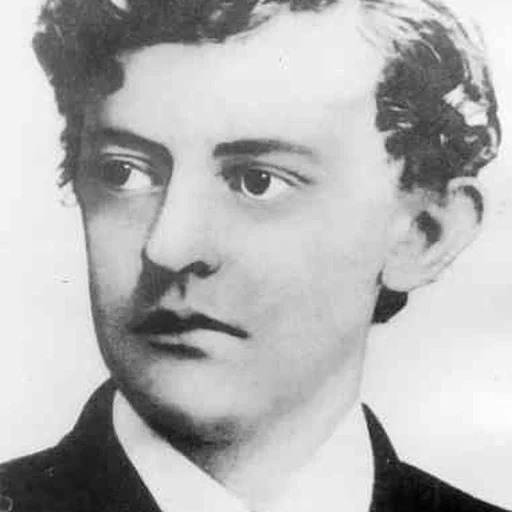
Ernst Heinrich Barlach (2 January 1870 – 24 October 1938) was a German expressionist sculptor, medallist, printmaker and writer.

 The Fugitives
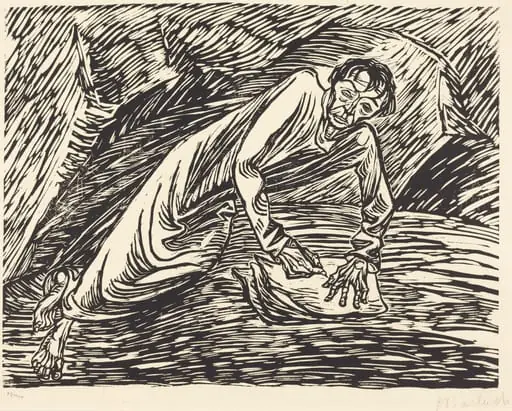 The Writing Prophet (Saint John on Patmos)
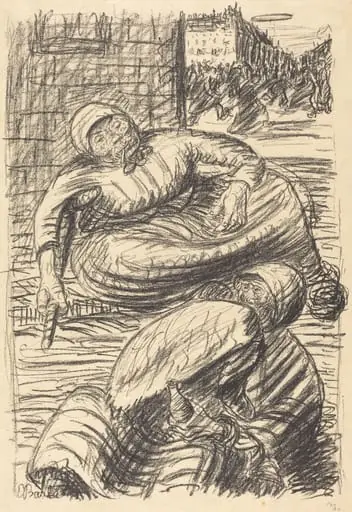 Street in Warsaw
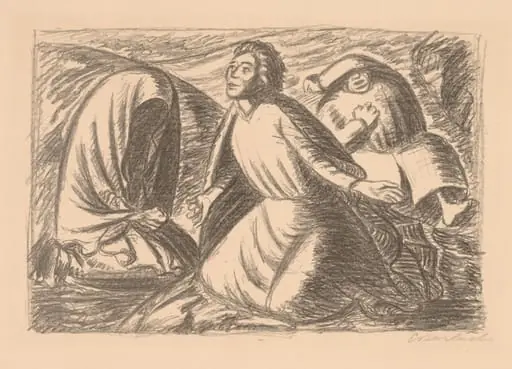 Hope and Despair II
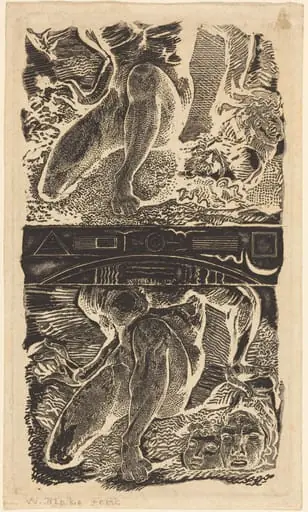 Unknown subject (Let Him look up into the Heaven and laugh in the bright air)
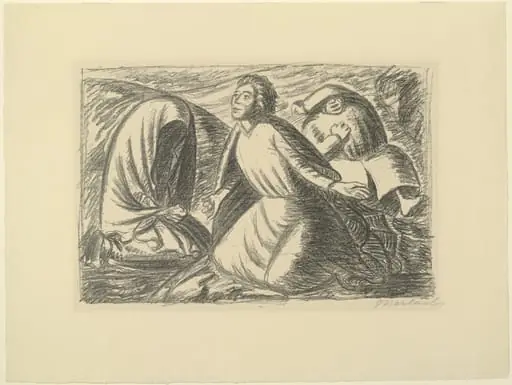 Untitled
 Untitled
 Untitled
 Untitled
 Untitled
 The Circle of the Traitors; Dante's Foot Striking Bocca degli Abbate
 Plate with the Head of a Horned Devil (Planche au diable cornu)