Artwork
Monk Saint [?] with a Model of a Church
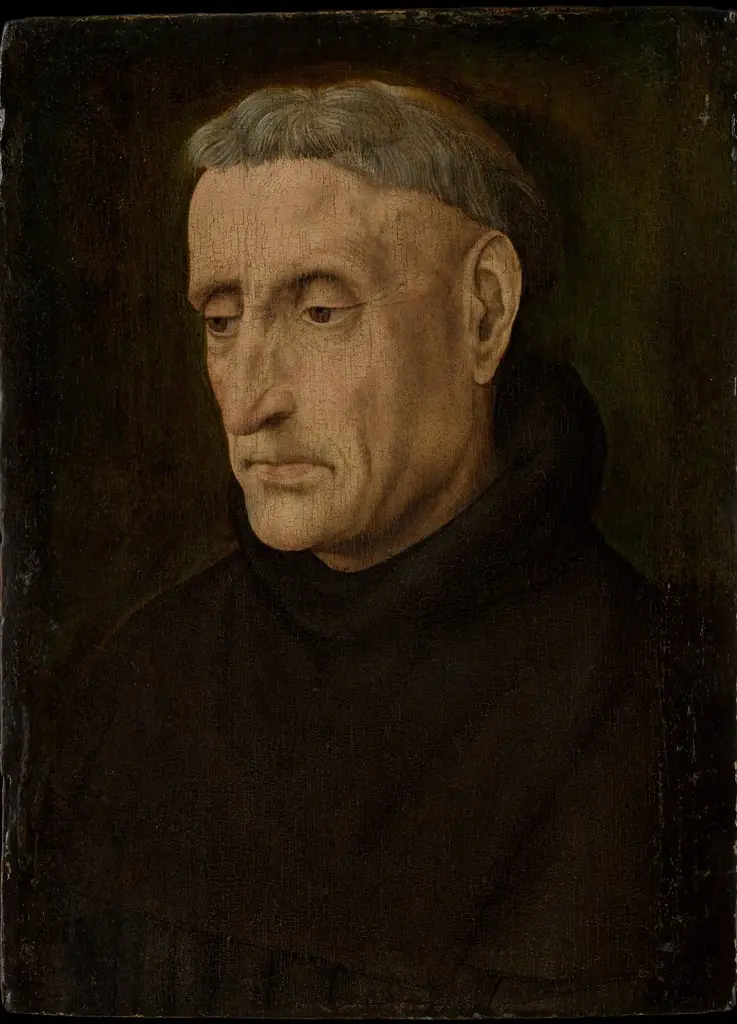
![Monk Saint [?] with a Model of a Church, by Bartolomeo degli Erri, oil](https://artifactworldgallery.com/img/bartolomeo-degli-erri--monk-saint-with-a-model-of-a-church--737af76ce54f07ee-w1024.webp)
Monk Saint [?] with a Model of a Church is an oil painting by the Early Renaissance artist Bartolomeo degli Erri. It is held in the collection of the Museu Nacional d'Art de Catalunya.
About this work
Overview
Executed during the early Renaissance in northern Italy, the painting reflects the transition from Gothic conventions to more naturalistic representation.
Painted in 1490 by Bartolomeo degli Erri, this oil-on-panel work portrays a monastic figure holding a miniature church. Executed during the early Renaissance in northern Italy, the painting reflects the transition from Gothic conventions to more naturalistic representation. It is now part of the collection at the Museu Nacional d'Art de Catalunya, where it stands as a rare surviving example of Erri’s devotional portraiture.
Subject & Meaning
The figure is likely a monk-saint, identified by his attire and solemn demeanor, presenting a scaled church model as an act of spiritual or architectural devotion. The object may symbolize the founding or patronage of a religious building, linking the saint’s piety to tangible ecclesiastical legacy. The absence of a named identity suggests the image was intended as a type rather than a specific historical person.
Technique & Style
Erri employed oil paint to achieve subtle tonal gradations, using chiaroscuro to model the monk’s face and robes with quiet realism. The dark background isolates the figures, enhancing their presence. The church model, rendered in lighter hues and precise detail, contrasts with the monk’s somber garments, directing focus to the symbolic object. Brushwork is controlled, reflecting a deliberate, devotional approach rather than theatrical expression.
History & Provenance
The painting was created in Modena during Erri’s active years, alongside his collaborative work on altarpieces such as the Coronation of the Virgin. Its journey to Barcelona remains undocumented, but its presence in the Museu Nacional d'Art de Catalunya indicates it entered the collection through 19th- or early 20th-century acquisitions of Italian Renaissance works, possibly from private European holdings.
Context
In late 15th-century Italy, devotional images of saints holding architectural models were common in religious communities, especially among mendicant orders. These works served both as objects of veneration and as records of monastic patronage. Erri’s style, rooted in the Emilian tradition, blends Gothic linearity with emerging Renaissance spatial awareness, reflecting regional artistic dialogue beyond Florence or Venice.
Legacy
Though not widely known outside regional art histories, Erri’s work contributes to understanding the diversity of early Renaissance painting in northern Italy. This piece exemplifies how smaller, intimate devotional images sustained religious practice outside grand altarpieces. Its preservation offers insight into the visual language of monastic identity and the role of material objects in spiritual expression during the Quattrocento.
Own this work as a print
Artist & collection
Artist
Bartolomeo degli Erri (1447–1482) was an Italian Gothic painter of the Italian Renaissance.

 Don Francisco Fernández de Córdoba y Mendoza
 Portret de bărbat
 Biagio Milanesi
 Portrait d'un jeune homme en demi-buste
 Saint Anthony of Padua
 Portrait of a Young Man
 Saint Benedict
 Johann Ernst, Duke of Saxe-Coburg
 Profile Portrait of a Boy
 Portrait of a Beardless Man
 Herzog Karl der Kühne (1433-1477) von Burgund
 A Benedictine Monk