Artwork
Two Studies of a Flayed Man (recto)
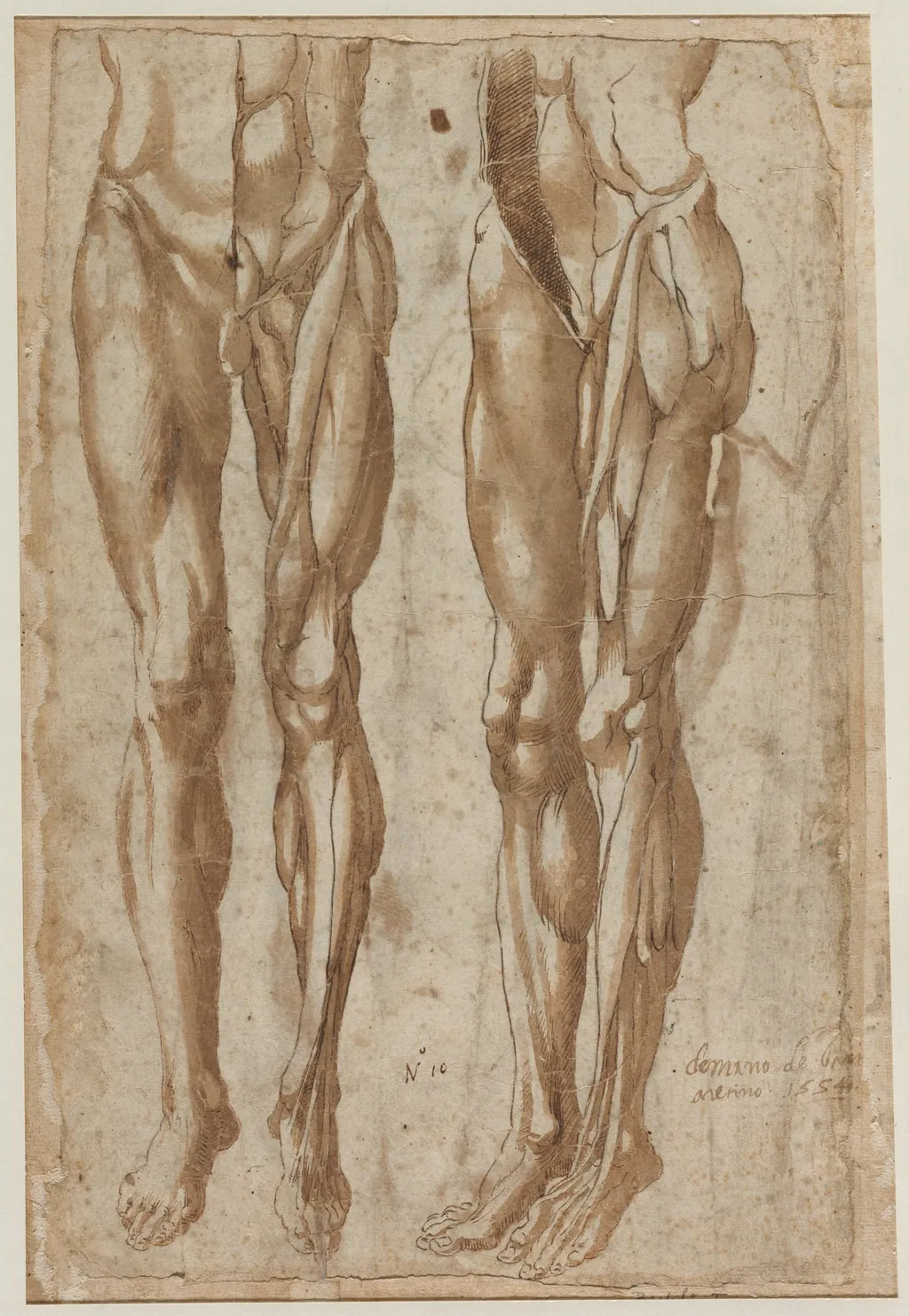
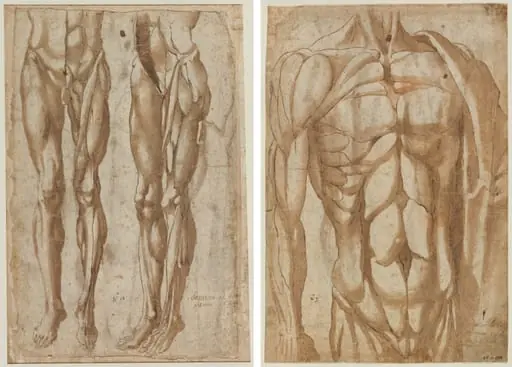
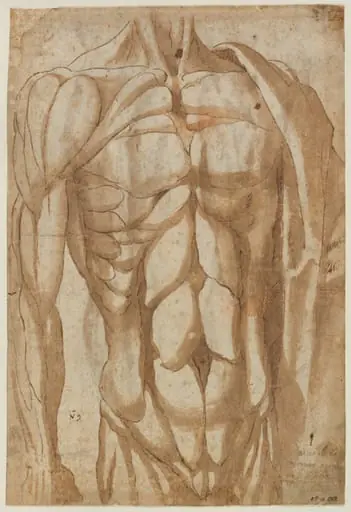
Two Studies of a Flayed Man (recto) is a drawing by the Renaissance artist Bartolommeo da Arezzo. It dates from 1554 and is held in the collection of the Cleveland Museum of Art.
About this work
Overview
The composition reflects a rigorous anatomical inquiry, typical of Renaissance artists seeking to depict the body with precision.
This drawing by Bartolommeo da Arezzo presents two angled studies of a flayed lower torso, suspended midair. Executed in a single medium, the figure is partially skinned, revealing musculature beneath. The composition reflects a rigorous anatomical inquiry, typical of Renaissance artists seeking to depict the body with precision. The sheet’s recto side contains both views, suggesting systematic observation rather than artistic display.
Subject & Meaning
The subject is a cadaver stripped of skin to expose underlying anatomy, likely sourced from illicit dissections. The hanging posture may reference classical or medical traditions of displaying dissected bodies for study. Unlike devotional imagery, this work serves purely as a technical exercise—focused on the mechanics of movement and structure, not symbolism or narrative.
Technique & Style
The drawing employs precise, linear contours to define muscle groups, with subtle shading to suggest volume and depth. Lines are controlled and deliberate, indicating repeated observation. There is no use of sfumato; instead, clarity and structural accuracy dominate. The absence of background or context isolates the form, emphasizing anatomical study over aesthetic composition.
History & Provenance
Bartolommeo da Arezzo, a follower of Michelangelo, gained notoriety for procuring corpses through grave robbing to advance his anatomical studies. This sheet likely dates to the early 16th century, produced during his intensive period of dissection work. Its survival suggests it was retained as a reference, possibly within a private collection of anatomical drawings passed among artists and physicians.
Context
During the Renaissance, direct study of the human body was essential for artistic realism, yet legal restrictions limited access to cadavers. Artists like Bartolommeo circumvented these limits through clandestine means. His work aligns with broader trends in Florence and Rome, where anatomical knowledge became a bridge between art, science, and medicine, despite societal and religious taboos.
Legacy
Though less celebrated than Michelangelo’s anatomical studies, Bartolommeo’s drawings contributed to the transmission of anatomical knowledge among later artists. His methods, though controversial, underscored the lengths to which Renaissance practitioners went to achieve accuracy. These studies remain valuable as historical records of how artistic training intersected with early scientific inquiry.
Artist & collection