Artwork
Dedication Page with Statue of Fama
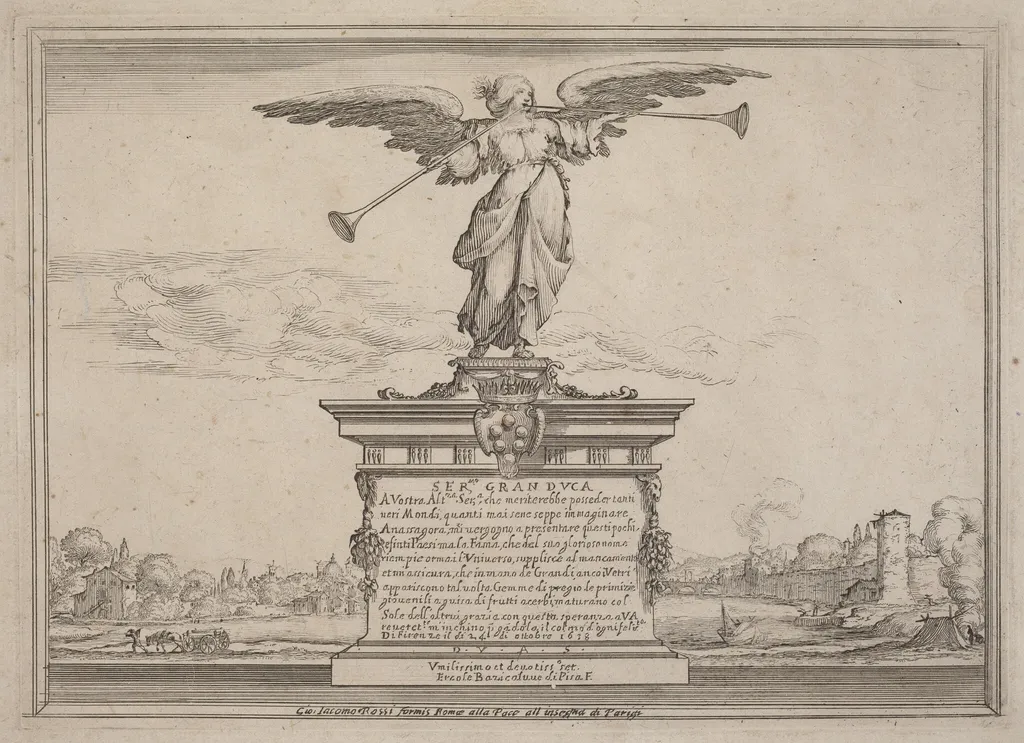
Dedication Page with Statue of Fama is an ink print by the Baroque artist Ercole Bazicaluva. It dates from 1638 and is held in the collection of the National Gallery of Art. Created in 1638 by the Italian engraver Ercole Bazzicaluva, this etching on laid paper serves as a dedication page for a printed work.
About this work
Overview
The composition blends allegory with decorative typography, typical of Baroque printed frontispieces designed to honor patrons or institutions.
Created in 1638 by the Italian engraver Ercole Bazzicaluva, this etching on laid paper serves as a dedication page for a printed work. It presents a single central figure—Fama, the Roman personification of fame—depicted as an angelic being hovering above a detailed terrestrial and maritime landscape. The composition blends allegory with decorative typography, typical of Baroque printed frontispieces designed to honor patrons or institutions.
Subject & Meaning
Fama, the Roman goddess of rumor and renown, is shown as a winged figure blowing a trumpet to proclaim news across land and sea. Her elevated position suggests divine or universal reach, while the surrounding landscape—featuring ships, buildings, and swirling clouds—implies the spread of reputation through human activity and commerce. The Latin inscription at the base reinforces the work’s ceremonial function, likely dedicating the enclosed text to a noble or ecclesiastical authority.
Technique & Style
Bazzicaluva employed etching to achieve fine, intricate lines that define the angel’s flowing drapery, the texture of clouds, and the miniature architecture below. The use of laid paper, with its characteristic chain lines, was standard for high-quality prints of the period. The composition balances vertical emphasis—the soaring figure—with horizontal detail in the horizon, creating depth through meticulous line work rather than tonal variation.
History & Provenance
The print was produced as part of a larger publication, likely a scholarly or religious text commissioned by a patron seeking to associate their name with enduring legacy. While the original volume’s full history is not fully documented, surviving impressions suggest it circulated among learned circles in Italy. Bazzicaluva’s role as a printmaker for ecclesiastical and academic publishers places this work within a broader tradition of illustrated dedications in early modern Europe.
Context
In mid-17th-century Italy, printed frontispieces like this one functioned as visual prologues, merging classical symbolism with contemporary print technology. The depiction of Fama reflects a cultural preoccupation with reputation and the transmission of knowledge. Similar imagery appeared in books by Jesuit scholars and aristocratic patrons, where allegorical figures served to legitimize and elevate the content within.
Legacy
Though Bazzicaluva is not widely known today, his work exemplifies the skilled craftsmanship of Baroque printmakers who bridged art and publishing. This etching contributes to the understanding of how visual allegory supported intellectual authority in early modern Europe. Surviving examples in institutional collections preserve its role as both artistic artifact and historical document of print culture.
Artist & collection

Artist
Ercole Bazzicaluva, also spelled Bezzicaluva or Bazzicaluve (active 1640), was an Italian engraver of the Baroque period.

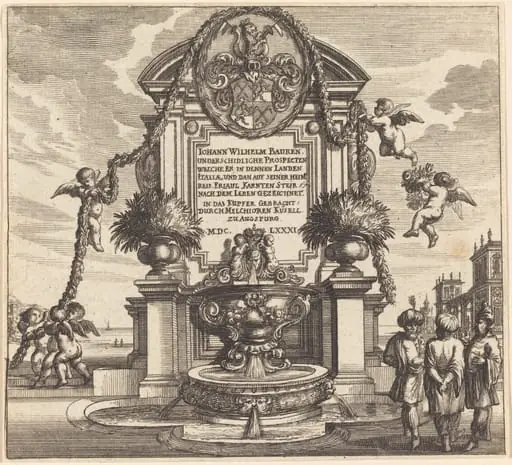 Title Page
 Catafalque for the Funeral of Giulio Thieni, Marquis of Scandiano
 Ornamental Panel Surmounted with a Head Flanked by Foliage
 The Annunciation
 Triumphal Arch in a Landscape
 The Seconda Macchina for the Chinea of 1746: The Territories of the Kingdom of Naples
 Two Angels Holding a Coat of Arms
 Frontispiece for "Fountains"
 Title Page
 Ornamental Panel Surmounted by a Winged Harpy