Artwork
Birds in Flight [verso]
![Birds in Flight [verso], by Girolamo Mazzola Bedoli, ink, 1534](https://artifactworldgallery.com/img/girolamo-mazzola-bedoli--birds-in-flight-verso--8bc1f047f8469dc6-w1024.webp)
Birds in Flight [verso] is an ink drawing by the Renaissance artist Girolamo Mazzola Bedoli. It dates from 1534 and is held in the collection of the National Gallery of Art.
About this work
Overview
This drawing, dated 1534, is attributed to Girolamo Mazzola Bedoli and executed in pen and brown ink on laid paper. It depicts a group of birds in motion, rendered with swift, economical strokes. The composition lacks background detail, focusing solely on the forms and trajectories of the birds. Its informal quality suggests it was made as a preparatory study rather than a finished piece.
Subject & Meaning
The birds are shown in varied orientations—some turning left, others right—capturing fleeting moments of flight. The absence of context or symbolism points to an observational intent, likely rooted in the artist’s interest in natural movement. Rather than conveying allegory, the drawing reflects a direct engagement with the physical world, typical of Renaissance study practices.
Technique & Style
Bedoli employed a light, fluid hand, using thin, confident lines to suggest wing motion and body weight. The ink flows with minimal correction, emphasizing spontaneity. The paper’s texture subtly interacts with the pen, enhancing the sense of immediacy. This approach reveals a focus on gesture and rhythm over anatomical precision, characteristic of preparatory sketches from the period.
History & Provenance
The drawing’s early history is undocumented, but its attribution to Bedoli aligns with his known body of graphic work from the 1530s. It likely remained in private collections in Italy before entering a public collection. No records link it directly to a larger commissioned work, though its style suggests it may have informed a mural or altarpiece design.
Context
In early 16th-century Italy, artists routinely made quick studies of nature to refine their understanding of form and motion. Bedoli, active in Parma and Bologna, participated in this tradition alongside contemporaries like Correggio. Such sketches were essential tools for translating observed reality into more elaborate compositions, reflecting the era’s empirical approach to art.
Legacy
This drawing exemplifies the quiet, disciplined practice underlying Renaissance artistic training. Though not widely exhibited, it contributes to the understanding of how artists like Bedoli developed their visual language through direct observation. Its preservation underscores the value placed on preparatory work, even when detached from final compositions.
Artist & collection

![Figures Studies [recto], by Girolamo Mazzola Bedoli](https://artifactworldgallery.com/img/girolamo-mazzola-bedoli--figures-studies-recto--1ed79b3eaa10b09e-w320.webp)
 Ornament
 Lemon blossom. Capri
 Marquetry Design
 Studies of Hands Playing Instruments (verso)
 Figure of a Man
 Decorative acanthus scrollwork with bird of prey and snail
 An Architectural Study with an Atlantid
 Vine Ornament with Two Birds
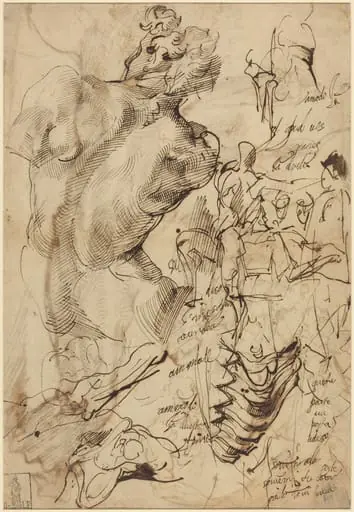 Studies of a Sculpture of a Male Nude, Vertebrae, and Gesturing Figures
 Sketch of a Child's Head (verso)
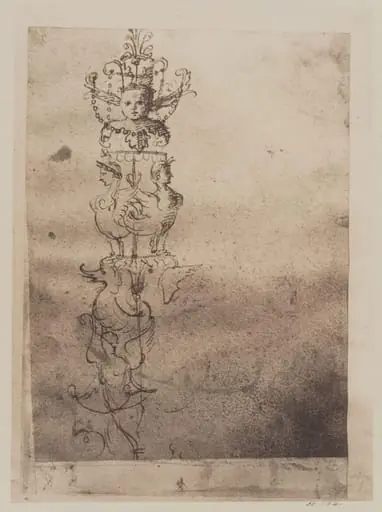 Ornament
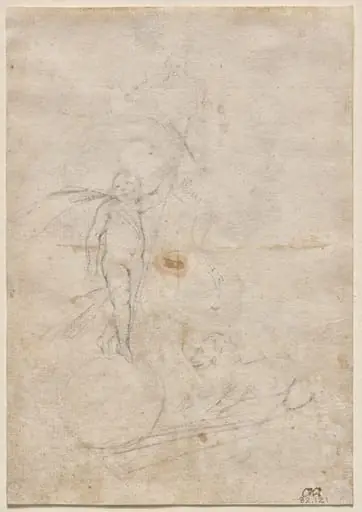 Resurrected Christ and Lamb of God (verso)