Artwork
The Penance of Saint John Chrysostom
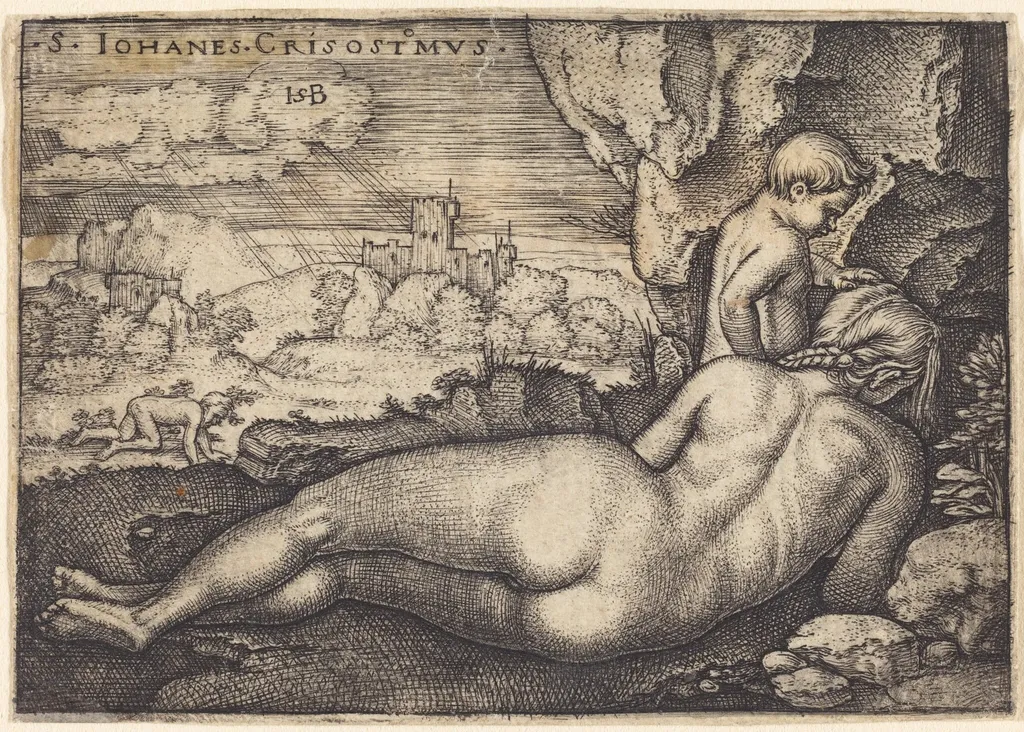
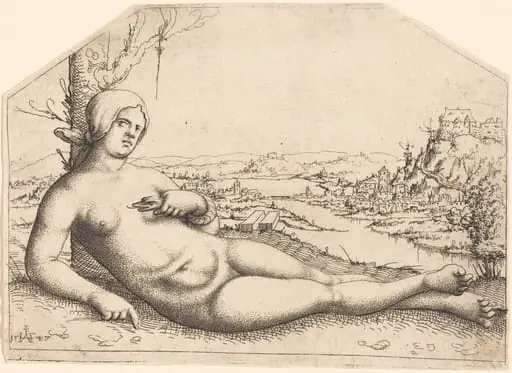
The Penance of Saint John Chrysostom is an ink print by the Renaissance artist Sebald Beham. It dates from 1538 and is held in the collection of the National Gallery of Art.
About this work
Overview
Sebald Beham, a German engraver active in the early 16th century, produced this small-scale print around 1538. As a member of the group known as the Little Masters, he specialized in intricate engravings that demanded close viewing. This work exemplifies his precision and technical control, rendered in fine lines that convey both texture and emotional gravity within a compact format.
Subject & Meaning
Depicted barefoot and clad only in a loincloth, he lies prostrate on the earth, arms crossed over his chest in a gesture of humility.
The scene portrays Saint John Chrysostom, the 4th-century bishop, in a moment of spiritual contrition. Depicted barefoot and clad only in a loincloth, he lies prostrate on the earth, arms crossed over his chest in a gesture of humility. A young attendant stands behind him, observing silently. The image reflects the saint’s historical exile and self-imposed penance, emphasizing inner devotion over external grandeur.
Technique & Style
Beham employed fine cross-hatching and delicate line work to model form and depth, characteristic of his engraving style. The landscape background—rolling hills, distant city, and sparse trees—is rendered with meticulous attention to detail, contrasting with the stark simplicity of the central figure. The tonal gradations are achieved through controlled density of lines, not shading, preserving the clarity and precision typical of Northern Renaissance printmaking.
History & Provenance
Created during Beham’s mature period, the engraving emerged from a time when religious imagery remained central to print culture despite growing Reformation tensions. Though specific early ownership records are sparse, the work aligns with the broader circulation of devotional prints among educated patrons in southern Germany and the Low Countries during the 1530s and 1540s.
Context
Beham’s work reflects the enduring influence of Albrecht Dürer’s graphic tradition, adapted into smaller, more intimate formats. While Protestant reformers questioned the veneration of saints, Catholic patrons still commissioned such imagery. This engraving thus exists at a cultural crossroads—devotional in intent, yet shaped by the era’s shifting religious and artistic norms.
Legacy
Beham’s engravings, including this one, contributed to the standardization of small-format religious prints in Northern Europe. His technical rigor influenced later generations of printmakers, even as stylistic tastes evolved. Though less widely known today than Dürer, his precise craftsmanship remains a significant reference in the study of 16th-century graphic arts.
Artist & collection
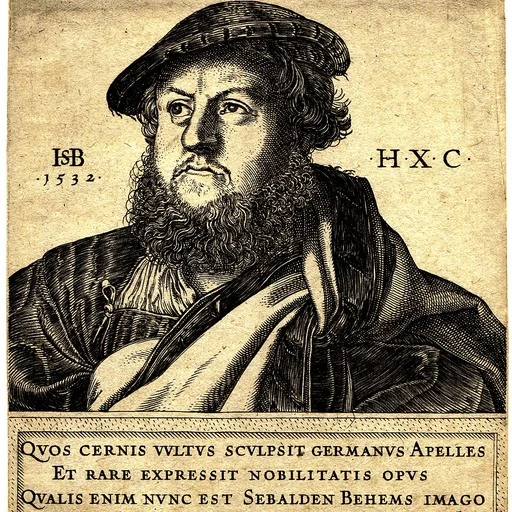
Artist
Sebald Beham (1500–1550) was a German painter and printmaker, mainly known for his very small engravings.