Artwork
Venus Reclining in a Landscape
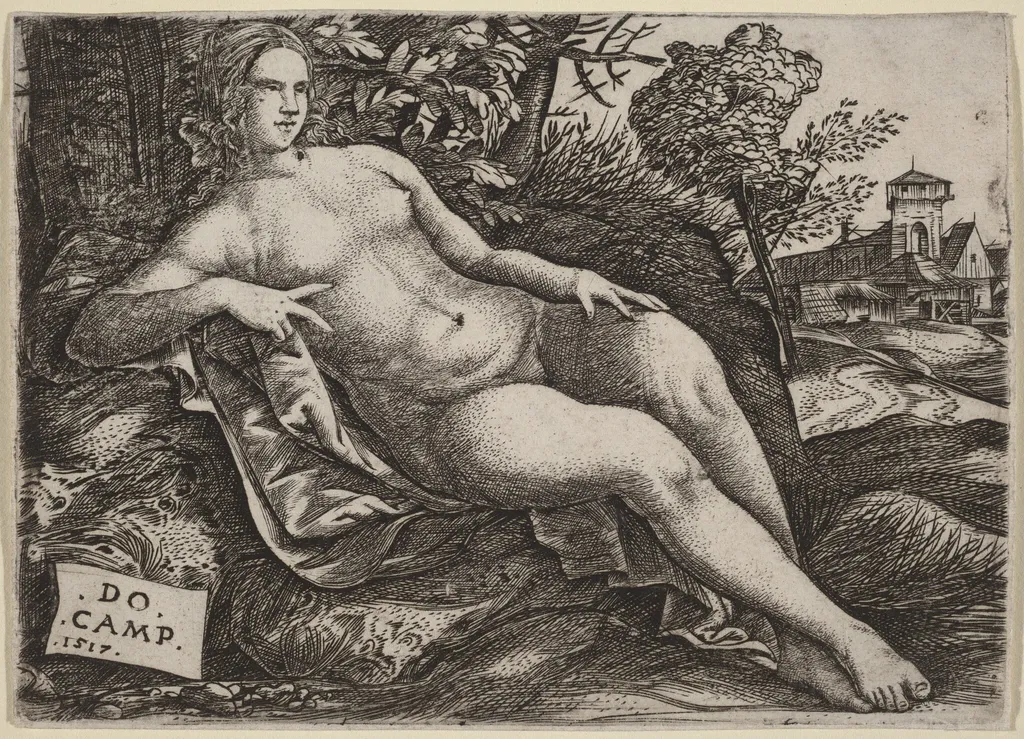
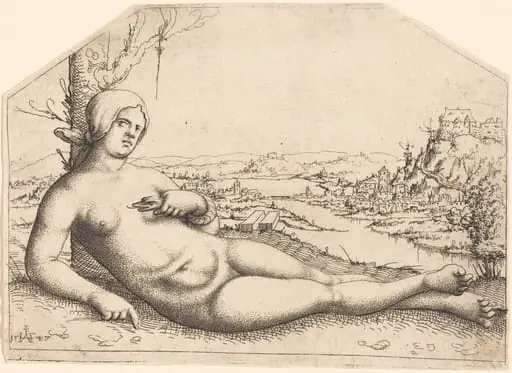
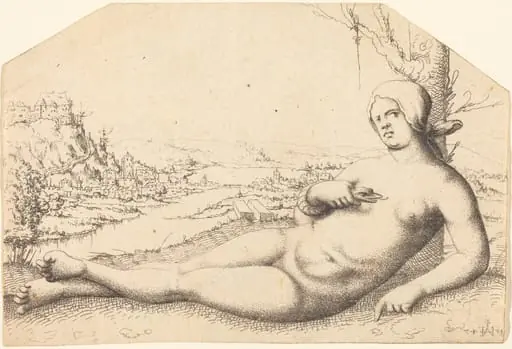
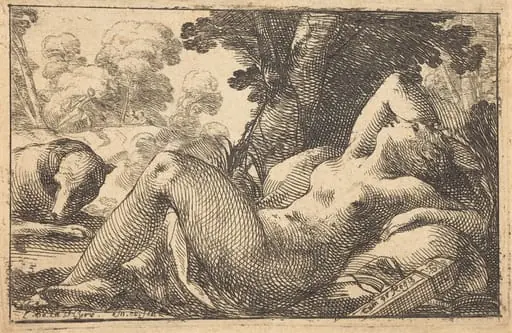
Venus Reclining in a Landscape is an ink print by the Renaissance artist Domenico Campagnola. It dates from 1517 and is held in the collection of the National Gallery of Art.
About this work
She’s wrapped in a loose cloth, with one arm bent under her head and the other resting on the ground.
This engraving shows a woman lying down in a grassy field, her body turned slightly toward us. She’s wrapped in a loose cloth, with one arm bent under her head and the other resting on the ground. Behind her, trees and a small building sit in the distance.
The artist used fine lines to show the folds of her cloth and the texture of the grass. The date "1517" is written in the corner, matching the year this was made.
Next, look up engraving to see how artists like this carved images into metal plates.
Overview
Domenico Campagnola’s 1517 engraving, titled Venus Reclining in a Landscape, presents a solitary female figure situated in an open, grassy setting. The composition places the nude, partially covered by a draped cloth, slightly turned toward the viewer, with her head supported by a bent arm and the other arm resting on the ground. Distant trees and a modest building complete the background, framing the central figure within a tranquil pastoral scene.
Subject & Meaning
The work depicts the classical goddess Venus in a relaxed pose, emphasizing both sensuality and natural harmony. By situating the deity amid an unadorned landscape, Campagnola aligns the figure with the Renaissance interest in integrating mythological subjects into everyday environments, suggesting a union of divine beauty and the simplicity of rural life.
Technique & Style
Executed as an intaglio engraving, the image relies on fine, closely spaced lines to render the delicate folds of the cloth and the texture of the grass. Campagnola’s handling of line creates subtle tonal variations, allowing depth and volume to emerge from the metal plate. The inscription of the date in the margin confirms the work’s completion in 1517.
History & Provenance
Created in the early sixteenth century, this print reflects Campagnola’s activity in the Venetian artistic circle, where engraving was increasingly used to disseminate compositions. While specific ownership records are scarce, the piece has been catalogued among his known works and appears in several early modern collections of prints, indicating its circulation among connoisseurs of the period.
Context
The engraving belongs to a broader trend of Renaissance artists reinterpreting classical themes through the medium of print, a practice that allowed wider distribution beyond painted commissions. Campagnola’s choice of a landscape setting for Venus mirrors contemporary interests in naturalism and the merging of mythological narrative with observed scenery.
Own this work as a print
Artist & collection