Artwork
Ewenny Priory, Glamorganshire
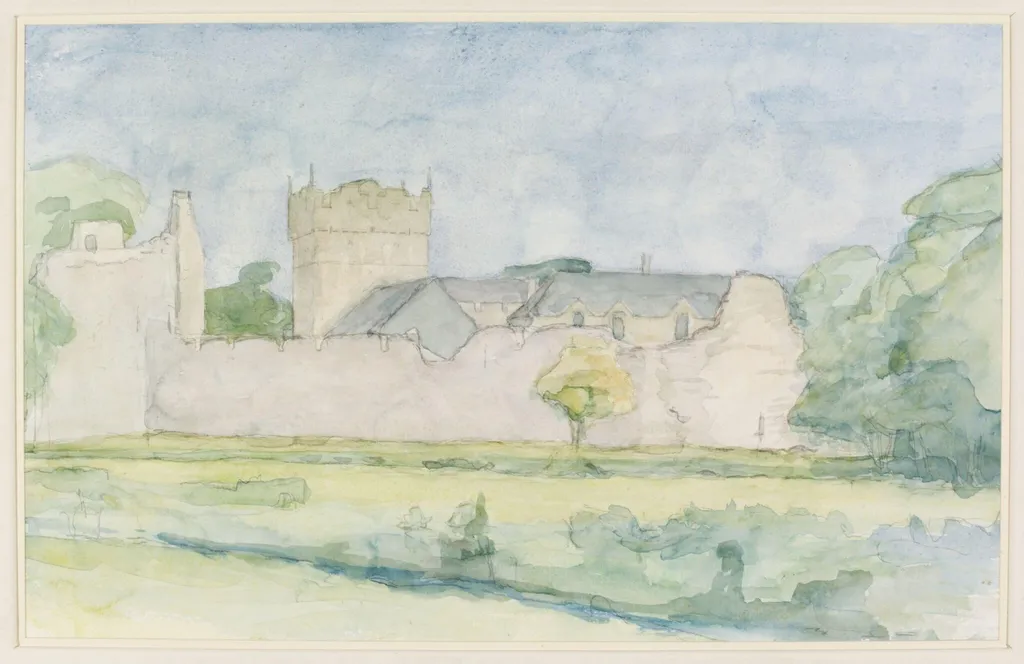
Ewenny Priory, Glamorganshire is a watercolor work on paper by the British Romanticist artist Graham Bell. It dates from 1940 and is held in the collection of the Victoria and Albert Museum.
About this work
Overview
Graham Bell’s 1940 watercolor presents Ewewny Priory in Glamorganshire, emphasizing the surviving fortified wall of the historic complex. The composition centers on the white stone structure, flanked by a tall tower on the left and a smaller annex on the right, set against a modestly treed lawn and a light‑blue, cloud‑dotted sky.
Subject & Meaning
The work records the priory’s medieval architecture at a time when many such sites were threatened by wartime bombing and post‑war redevelopment. By focusing on the sturdy wall and its surrounding landscape, Bell underscores the endurance of the built heritage amid a period of national uncertainty.
Technique & Style
Executed in watercolor, the painting employs soft, fluid brushstrokes that blend muted greens, blues, and yellows into a tranquil atmosphere. The delicate washes create a slightly hazy effect, while the restrained palette conveys a sense of calm rather than dramatic contrast, characteristic of the Recording Britain aesthetic.
History & Provenance
The piece was produced under the Recording Britain project, a wartime initiative directed by Sir Kenneth Clark and funded by the Pilgrim Trust through the Committee for the Employment of Artists in Wartime. It forms part of a broader collection of watercolors documenting vulnerable British landscapes and edifices across England, Wales, and Scotland.
Context
Created during the early 1940s, the work reflects a national effort to preserve visual records of cultural landmarks perceived to be at risk from aerial attacks and modern change. Bell’s contribution aligns with those of other notable watercolorists commissioned to capture the country’s architectural and rural scenery for posterity.
Artist & collection
Artist
Frank Graham Bell (21 November 1910 – 9 August 1943) was a painter of portraits, landscapes and still-life, and a founder member of the realist Euston Road School.

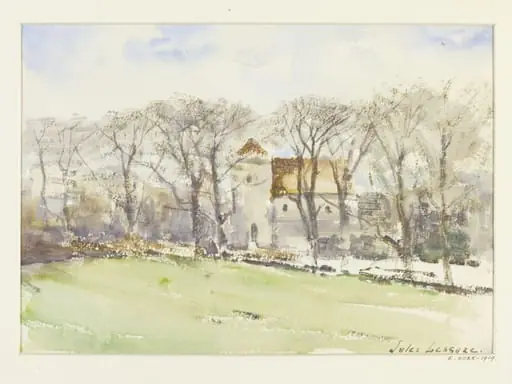 A Country Church seen through Trees
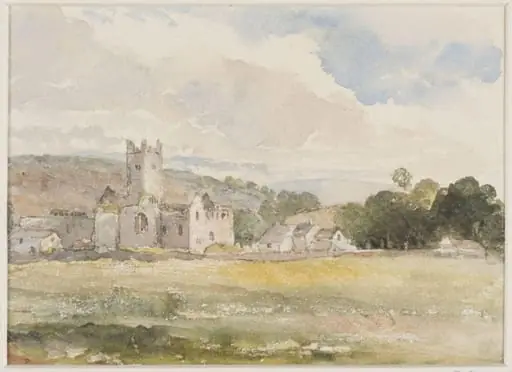 Jerpoint Abbey
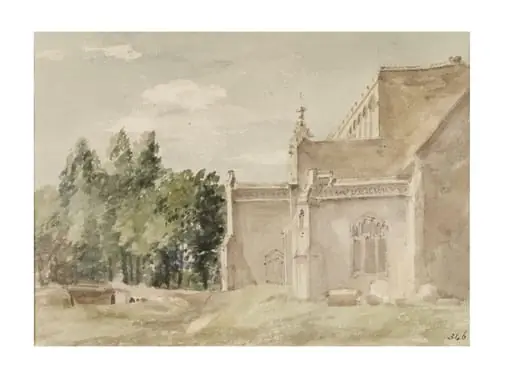 East Bergholt Church: view from the east
 Winchester Cathedral: entrance to the Deanery from the south
 The Vale of Pickering from the Castle Grounds
 St. Bartholomew's Church, Fingest
 St. Peter's Church, Theberton
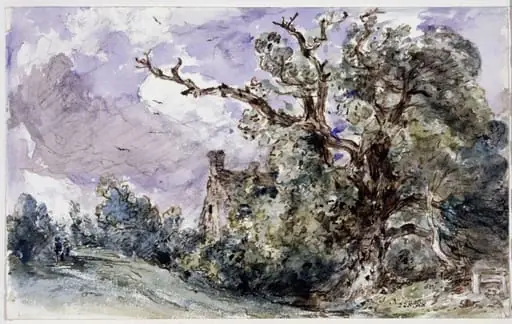 A cottage by a wood at Findon, Sussex
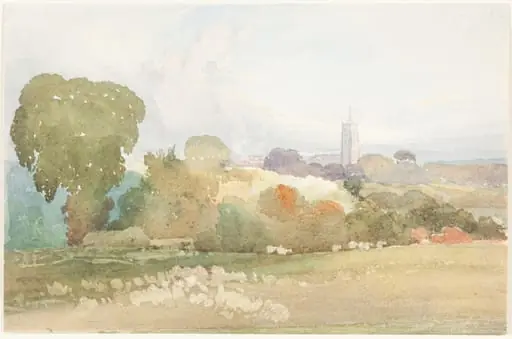 Landscape with Church Steeple