Artwork
St. Bartholomew's Church, Fingest
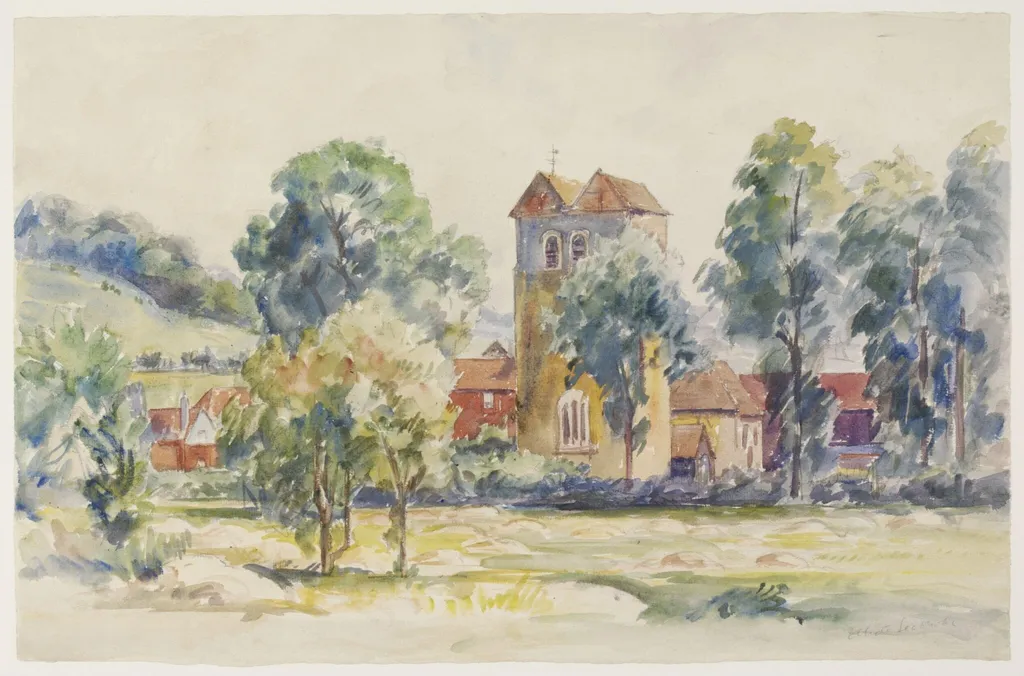
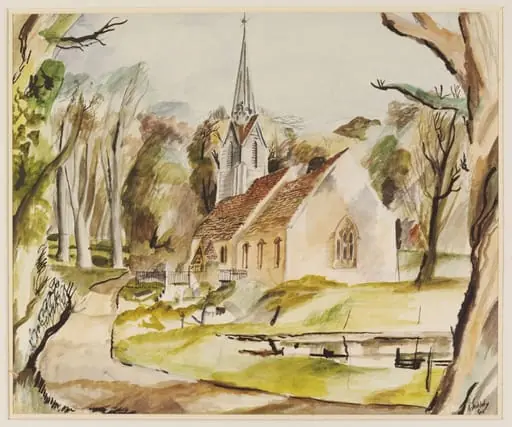
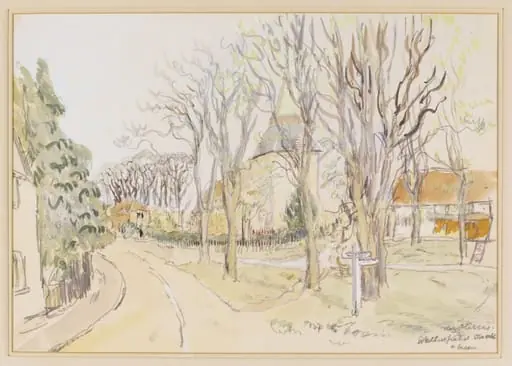
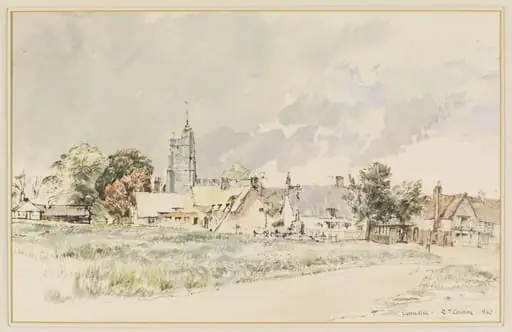
St. Bartholomew's Church, Fingest is a watercolor work on paper by Elliott Seabrooke. It dates from 1940 and is held in the collection of the Victoria and Albert Museum.
About this work
Overview
The piece is signed and dated by the artist, affirming its place within a documented national project.
This 1940 watercolour by Elliott Seabrooke captures St. Bartholomew’s Church in the village of Fingest, Buckinghamshire. Executed as part of the 'Recording Britain' initiative, the work belongs to a broader effort to visually archive the nation’s architectural and rural character during the early years of the Second World War. The piece is signed and dated by the artist, affirming its place within a documented national project.
Subject & Meaning
The painting centers on the church’s robust Norman tower, a durable structure standing amid mature trees and a quiet, undisturbed landscape. Its simplicity and isolation suggest a quiet endurance, evoking the persistence of rural tradition amid the upheaval of war. The scene conveys no human presence, emphasizing instead the quiet dignity of place and the passage of time.
Technique & Style
Seabrooke employed delicate watercolour washes to render soft transitions of light and shadow across the church’s stone surfaces and the surrounding foliage. Muted tones of pale yellow, grey-green, and earthy browns create a subdued atmosphere, while the sparse use of color enhances the sense of stillness. The brushwork is restrained, favoring atmospheric suggestion over fine detail.
History & Provenance
Commissioned by the 'Recording Britain' project, initiated by Sir Kenneth Clark in 1939, the work was produced to safeguard visual records of vulnerable heritage sites. The painting entered the collection of the Victoria and Albert Museum, where it remains as part of a significant archive of wartime topographical art, intended as both cultural record and act of preservation.
Context
During the early 1940s, Britain faced the threat of aerial bombardment and rapid social change. The 'Recording Britain' project responded to fears that historic buildings and rural landscapes might vanish. Artists like Seabrooke were deployed to document unassuming but culturally resonant sites, offering a quiet counterpoint to the urgency of wartime reporting.
Legacy
The watercolour endures as a representative example of a wartime cultural initiative that prioritized observation over grandeur. Its quiet composition reflects a deliberate choice to honor the ordinary, preserving a visual record of England’s countryside at a moment of national fragility. Today, it contributes to ongoing studies of heritage, memory, and the role of art in times of crisis.
Artist & collection
Artist
British water-colourist of the 1930s–40s, Elliott Seabrooke put church spires and village greens onto paper with quick, luminous strokes.