Artwork
Another view of Castleknock with an [sic] mutilated tower on a hill at some distance [...]
![Another view of Castleknock with an [sic] mutilated tower on a hill at some distance [...], by Gabriel, ca.1729-1817 Beranger, unspecified, 1790](https://artifactworldgallery.com/img/gabriel-ca-1729-1817-beranger--another-view-of-castleknock-with-an-sic-mutilated-tower-on-a--4e08fdbddd5c4a48-w1024.webp)
Another view of Castleknock with an [sic] mutilated tower on a hill at some distance [...] is an unspecified work on paper by the Rococo painting artist Gabriel, ca.1729-1817 Beranger. It dates from 1790 and is held in the collection of the Royal Irish Academy. This watercolor depicts a distant landscape of Castleknock in County Dublin, focusing on the remnants of a medieval tower perched on a hill.
About this work
To learn more about the artist who created this scene, look up the artist: Beranger, Gabriel, ca.
You see a watercolor painting of a hill with a tower in the distance.
The tower is damaged, and two men stand to its right.
The painting also shows the old castle ruins on the left side of the hill.
This painting is interesting because it shows a specific place, Castleknock, from a unique view.
To learn more about the artist who created this scene, look up the artist: Beranger, Gabriel, ca.1729-1817.
Overview
This watercolor depicts a distant landscape of Castleknock in County Dublin, focusing on the remnants of a medieval tower perched on a hill. To the right, two figures stand near the structure, while the fragmented remains of an older castle complex appear on the left. The composition emphasizes topographical detail over narrative, capturing a quiet, unidealized view of rural Irish ruins in the late 18th century.
Subject & Meaning
The scene records the physical decay of Castleknock’s historic structures, likely reflecting the passage of time and changing land use. The presence of two men suggests human interaction with the ruins, though their identities and purpose remain unspecified. The painting functions as a topographical record rather than a romanticized ruin, emphasizing observation over symbolism.
Technique & Style
Executed in watercolor, the work employs delicate washes to suggest atmospheric depth and subtle shifts in terrain. The tower and ruins are rendered with restrained detail, avoiding dramatic embellishment. The figures are minimally defined, serving as scale indicators rather than focal points. The style aligns with 18th-century topographical drawing, prioritizing accuracy over expressive flourish.
History & Provenance
Attributed to Gabriel Beranger (c.1729–1817), an Irish antiquarian and artist known for documenting historic sites across Ireland, the piece likely stems from his fieldwork in the 1770s–1790s. Beranger traveled extensively to sketch castles and ecclesiastical remains, often for private collections or scholarly use. This work may have been part of a broader effort to preserve visual records of structures before further deterioration.
Context
In late 18th-century Ireland, there was growing interest among antiquarians in preserving visual records of medieval heritage amid neglect and demolition. Beranger’s work emerged within this movement, contributing to early efforts to catalog Ireland’s architectural past. His depictions, though unembellished, provided valuable evidence of structures later lost or altered beyond recognition.
Legacy
Beranger’s watercolors, including this view of Castleknock, remain important references for historians studying Ireland’s architectural decline and preservation efforts. Though not widely exhibited in his lifetime, his drawings have since been recognized for their documentary value, offering a sober, unvarnished glimpse into the state of Ireland’s historic sites at the close of the 18th century.
Artist & collection
Artist
Gabriel, ca.1729-1817 Beranger
Gabriel Beranger made watercolors of Dublin and its surroundings in the late 1700s.
![A view of the round tower of Michael of Pole in the city of Dublin [...], by Gabriel, ca.1729-1817 Beranger](https://artifactworldgallery.com/img/gabriel-ca-1729-1817-beranger--a-view-of-the-round-tower-of-michael-of-pole-in-the-city-of--066346c3e06cc1f8-w320.webp) A view of the round tower of Michael of Pole in the city of Dublin [...]
A view of the round tower of Michael of Pole in the city of Dublin [...]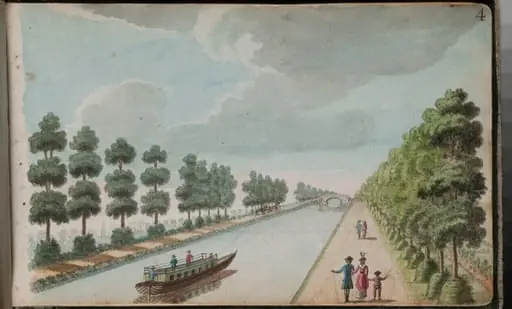 View of the Grand Canal, taken between the first bridge and the first lock looking towards Dublin
![View of the castle of Rabuck [Roebuck], 2 miles from Dublin [...], by Gabriel, ca.1729-1817 Beranger](https://artifactworldgallery.com/img/gabriel-ca-1729-1817-beranger--view-of-the-castle-of-rabuck-roebuck-2-miles-from-dublin--12853cdd66c2654f-w320.webp) View of the castle of Rabuck [Roebuck], 2 miles from Dublin [...]
View of the castle of Rabuck [Roebuck], 2 miles from Dublin [...]![Rathgar Castle, 1 1/2 miles from Dublin [...], by Gabriel, ca.1729-1817 Beranger](https://artifactworldgallery.com/img/gabriel-ca-1729-1817-beranger--rathgar-castle-1-1-2-miles-from-dublin--17cfe3f4e70405c2-w320.webp) Rathgar Castle, 1 1/2 miles from Dublin [...]
Rathgar Castle, 1 1/2 miles from Dublin [...]![Grange Castle, near Clondalken [Clondalkin], 6 miles from Dublin [...], by Gabriel, ca.1729-1817 Beranger](https://artifactworldgallery.com/img/gabriel-ca-1729-1817-beranger--grange-castle-near-clondalken-clondalkin-6-miles-from-dublin--29b767d07d01cfc8-w320.webp) Grange Castle, near Clondalken [Clondalkin], 6 miles from Dublin [...]
Grange Castle, near Clondalken [Clondalkin], 6 miles from Dublin [...]![View of Balymount [Ballymount] Castle, 3 miles from Dublin [...], by Gabriel, ca.1729-1817 Beranger](https://artifactworldgallery.com/img/gabriel-ca-1729-1817-beranger--view-of-balymount-ballymount-castle-3-miles-from-dublin--32c2f3cc4ed12e5f-w320.webp) View of Balymount [Ballymount] Castle, 3 miles from Dublin [...]
View of Balymount [Ballymount] Castle, 3 miles from Dublin [...]![A second view of Rathfarnham Castle, showing the front or entrance [...], by Gabriel, ca.1729-1817 Beranger](https://artifactworldgallery.com/img/gabriel-ca-1729-1817-beranger--a-second-view-of-rathfarnham-castle-showing-the-front-or-ent--3b1f8da88f33e09f-w320.webp) A second view of Rathfarnham Castle, showing the front or entrance [...]
A second view of Rathfarnham Castle, showing the front or entrance [...]![View of the Castle of Carrick, on the River Boyne, County of E[ast] Meath, 24 m[iles] fr[om] Dublin [...], by Gabriel, ca.1729-1817 Beranger](https://artifactworldgallery.com/img/gabriel-ca-1729-1817-beranger--view-of-the-castle-of-carrick-on-the-river-boyne-county-of-e--47a9c858b28e8890-w320.webp) View of the Castle of Carrick, on the River Boyne, County of E[ast] Meath, 24 m[iles] fr[om] Dublin [...]
View of the Castle of Carrick, on the River Boyne, County of E[ast] Meath, 24 m[iles] fr[om] Dublin [...]
![View of Castle-knock, 3 miles from Dublin [...], by Gabriel, ca.1729-1817 Beranger](https://artifactworldgallery.com/img/gabriel-ca-1729-1817-beranger--view-of-castle-knock-3-miles-from-dublin--4e9a7099f4e41684-w320.webp) View of Castle-knock, 3 miles from Dublin [...]
View of Castle-knock, 3 miles from Dublin [...]![View of another castle at Monkstown [...], by Gabriel, ca.1729-1817 Beranger](https://artifactworldgallery.com/img/gabriel-ca-1729-1817-beranger--view-of-another-castle-at-monkstown--aa06605166c02b4a-w320.webp) View of another castle at Monkstown [...]
View of another castle at Monkstown [...]![View of the tumulus or barrow at Douth [Dowth], Co. of E[ast] Meath, 25 miles from Dublin [...], by Gabriel, ca.1729-1817 Beranger](https://artifactworldgallery.com/img/gabriel-ca-1729-1817-beranger--view-of-the-tumulus-or-barrow-at-douth-dowth-co-of-e-ast-mea--32266a93c2c75aee-w320.webp) View of the tumulus or barrow at Douth [Dowth], Co. of E[ast] Meath, 25 miles from Dublin [...]
View of the tumulus or barrow at Douth [Dowth], Co. of E[ast] Meath, 25 miles from Dublin [...]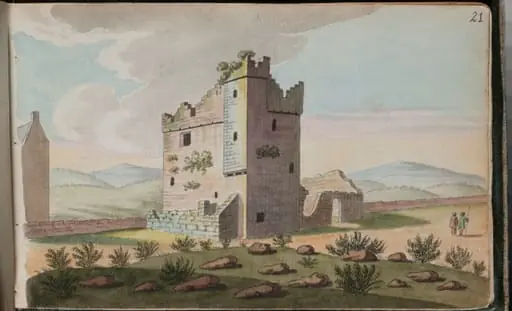 View of one of Dalkey's castles taken from the church yard on the opposite side
![View of Cappoge Castle [...], by Gabriel, ca.1729-1817 Beranger](https://artifactworldgallery.com/img/gabriel-ca-1729-1817-beranger--view-of-cappoge-castle--885594fac18874cc-w320.webp) View of Cappoge Castle [...]
View of Cappoge Castle [...]![View of the Plunket's [sic] Castle, near St. Margaret's, 5 1/2 miles from Dublin [...], by Gabriel, ca.1729-1817 Beranger](https://artifactworldgallery.com/img/gabriel-ca-1729-1817-beranger--view-of-the-plunket-s-sic-castle-near-st-margaret-s-5-1-2-mi--aaf2a207a5920843-w320.webp) View of the Plunket's [sic] Castle, near St. Margaret's, 5 1/2 miles from Dublin [...]
View of the Plunket's [sic] Castle, near St. Margaret's, 5 1/2 miles from Dublin [...]![View of Kilgoben [Kilgobbin] Castle, 5 miles from Dublin [...], by Gabriel, ca.1729-1817 Beranger](https://artifactworldgallery.com/img/gabriel-ca-1729-1817-beranger--view-of-kilgoben-kilgobbin-castle-5-miles-from-dublin--924293240c630cbc-w320.webp) View of Kilgoben [Kilgobbin] Castle, 5 miles from Dublin [...]
View of Kilgoben [Kilgobbin] Castle, 5 miles from Dublin [...]![View of the remains of a druidical monument at Douth [Dowth], Co[unty] of Meath, 2 miles from Slane, & 24 miles from Dublin [...], by Gabriel, ca.1729-1817 Beranger](https://artifactworldgallery.com/img/gabriel-ca-1729-1817-beranger--view-of-the-remains-of-a-druidical-monument-at-douth-dowth-c--599f96d588ed28a4-w320.webp) View of the remains of a druidical monument at Douth [Dowth], Co[unty] of Meath, 2 miles from Slane, & 24 miles from Dublin [...]
View of the remains of a druidical monument at Douth [Dowth], Co[unty] of Meath, 2 miles from Slane, & 24 miles from Dublin [...]