Artwork
A second view of Rathfarnham Castle, showing the front or entrance [...]
![A second view of Rathfarnham Castle, showing the front or entrance [...], by Gabriel, ca.1729-1817 Beranger, unspecified, 1790](https://artifactworldgallery.com/img/gabriel-ca-1729-1817-beranger--a-second-view-of-rathfarnham-castle-showing-the-front-or-ent--3b1f8da88f33e09f-w1024.webp)
A second view of Rathfarnham Castle, showing the front or entrance [...] is an unspecified work on paper by the Rococo painting artist Gabriel, ca.1729-1817 Beranger. It dates from 1790 and is held in the collection of the Royal Irish Academy.
About this work
Watercolor lets Beranger show light and shadow in a way that photographs couldn’t then.
Gabriel Beranger painted Rathfarnham Castle in watercolor. The scene shows the castle’s entrance with trees behind it. In the front, a woman and man walk through the grounds.
This work stands out for its soft colors and clear details. Watercolor lets Beranger show light and shadow in a way that photographs couldn’t then. The figures add life without taking focus from the building.
Try looking up Beranger, Gabriel, ca.1729-1817 next.
Overview
Gabriel Beranger created this watercolor depiction of Rathfarnham Castle in County Dublin, capturing the building’s entrance with quiet precision. The composition centers on the castle’s façade, framed by a line of trees, while two figures stroll in the foreground. Rendered in delicate washes, the image balances architectural detail with atmospheric softness, reflecting Beranger’s skill in translating stone and foliage into subtle tonal gradations.
Subject & Meaning
The painting presents the castle not as a ruin or fortress, but as a lived-in estate. The presence of a man and woman walking through the grounds suggests domestic tranquility and private use, contrasting with the castle’s earlier military or noble associations. Their small scale emphasizes the building’s permanence, framing it as a quiet anchor within a cultivated landscape rather than a monument to power.
Technique & Style
Beranger employed watercolor to achieve a luminous, layered effect, using thin glazes to suggest changing light and texture. The soft edges of the trees and the gentle modeling of the castle’s stonework reveal his command of the medium’s fluidity. Unlike early photography, which struggled with tonal range, his technique allowed nuanced rendering of shadow and atmosphere, enhancing the scene’s quiet realism without theatricality.
History & Provenance
Created in the late 18th century, this work is part of Beranger’s broader documentation of Irish antiquities. He traveled extensively, recording castles and ruins at a time when such structures were often neglected or altered. This watercolor likely served as a record for antiquarians or landowners, preserving the castle’s appearance before later renovations or decay. Its survival offers a rare visual archive of pre-modern Irish architecture.
Context
During Beranger’s lifetime, Ireland’s historic buildings were increasingly vulnerable to neglect or redevelopment. His watercolors emerged from a growing interest in preserving national heritage, often commissioned by scholars or collectors. This image reflects a shift from romanticized depictions to observational accuracy, aligning with Enlightenment-era values of documentation over embellishment.
Legacy
Beranger’s watercolors remain valuable for their fidelity and restraint. This image of Rathfarnham Castle contributes to a visual record that informs architectural restoration and historical study. His approach—attentive to detail yet unembellished—established a precedent for topographical art in Ireland, influencing later artists who sought to capture the nation’s built heritage with clarity rather than drama.
Artist & collection
Artist
Gabriel, ca.1729-1817 Beranger
Gabriel Beranger made watercolors of Dublin and its surroundings in the late 1700s.
![A view of the round tower of Michael of Pole in the city of Dublin [...], by Gabriel, ca.1729-1817 Beranger](https://artifactworldgallery.com/img/gabriel-ca-1729-1817-beranger--a-view-of-the-round-tower-of-michael-of-pole-in-the-city-of--066346c3e06cc1f8-w320.webp) A view of the round tower of Michael of Pole in the city of Dublin [...]
A view of the round tower of Michael of Pole in the city of Dublin [...]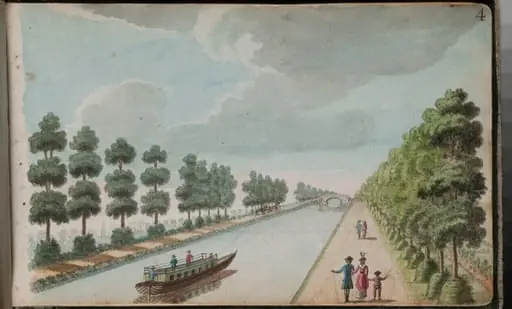 View of the Grand Canal, taken between the first bridge and the first lock looking towards Dublin
![View of the castle of Rabuck [Roebuck], 2 miles from Dublin [...], by Gabriel, ca.1729-1817 Beranger](https://artifactworldgallery.com/img/gabriel-ca-1729-1817-beranger--view-of-the-castle-of-rabuck-roebuck-2-miles-from-dublin--12853cdd66c2654f-w320.webp) View of the castle of Rabuck [Roebuck], 2 miles from Dublin [...]
View of the castle of Rabuck [Roebuck], 2 miles from Dublin [...]![Rathgar Castle, 1 1/2 miles from Dublin [...], by Gabriel, ca.1729-1817 Beranger](https://artifactworldgallery.com/img/gabriel-ca-1729-1817-beranger--rathgar-castle-1-1-2-miles-from-dublin--17cfe3f4e70405c2-w320.webp) Rathgar Castle, 1 1/2 miles from Dublin [...]
Rathgar Castle, 1 1/2 miles from Dublin [...]![Grange Castle, near Clondalken [Clondalkin], 6 miles from Dublin [...], by Gabriel, ca.1729-1817 Beranger](https://artifactworldgallery.com/img/gabriel-ca-1729-1817-beranger--grange-castle-near-clondalken-clondalkin-6-miles-from-dublin--29b767d07d01cfc8-w320.webp) Grange Castle, near Clondalken [Clondalkin], 6 miles from Dublin [...]
Grange Castle, near Clondalken [Clondalkin], 6 miles from Dublin [...]![View of Balymount [Ballymount] Castle, 3 miles from Dublin [...], by Gabriel, ca.1729-1817 Beranger](https://artifactworldgallery.com/img/gabriel-ca-1729-1817-beranger--view-of-balymount-ballymount-castle-3-miles-from-dublin--32c2f3cc4ed12e5f-w320.webp) View of Balymount [Ballymount] Castle, 3 miles from Dublin [...]
View of Balymount [Ballymount] Castle, 3 miles from Dublin [...]![View of the Castle of Carrick, on the River Boyne, County of E[ast] Meath, 24 m[iles] fr[om] Dublin [...], by Gabriel, ca.1729-1817 Beranger](https://artifactworldgallery.com/img/gabriel-ca-1729-1817-beranger--view-of-the-castle-of-carrick-on-the-river-boyne-county-of-e--47a9c858b28e8890-w320.webp) View of the Castle of Carrick, on the River Boyne, County of E[ast] Meath, 24 m[iles] fr[om] Dublin [...]
View of the Castle of Carrick, on the River Boyne, County of E[ast] Meath, 24 m[iles] fr[om] Dublin [...]![Another view of Castleknock with an [sic] mutilated tower on a hill at some distance [...], by Gabriel, ca.1729-1817 Beranger](https://artifactworldgallery.com/img/gabriel-ca-1729-1817-beranger--another-view-of-castleknock-with-an-sic-mutilated-tower-on-a--4e08fdbddd5c4a48-w320.webp) Another view of Castleknock with an [sic] mutilated tower on a hill at some distance [...]
Another view of Castleknock with an [sic] mutilated tower on a hill at some distance [...]
![View of Monkstown Castle, 4 1/2 miles from Dublin [...], by Gabriel, ca.1729-1817 Beranger](https://artifactworldgallery.com/img/gabriel-ca-1729-1817-beranger--view-of-monkstown-castle-4-1-2-miles-from-dublin--9cf4cde63d5dec9c-w320.webp) View of Monkstown Castle, 4 1/2 miles from Dublin [...]
View of Monkstown Castle, 4 1/2 miles from Dublin [...]![View of Drumnagh [Drimnagh] Castle, near Crumlin [...], by Gabriel, ca.1729-1817 Beranger](https://artifactworldgallery.com/img/gabriel-ca-1729-1817-beranger--view-of-drumnagh-drimnagh-castle-near-crumlin--606b31c4594851c7-w320.webp) View of Drumnagh [Drimnagh] Castle, near Crumlin [...]
View of Drumnagh [Drimnagh] Castle, near Crumlin [...]![View of the Plunket's [sic] Castle, near St. Margaret's, 5 1/2 miles from Dublin [...], by Gabriel, ca.1729-1817 Beranger](https://artifactworldgallery.com/img/gabriel-ca-1729-1817-beranger--view-of-the-plunket-s-sic-castle-near-st-margaret-s-5-1-2-mi--aaf2a207a5920843-w320.webp) View of the Plunket's [sic] Castle, near St. Margaret's, 5 1/2 miles from Dublin [...]
View of the Plunket's [sic] Castle, near St. Margaret's, 5 1/2 miles from Dublin [...]![View of Kilgoben [Kilgobbin] Castle, 5 miles from Dublin [...], by Gabriel, ca.1729-1817 Beranger](https://artifactworldgallery.com/img/gabriel-ca-1729-1817-beranger--view-of-kilgoben-kilgobbin-castle-5-miles-from-dublin--924293240c630cbc-w320.webp) View of Kilgoben [Kilgobbin] Castle, 5 miles from Dublin [...]
View of Kilgoben [Kilgobbin] Castle, 5 miles from Dublin [...]![View of the castle at Tallagh [Tallaght], 4 miles from Dublin [...], by Gabriel, ca.1729-1817 Beranger](https://artifactworldgallery.com/img/gabriel-ca-1729-1817-beranger--view-of-the-castle-at-tallagh-tallaght-4-miles-from-dublin--91b676c483b47739-w320.webp) View of the castle at Tallagh [Tallaght], 4 miles from Dublin [...]
View of the castle at Tallagh [Tallaght], 4 miles from Dublin [...]![View of Dundrum Castle from the court yard [...], by Gabriel, ca.1729-1817 Beranger](https://artifactworldgallery.com/img/gabriel-ca-1729-1817-beranger--view-of-dundrum-castle-from-the-court-yard--9adf863f6e8a85bf-w320.webp) View of Dundrum Castle from the court yard [...]
View of Dundrum Castle from the court yard [...]![View of Merion [Merrion] Castle, 2 miles from Dublin [...], by Gabriel, ca.1729-1817 Beranger](https://artifactworldgallery.com/img/gabriel-ca-1729-1817-beranger--view-of-merion-merrion-castle-2-miles-from-dublin--ff55e85c19078a20-w320.webp) View of Merion [Merrion] Castle, 2 miles from Dublin [...]
View of Merion [Merrion] Castle, 2 miles from Dublin [...]