Artwork
View of the castle of Rabuck [Roebuck], 2 miles from Dublin [...]
![View of the castle of Rabuck [Roebuck], 2 miles from Dublin [...], by Gabriel, ca.1729-1817 Beranger, unspecified, 1790](https://artifactworldgallery.com/img/gabriel-ca-1729-1817-beranger--view-of-the-castle-of-rabuck-roebuck-2-miles-from-dublin--12853cdd66c2654f-w1024.webp)
View of the castle of Rabuck [Roebuck], 2 miles from Dublin [...] is an unspecified work on paper by the Rococo painting artist Gabriel, ca.1729-1817 Beranger. It dates from 1790 and is held in the collection of the Royal Irish Academy. This watercolor depicts Roebuck Castle, a modest stone structure located two miles from Dublin.
About this work
This watercolor shows a worn stone castle near Dublin. A man carries logs in the yard. Another man in the front looks down at a paper or plan.
Beranger often drew old buildings this way. He used watercolor and small glazes to show light and age. The colors stay soft but clear.
This feels like early Irish views. Look up Beranger, Gabriel, ca.1729-1817.
Overview
The composition emphasizes the castle’s weathered presence within its landscape, rendered with restrained detail and a sense of quiet observation.
This watercolor depicts Roebuck Castle, a modest stone structure located two miles from Dublin. The scene captures quiet daily activity: a figure carries firewood toward the building’s entrance, while another stands near the foreground wall, studying a document. The composition emphasizes the castle’s weathered presence within its landscape, rendered with restrained detail and a sense of quiet observation.
Subject & Meaning
The painting presents no grand narrative but instead records ordinary life around an aging structure. The figures—engaged in labor and contemplation—suggest the castle’s continued, if diminished, utility. The paper or plan held by the foreground figure implies possible architectural interest or maintenance, hinting at the building’s transition from noble residence to rural relic.
Technique & Style
Gabriel Beranger employed delicate watercolor washes and subtle glazes to convey the texture of aged stone and the softness of natural light. His palette remains muted yet clear, avoiding dramatic contrasts. The brushwork is precise but unobtrusive, allowing the architecture and atmosphere to dominate. This method aligns with his broader practice of documenting Ireland’s historic buildings with documentary clarity.
History & Provenance
Created by Gabriel Beranger (c.1729–1817), this work is part of a larger series of topographical watercolors he produced during the late 18th century. Beranger traveled extensively across Ireland, recording castles, abbeys, and ruins at a time when many were decaying. His drawings served as visual archives, later used by antiquarians and historians to trace architectural change.
Context
In the decades before the Act of Union, Irish antiquarians and landowners showed growing interest in preserving native heritage. Beranger’s work emerged within this cultural shift, offering factual records of structures often overlooked or neglected. His depictions of Roebuck Castle reflect a broader effort to document Ireland’s medieval and early modern built environment before further deterioration.
Legacy
Beranger’s watercolors, including this view of Roebuck Castle, became foundational references for later studies of Irish architecture. Though not widely exhibited in his lifetime, his collection was preserved and eventually recognized for its historical value. Today, his works remain key sources for understanding the state of Ireland’s historic buildings in the late 1700s.
Artist & collection
Artist
Gabriel, ca.1729-1817 Beranger
Gabriel Beranger made watercolors of Dublin and its surroundings in the late 1700s.
![A view of the round tower of Michael of Pole in the city of Dublin [...], by Gabriel, ca.1729-1817 Beranger](https://artifactworldgallery.com/img/gabriel-ca-1729-1817-beranger--a-view-of-the-round-tower-of-michael-of-pole-in-the-city-of--066346c3e06cc1f8-w320.webp) A view of the round tower of Michael of Pole in the city of Dublin [...]
A view of the round tower of Michael of Pole in the city of Dublin [...]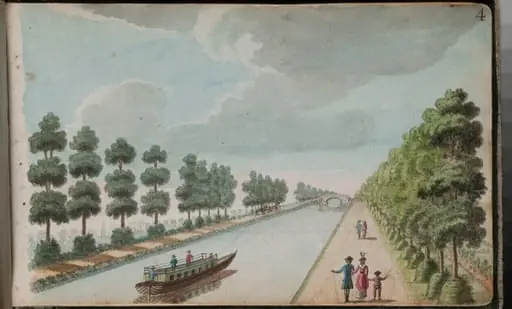 View of the Grand Canal, taken between the first bridge and the first lock looking towards Dublin
![Rathgar Castle, 1 1/2 miles from Dublin [...], by Gabriel, ca.1729-1817 Beranger](https://artifactworldgallery.com/img/gabriel-ca-1729-1817-beranger--rathgar-castle-1-1-2-miles-from-dublin--17cfe3f4e70405c2-w320.webp) Rathgar Castle, 1 1/2 miles from Dublin [...]
Rathgar Castle, 1 1/2 miles from Dublin [...]![Grange Castle, near Clondalken [Clondalkin], 6 miles from Dublin [...], by Gabriel, ca.1729-1817 Beranger](https://artifactworldgallery.com/img/gabriel-ca-1729-1817-beranger--grange-castle-near-clondalken-clondalkin-6-miles-from-dublin--29b767d07d01cfc8-w320.webp) Grange Castle, near Clondalken [Clondalkin], 6 miles from Dublin [...]
Grange Castle, near Clondalken [Clondalkin], 6 miles from Dublin [...]![View of Balymount [Ballymount] Castle, 3 miles from Dublin [...], by Gabriel, ca.1729-1817 Beranger](https://artifactworldgallery.com/img/gabriel-ca-1729-1817-beranger--view-of-balymount-ballymount-castle-3-miles-from-dublin--32c2f3cc4ed12e5f-w320.webp) View of Balymount [Ballymount] Castle, 3 miles from Dublin [...]
View of Balymount [Ballymount] Castle, 3 miles from Dublin [...]![A second view of Rathfarnham Castle, showing the front or entrance [...], by Gabriel, ca.1729-1817 Beranger](https://artifactworldgallery.com/img/gabriel-ca-1729-1817-beranger--a-second-view-of-rathfarnham-castle-showing-the-front-or-ent--3b1f8da88f33e09f-w320.webp) A second view of Rathfarnham Castle, showing the front or entrance [...]
A second view of Rathfarnham Castle, showing the front or entrance [...]![View of the Castle of Carrick, on the River Boyne, County of E[ast] Meath, 24 m[iles] fr[om] Dublin [...], by Gabriel, ca.1729-1817 Beranger](https://artifactworldgallery.com/img/gabriel-ca-1729-1817-beranger--view-of-the-castle-of-carrick-on-the-river-boyne-county-of-e--47a9c858b28e8890-w320.webp) View of the Castle of Carrick, on the River Boyne, County of E[ast] Meath, 24 m[iles] fr[om] Dublin [...]
View of the Castle of Carrick, on the River Boyne, County of E[ast] Meath, 24 m[iles] fr[om] Dublin [...]![Another view of Castleknock with an [sic] mutilated tower on a hill at some distance [...], by Gabriel, ca.1729-1817 Beranger](https://artifactworldgallery.com/img/gabriel-ca-1729-1817-beranger--another-view-of-castleknock-with-an-sic-mutilated-tower-on-a--4e08fdbddd5c4a48-w320.webp) Another view of Castleknock with an [sic] mutilated tower on a hill at some distance [...]
Another view of Castleknock with an [sic] mutilated tower on a hill at some distance [...]
![View of the Plunket's [sic] Castle, near St. Margaret's, 5 1/2 miles from Dublin [...], by Gabriel, ca.1729-1817 Beranger](https://artifactworldgallery.com/img/gabriel-ca-1729-1817-beranger--view-of-the-plunket-s-sic-castle-near-st-margaret-s-5-1-2-mi--aaf2a207a5920843-w320.webp) View of the Plunket's [sic] Castle, near St. Margaret's, 5 1/2 miles from Dublin [...]
View of the Plunket's [sic] Castle, near St. Margaret's, 5 1/2 miles from Dublin [...]![View of Monkstown Castle, 4 1/2 miles from Dublin [...], by Gabriel, ca.1729-1817 Beranger](https://artifactworldgallery.com/img/gabriel-ca-1729-1817-beranger--view-of-monkstown-castle-4-1-2-miles-from-dublin--9cf4cde63d5dec9c-w320.webp) View of Monkstown Castle, 4 1/2 miles from Dublin [...]
View of Monkstown Castle, 4 1/2 miles from Dublin [...]![View of Merion [Merrion] Castle, 2 miles from Dublin [...], by Gabriel, ca.1729-1817 Beranger](https://artifactworldgallery.com/img/gabriel-ca-1729-1817-beranger--view-of-merion-merrion-castle-2-miles-from-dublin--ff55e85c19078a20-w320.webp) View of Merion [Merrion] Castle, 2 miles from Dublin [...]
View of Merion [Merrion] Castle, 2 miles from Dublin [...]![View of two more of Dalkey's castles, the old church and church yard [...], by Gabriel, ca.1729-1817 Beranger](https://artifactworldgallery.com/img/gabriel-ca-1729-1817-beranger--view-of-two-more-of-dalkey-s-castles-the-old-church-and-chur--8acaea1fbac6279c-w320.webp) View of two more of Dalkey's castles, the old church and church yard [...]
View of two more of Dalkey's castles, the old church and church yard [...]![View of Cappoge Castle [...], by Gabriel, ca.1729-1817 Beranger](https://artifactworldgallery.com/img/gabriel-ca-1729-1817-beranger--view-of-cappoge-castle--885594fac18874cc-w320.webp) View of Cappoge Castle [...]
View of Cappoge Castle [...]![View of Baggoths rath [Baggot Rath], a castle half a mile from Dublin [...], by Gabriel, ca.1729-1817 Beranger](https://artifactworldgallery.com/img/gabriel-ca-1729-1817-beranger--view-of-baggoths-rath-baggot-rath-a-castle-half-a-mile-from--c625749ddb0ab425-w320.webp) View of Baggoths rath [Baggot Rath], a castle half a mile from Dublin [...]
View of Baggoths rath [Baggot Rath], a castle half a mile from Dublin [...]![View of the castle at Tallagh [Tallaght], 4 miles from Dublin [...], by Gabriel, ca.1729-1817 Beranger](https://artifactworldgallery.com/img/gabriel-ca-1729-1817-beranger--view-of-the-castle-at-tallagh-tallaght-4-miles-from-dublin--91b676c483b47739-w320.webp) View of the castle at Tallagh [Tallaght], 4 miles from Dublin [...]
View of the castle at Tallagh [Tallaght], 4 miles from Dublin [...]![View of Kilgoben [Kilgobbin] Castle, 5 miles from Dublin [...], by Gabriel, ca.1729-1817 Beranger](https://artifactworldgallery.com/img/gabriel-ca-1729-1817-beranger--view-of-kilgoben-kilgobbin-castle-5-miles-from-dublin--924293240c630cbc-w320.webp) View of Kilgoben [Kilgobbin] Castle, 5 miles from Dublin [...]
View of Kilgoben [Kilgobbin] Castle, 5 miles from Dublin [...]![View of another castle at Monkstown [...], by Gabriel, ca.1729-1817 Beranger](https://artifactworldgallery.com/img/gabriel-ca-1729-1817-beranger--view-of-another-castle-at-monkstown--aa06605166c02b4a-w320.webp) View of another castle at Monkstown [...]
View of another castle at Monkstown [...]