Artwork
View of the Castle of Carrick, on the River Boyne, County of E[ast] Meath, 24 m[iles] fr[om] Dublin [...]
![View of the Castle of Carrick, on the River Boyne, County of E[ast] Meath, 24 m[iles] fr[om] Dublin [...], by Gabriel, ca.1729-1817 Beranger, unspecified, 1790](https://artifactworldgallery.com/img/gabriel-ca-1729-1817-beranger--view-of-the-castle-of-carrick-on-the-river-boyne-county-of-e--47a9c858b28e8890-w1024.webp)
View of the Castle of Carrick, on the River Boyne, County of E[ast] Meath, 24 m[iles] fr[om] Dublin [...] is an unspecified work on paper by the Rococo painting artist Gabriel, ca.1729-1817 Beranger. It dates from 1790 and is held in the collection of the Royal Irish Academy.
About this work
They seem to be going about their daily lives, with women and children together, and a man and boy holding sticks or fishing rods.
This painting shows a castle on the River Boyne with people in the foreground.
The people are looking at something to the right of the castle. They seem to be going about their daily lives, with women and children together, and a man and boy holding sticks or fishing rods.
This scene is reminiscent of everyday life, and to learn more about the artist who created it, look up Beranger, Gabriel, ca.1729-1817.
Overview
The image depicts the ruined Carrick Castle, also known as Carrickdexter, situated on the River Boyne near Slane in County Meath, roughly twenty‑four miles north of Dublin. The composition places the decayed structure centrally, while a small group of figures occupies the foreground, creating a narrative of everyday activity against the historic backdrop.
Subject & Meaning
In the foreground, two women—one cradling an infant—and a man accompanied by a boy are shown holding sticks that may be fishing rods. Their gaze is directed toward a wall positioned to the right of the castle, suggesting a moment of pause or observation within a routine riverside setting.
Technique & Style
The work is executed in a detailed, topographical manner characteristic of late‑18th‑century Irish landscape drawing. Precise line work conveys the ruin’s architecture, while the figures are rendered with modest shading, emphasizing their modest scale relative to the surrounding scenery and reinforcing a documentary quality.
History & Provenance
The piece is attributed to Gabriel Beranger (c.1729‑1817), an Irish artist known for recording antiquities and rural scenes. Beranger’s surveys of Irish ruins were often compiled for antiquarian publications, and this view likely formed part of his systematic visual record of Meath’s historic sites.
Context
During the period of its creation, interest in Ireland’s medieval remnants was growing among scholars and the gentry, reflecting a broader Romantic fascination with ruins. The inclusion of ordinary figures underscores the coexistence of daily life with the lingering presence of past fortifications along the Boyne.
Artist & collection
Artist
Gabriel, ca.1729-1817 Beranger
Gabriel Beranger made watercolors of Dublin and its surroundings in the late 1700s.
![A view of the round tower of Michael of Pole in the city of Dublin [...], by Gabriel, ca.1729-1817 Beranger](https://artifactworldgallery.com/img/gabriel-ca-1729-1817-beranger--a-view-of-the-round-tower-of-michael-of-pole-in-the-city-of--066346c3e06cc1f8-w320.webp) A view of the round tower of Michael of Pole in the city of Dublin [...]
A view of the round tower of Michael of Pole in the city of Dublin [...]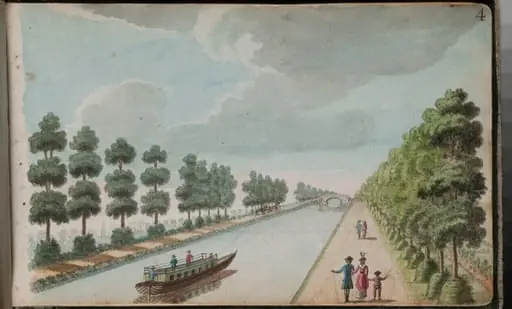 View of the Grand Canal, taken between the first bridge and the first lock looking towards Dublin
![View of the castle of Rabuck [Roebuck], 2 miles from Dublin [...], by Gabriel, ca.1729-1817 Beranger](https://artifactworldgallery.com/img/gabriel-ca-1729-1817-beranger--view-of-the-castle-of-rabuck-roebuck-2-miles-from-dublin--12853cdd66c2654f-w320.webp) View of the castle of Rabuck [Roebuck], 2 miles from Dublin [...]
View of the castle of Rabuck [Roebuck], 2 miles from Dublin [...]![Rathgar Castle, 1 1/2 miles from Dublin [...], by Gabriel, ca.1729-1817 Beranger](https://artifactworldgallery.com/img/gabriel-ca-1729-1817-beranger--rathgar-castle-1-1-2-miles-from-dublin--17cfe3f4e70405c2-w320.webp) Rathgar Castle, 1 1/2 miles from Dublin [...]
Rathgar Castle, 1 1/2 miles from Dublin [...]![Grange Castle, near Clondalken [Clondalkin], 6 miles from Dublin [...], by Gabriel, ca.1729-1817 Beranger](https://artifactworldgallery.com/img/gabriel-ca-1729-1817-beranger--grange-castle-near-clondalken-clondalkin-6-miles-from-dublin--29b767d07d01cfc8-w320.webp) Grange Castle, near Clondalken [Clondalkin], 6 miles from Dublin [...]
Grange Castle, near Clondalken [Clondalkin], 6 miles from Dublin [...]![View of Balymount [Ballymount] Castle, 3 miles from Dublin [...], by Gabriel, ca.1729-1817 Beranger](https://artifactworldgallery.com/img/gabriel-ca-1729-1817-beranger--view-of-balymount-ballymount-castle-3-miles-from-dublin--32c2f3cc4ed12e5f-w320.webp) View of Balymount [Ballymount] Castle, 3 miles from Dublin [...]
View of Balymount [Ballymount] Castle, 3 miles from Dublin [...]![A second view of Rathfarnham Castle, showing the front or entrance [...], by Gabriel, ca.1729-1817 Beranger](https://artifactworldgallery.com/img/gabriel-ca-1729-1817-beranger--a-second-view-of-rathfarnham-castle-showing-the-front-or-ent--3b1f8da88f33e09f-w320.webp) A second view of Rathfarnham Castle, showing the front or entrance [...]
A second view of Rathfarnham Castle, showing the front or entrance [...]![Another view of Castleknock with an [sic] mutilated tower on a hill at some distance [...], by Gabriel, ca.1729-1817 Beranger](https://artifactworldgallery.com/img/gabriel-ca-1729-1817-beranger--another-view-of-castleknock-with-an-sic-mutilated-tower-on-a--4e08fdbddd5c4a48-w320.webp) Another view of Castleknock with an [sic] mutilated tower on a hill at some distance [...]
Another view of Castleknock with an [sic] mutilated tower on a hill at some distance [...]
![View of Castle-knock, 3 miles from Dublin [...], by Gabriel, ca.1729-1817 Beranger](https://artifactworldgallery.com/img/gabriel-ca-1729-1817-beranger--view-of-castle-knock-3-miles-from-dublin--4e9a7099f4e41684-w320.webp) View of Castle-knock, 3 miles from Dublin [...]
View of Castle-knock, 3 miles from Dublin [...]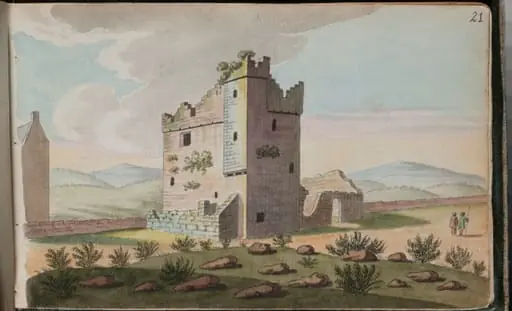 View of one of Dalkey's castles taken from the church yard on the opposite side
![View of two more of Dalkey's castles, the old church and church yard [...], by Gabriel, ca.1729-1817 Beranger](https://artifactworldgallery.com/img/gabriel-ca-1729-1817-beranger--view-of-two-more-of-dalkey-s-castles-the-old-church-and-chur--8acaea1fbac6279c-w320.webp) View of two more of Dalkey's castles, the old church and church yard [...]
View of two more of Dalkey's castles, the old church and church yard [...]![View of the Plunket's [sic] Castle, near St. Margaret's, 5 1/2 miles from Dublin [...], by Gabriel, ca.1729-1817 Beranger](https://artifactworldgallery.com/img/gabriel-ca-1729-1817-beranger--view-of-the-plunket-s-sic-castle-near-st-margaret-s-5-1-2-mi--aaf2a207a5920843-w320.webp) View of the Plunket's [sic] Castle, near St. Margaret's, 5 1/2 miles from Dublin [...]
View of the Plunket's [sic] Castle, near St. Margaret's, 5 1/2 miles from Dublin [...]![View of Cappoge Castle [...], by Gabriel, ca.1729-1817 Beranger](https://artifactworldgallery.com/img/gabriel-ca-1729-1817-beranger--view-of-cappoge-castle--885594fac18874cc-w320.webp) View of Cappoge Castle [...]
View of Cappoge Castle [...]![View of another castle at Monkstown [...], by Gabriel, ca.1729-1817 Beranger](https://artifactworldgallery.com/img/gabriel-ca-1729-1817-beranger--view-of-another-castle-at-monkstown--aa06605166c02b4a-w320.webp) View of another castle at Monkstown [...]
View of another castle at Monkstown [...]![View of Kilgoben [Kilgobbin] Castle, 5 miles from Dublin [...], by Gabriel, ca.1729-1817 Beranger](https://artifactworldgallery.com/img/gabriel-ca-1729-1817-beranger--view-of-kilgoben-kilgobbin-castle-5-miles-from-dublin--924293240c630cbc-w320.webp) View of Kilgoben [Kilgobbin] Castle, 5 miles from Dublin [...]
View of Kilgoben [Kilgobbin] Castle, 5 miles from Dublin [...]![View of the church and adjacent ruins at Dunshaghlin [Dunshaughlin], Co[unt]y of E[ast] Meath, 13 miles from Dublin [...], by Gabriel, ca.1729-1817 Beranger](https://artifactworldgallery.com/img/gabriel-ca-1729-1817-beranger--view-of-the-church-and-adjacent-ruins-at-dunshaghlin-dunshau--b4275bcb8c0ebd0f-w320.webp) View of the church and adjacent ruins at Dunshaghlin [Dunshaughlin], Co[unt]y of E[ast] Meath, 13 miles from Dublin [...]
View of the church and adjacent ruins at Dunshaghlin [Dunshaughlin], Co[unt]y of E[ast] Meath, 13 miles from Dublin [...]