Artwork
The Public in the Salon of the Louvre, Viewing the Painting of the "Sacre"
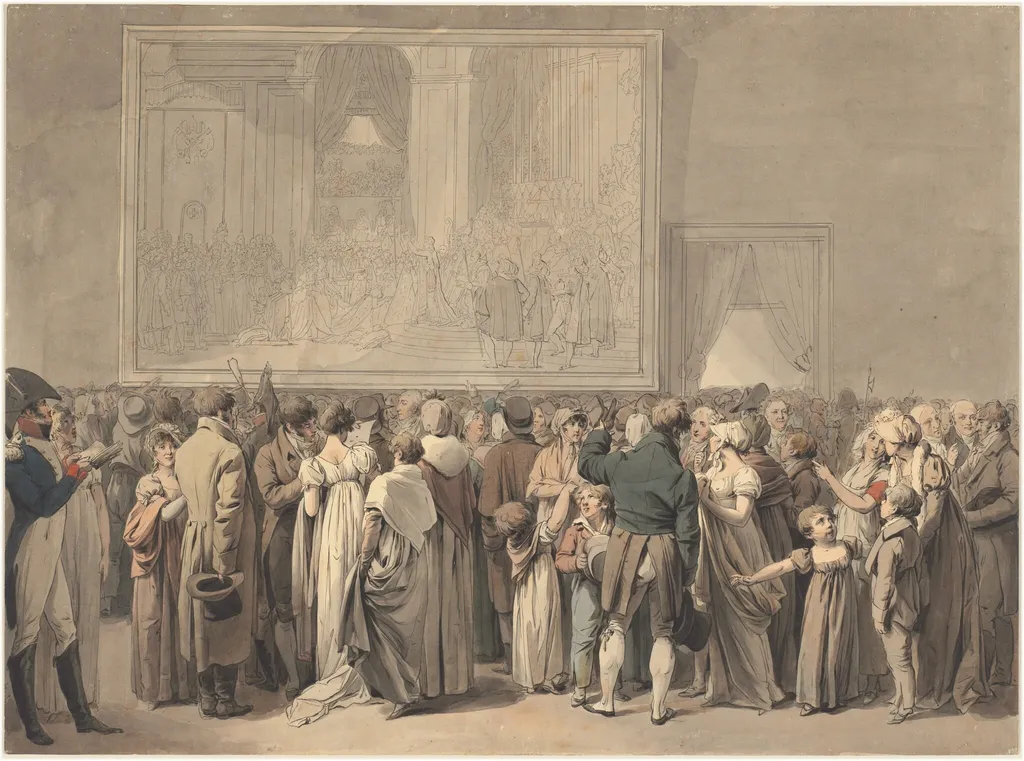
The Public in the Salon of the Louvre, Viewing the Painting of the "Sacre" is an ink drawing by the Romanticist artist Louis-Léopold Boilly. It dates from 1808 and is held in the collection of the National Gallery of Art.
About this work
Overview
Created in 1808, this drawing by Louis-Léopold Boilly captures a moment inside the Louvre’s Salon, where visitors gather to view Jacques-Louis David’s monumental painting The Coronation of Napoleon. Executed in pen, black ink, gray wash, and watercolor over graphite, the work records the public’s engagement with art in a newly accessible institutional space, transforming the act of viewing into a social spectacle.
Subject & Meaning
The crowd’s anonymity underscores the emerging role of the general public in the art world, rather than elite patrons.
The scene depicts a dense assembly of Parisians—men in coats and tricorne hats, women in high-waisted gowns, and children—lined up to observe David’s grand historical composition. Their attention is uniformly directed toward the wall-mounted painting, emphasizing the cultural authority of the artwork and the ritualized nature of public exhibition. The crowd’s anonymity underscores the emerging role of the general public in the art world, rather than elite patrons.
Technique & Style
Boilly employed layered watercolor glazes over ink outlines to suggest depth and texture in the crowd’s clothing and the architectural setting. Subtle gradations of gray wash model the figures’ forms, while delicate graphite traces guide composition. The dense, almost mosaic-like arrangement of bodies creates rhythmic visual movement, balancing individual detail with overall atmospheric density without resorting to caricature.
History & Provenance
The drawing was made shortly after David’s The Coronation of Napoleon was installed in the Louvre in 1808, where it became a major attraction. Boilly, known for documenting Parisian life, produced this as part of a series observing public behavior in cultural spaces. It likely served as a study for a later oil painting, preserving a transient moment in the institutionalization of art viewing in post-revolutionary France.
Context
In the early 19th century, the Louvre, formerly a royal palace, had become a public museum following the French Revolution. This shift allowed citizens from all classes to view art previously reserved for the monarchy. Boilly’s work reflects this democratization, portraying the crowd not as a mob but as a diverse, orderly assembly participating in a new civic ritual centered on national heritage.
Legacy
The drawing stands as an early anthropological record of museum-going culture. Boilly’s precise observation of social dynamics influenced later artists documenting public life, from Daumier to Degas. Its quiet realism—avoiding sentimentality or satire—offers a foundational view of how art became embedded in everyday urban experience, shaping modern conceptions of public galleries.
Artist & collection


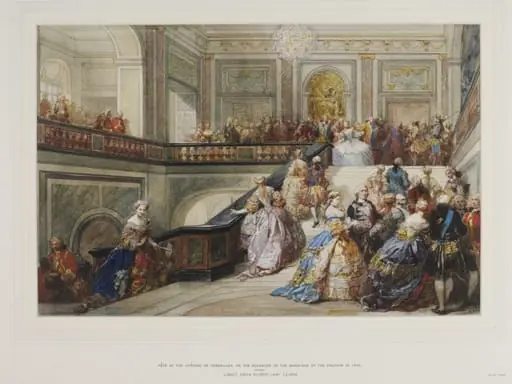 Fete at the Chateau de Versailles in 1745 on the occasion of the marriage of the Dauphin
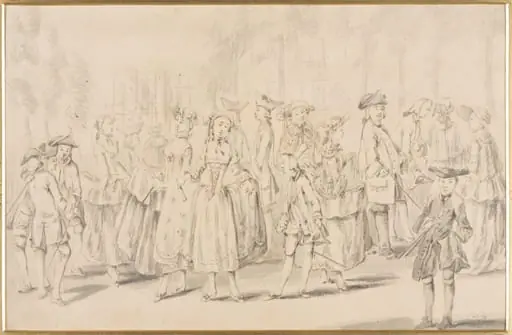 Promenaders in St. James' Park
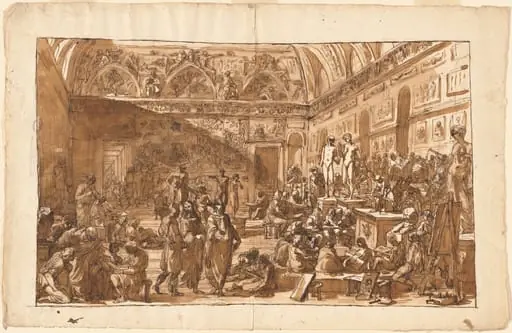 The School of Rome
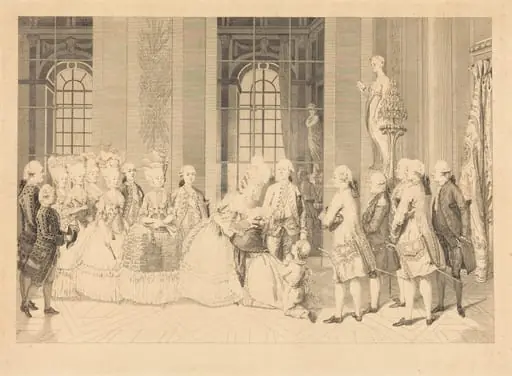 La Reine annonçant à Mme Bellegarde, des Juges, et la liberté de son mari en mai 1777
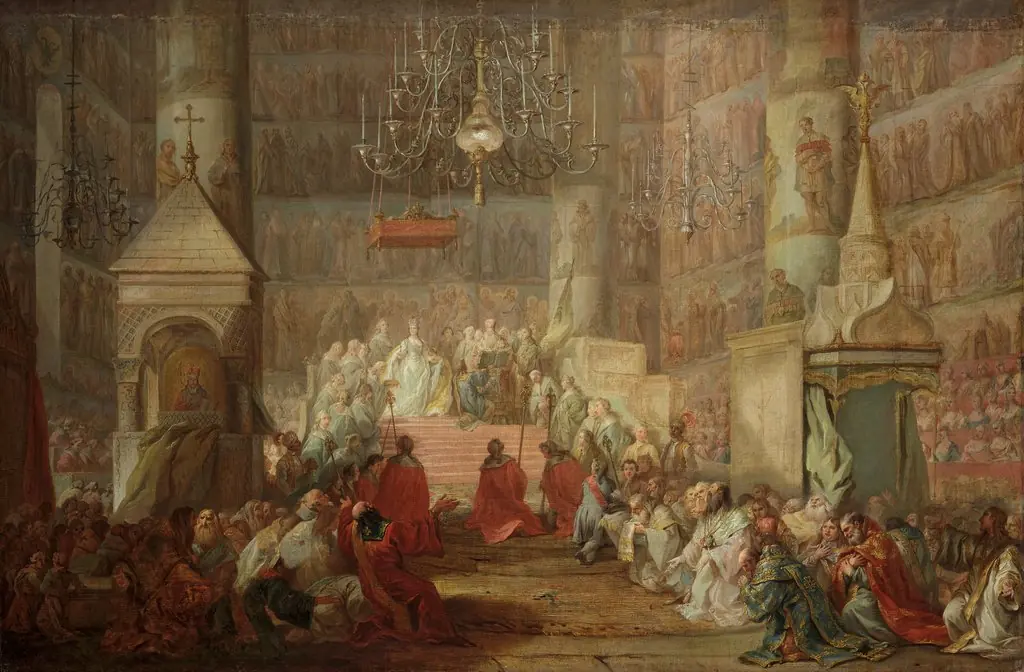 Coronation of Catherine II
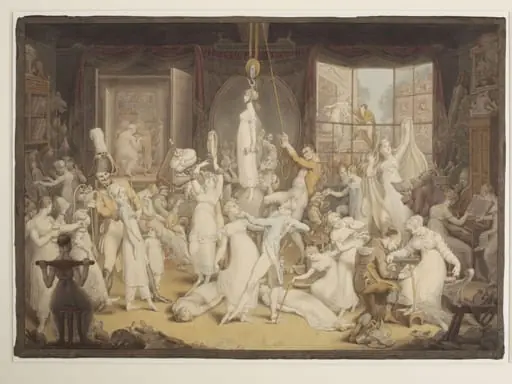 An elegant establishment for young ladies
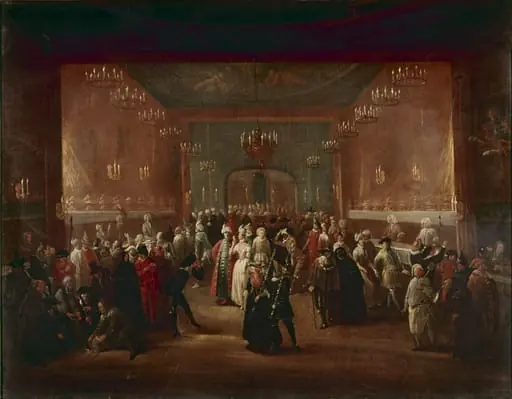 A Masquerade at the King's Theatre, Haymarket
 Theme from the Venetian Carnival – In the Parlatory of the Monastery
 A Christening in Revolutionary France
 Couronnement de Voltaire (The Crowning of Voltaire)
 The Royal Banquet
 La Noce au Chateau