Artwork
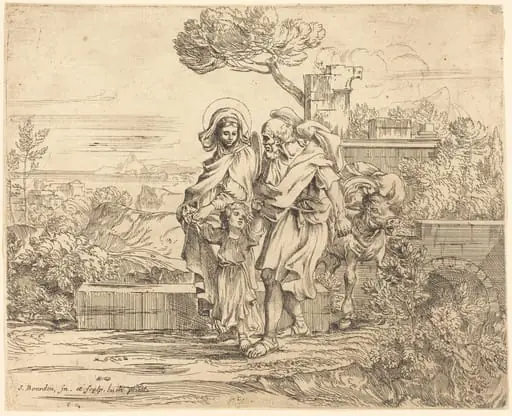
Rest on the Flight into Egypt
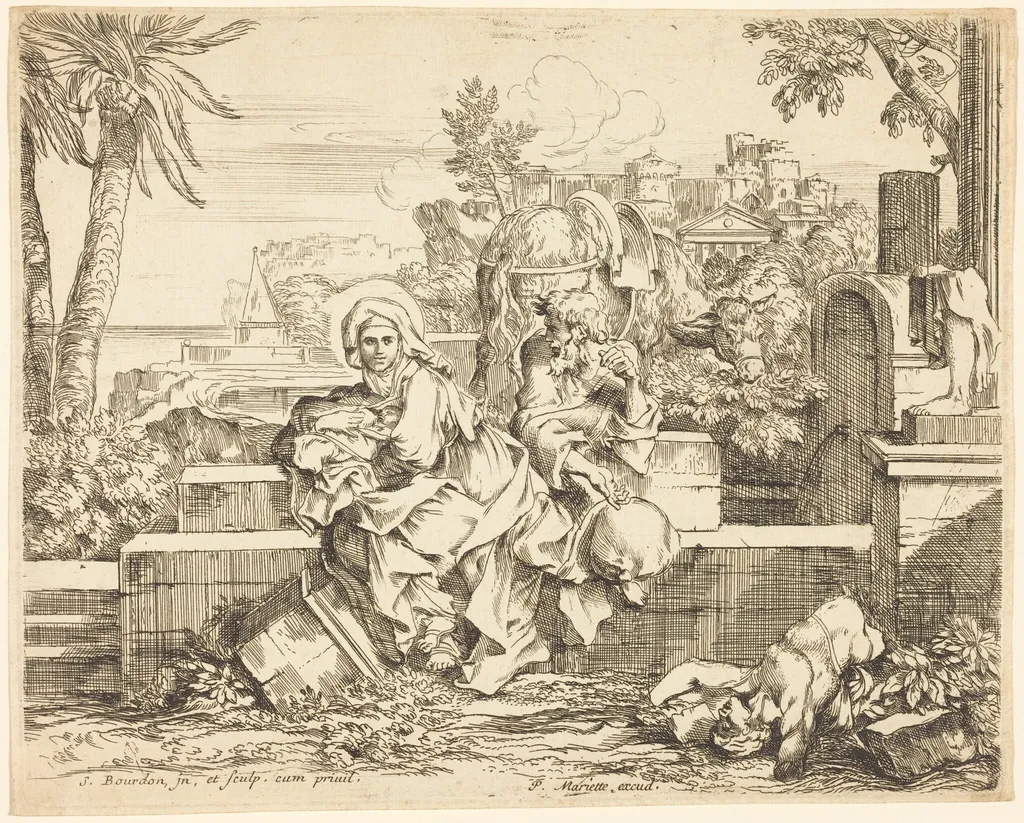
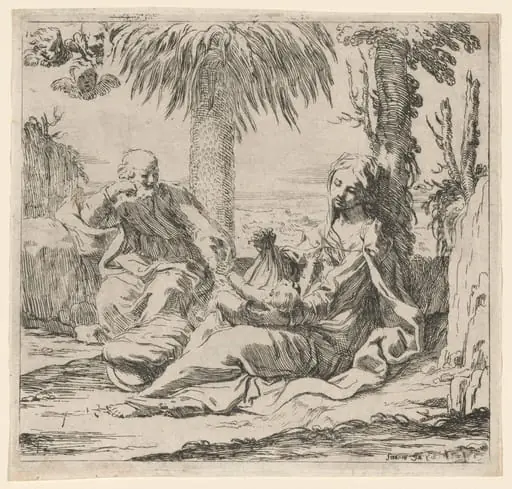
Rest on the Flight into Egypt is an ink print by the Baroque artist Sébastien Bourdon. It dates from 1650 and is held in the collection of the National Gallery of Art.
About this work
Overview
Executed on laid paper, the work captures a quiet moment from the biblical narrative of the Holy Family’s flight into Egypt.
Sébastien Bourdon, a French artist active in the mid-17th century, produced this etching around 1650 as part of his engagement with printmaking alongside his painting practice. Executed on laid paper, the work captures a quiet moment from the biblical narrative of the Holy Family’s flight into Egypt. Bourdon’s technical precision in etching allowed him to translate the emotional subtlety of the scene into fine, controlled lines, distinguishing it from his more dramatic painted compositions.
Subject & Meaning
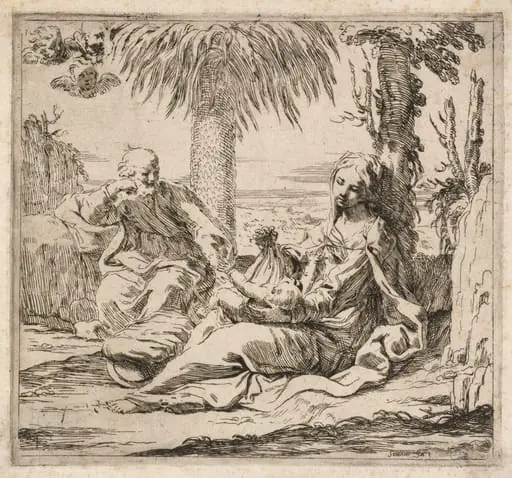
The scene illustrates the Holy Family’s temporary rest during their journey to escape Herod’s persecution. Mary, veiled and seated, cradles the infant Jesus, who lies on the ground nearby. Joseph, bearded and holding a water jug, watches over them. The stillness of the moment conveys protection and respite amid uncertainty. The inclusion of palm trees and distant architecture situates the event in a recognizable Near Eastern landscape, grounding the sacred in the tangible.
Technique & Style
Bourdon employed fine, layered etching lines to model form and suggest texture—fabric folds, foliage, and stone surfaces are rendered with delicate precision. Subtle tonal gradations, achieved through cross-hatching and controlled ink density, create a sense of atmospheric depth. The composition avoids theatricality, favoring quiet realism over Baroque drama, though the interplay of light and shadow still reflects the period’s sensitivity to chiaroscuro.
History & Provenance
The etching was likely produced during Bourdon’s time in Paris, following his return from Italy, when he was actively involved in printmaking circles. Few early impressions survive, and those that do are held in major European collections, including the Louvre and the British Museum. Its circulation among collectors and artists underscores its role as a study in compositional restraint and technical mastery within 17th-century French print culture.
Context
In mid-17th-century France, religious subjects remained central to artistic production, even in prints intended for private devotion or scholarly study. Bourdon’s approach diverged from the grandeur of Italian Baroque, instead embracing a more intimate, humanized vision. His etchings were valued for their clarity and emotional nuance, aligning with a growing interest in domestic spirituality among educated patrons.
Legacy
Though less celebrated than his paintings, Bourdon’s etchings influenced later French printmakers through their balance of technical discipline and emotional restraint. This particular work exemplifies how biblical narratives were reimagined for quiet contemplation rather than public spectacle. Its enduring presence in museum collections attests to its role as a refined example of Baroque printmaking outside the dominant Italian tradition.
Artist & collection
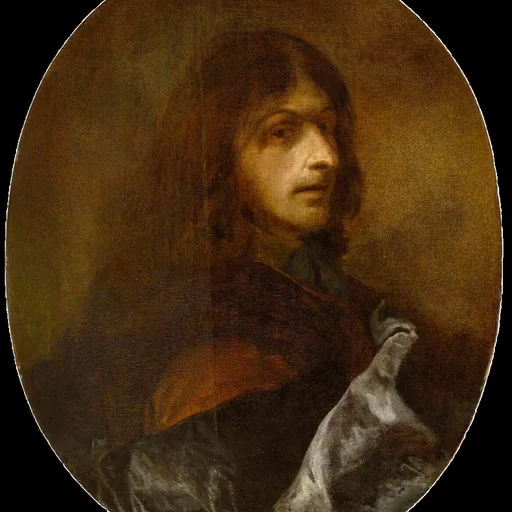
Artist
Sébastien Bourdon (French pronunciation: ; 2 February 1616 – 8 May 1671) was a French painter and engraver. His chef d'œuvre is The Crucifixion of St. Peter made for the cathedral of Notre Dame.

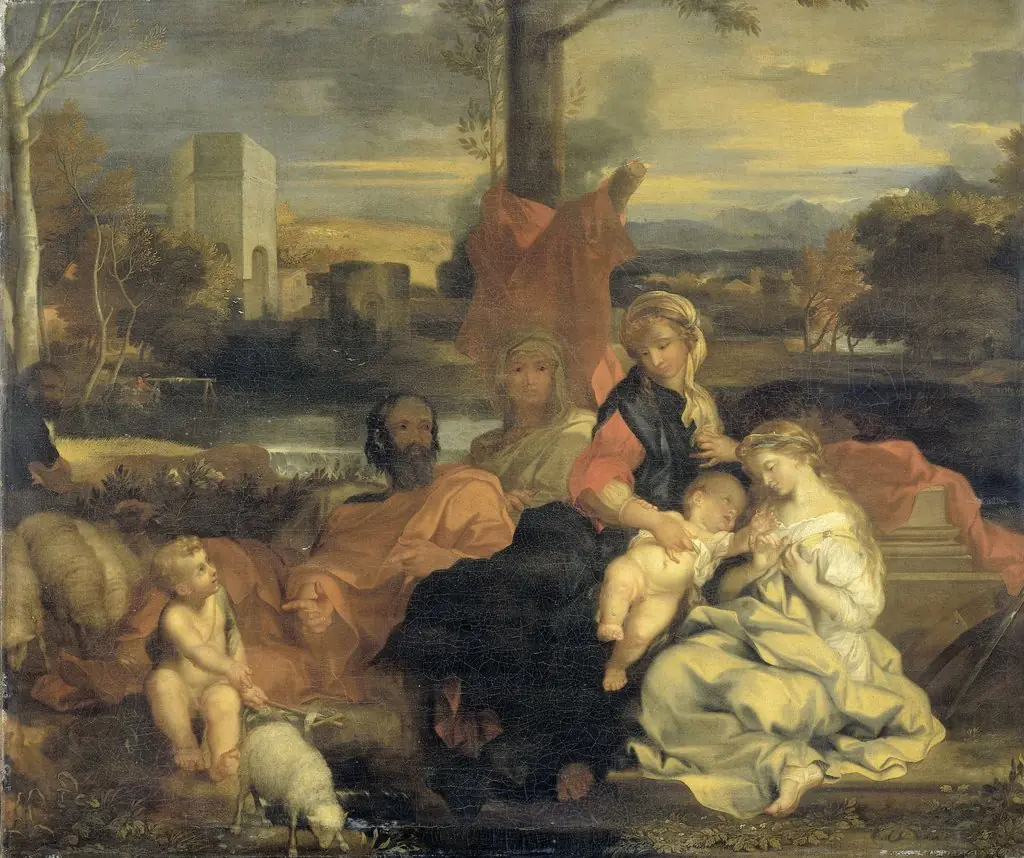
 Rest on the Flight into Egypt
 Rest on the Flight into Egypt
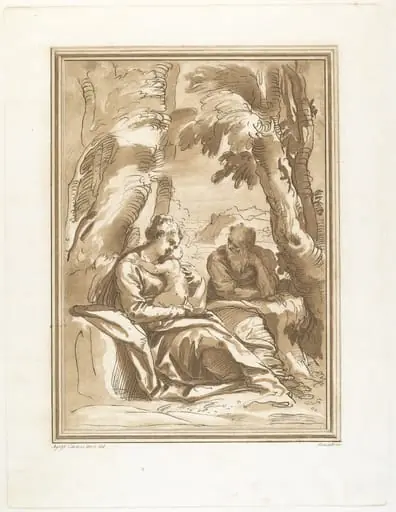 Rest on the Flight into Egypt
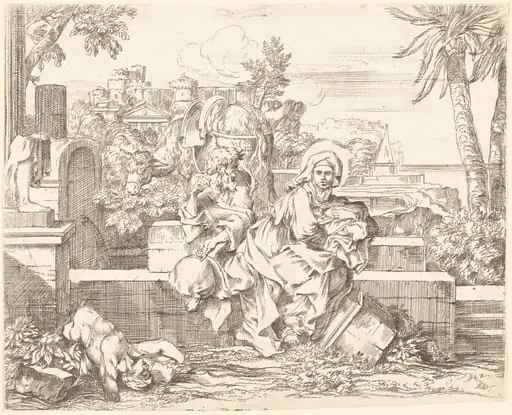 The Return from Egypt
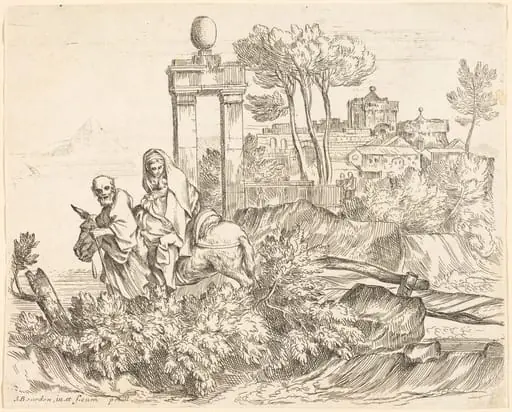 The Flight into Egypt
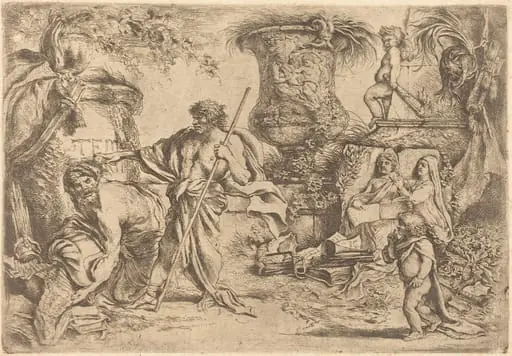 Temporalitas Aeternitas
 The Rest on the Flight into Egypt
![Historical Scene [recto], by Angelo Marullo](https://artifactworldgallery.com/img/angelo-marullo--historical-scene-recto--24e0b0a5c4f7634c-w320.webp) Historical Scene [recto]
Historical Scene [recto]![Temporalis Aeternitas [Second Version], by Giovanni Benedetto Castiglione](https://artifactworldgallery.com/img/giovanni-benedetto-castiglione--temporalis-aeternitas-second-version--d9ecb26010022a5a-w320.webp) Temporalis Aeternitas [Second Version]
Temporalis Aeternitas [Second Version] Jesus and the Samaritan
 Potare sitientes
 Holy Family Seated on an Arch