Artwork
Baudelaire
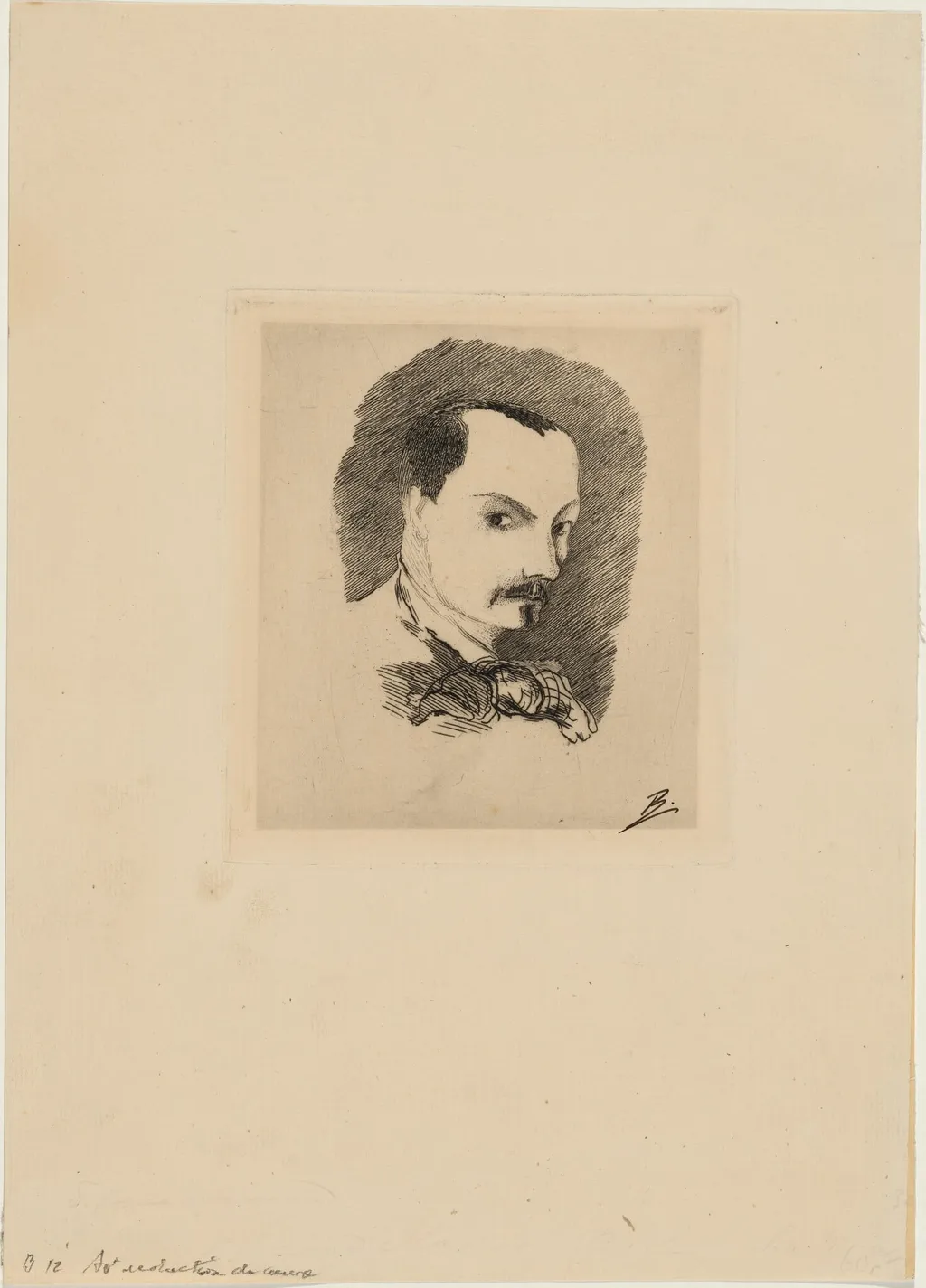
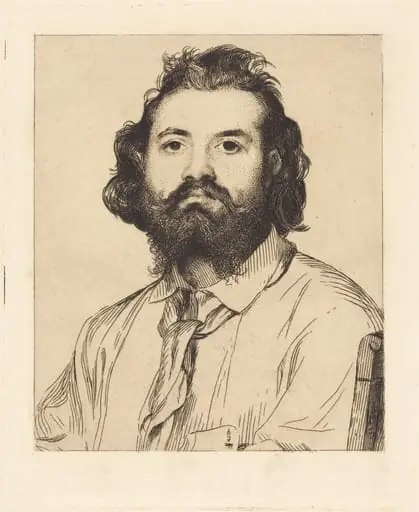
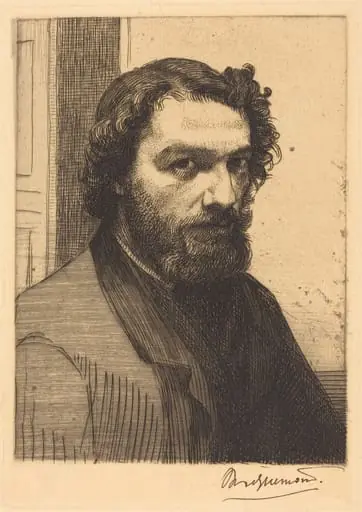
Baudelaire is an ink print by the Impressionist artist Félix Bracquemond. It dates from 1869 and is held in the collection of the National Gallery of Art.
About this work
Overview
Félix Henri Bracquemond created this etching of Charles Baudelaire in 1869, using the traditional technique of etching on laid paper.
Félix Henri Bracquemond created this etching of Charles Baudelaire in 1869, using the traditional technique of etching on laid paper. As a key figure in the 19th-century revival of printmaking, Bracquemond favored the medium for its capacity to capture subtle tonal variations and spontaneous line work. The portrait reflects his commitment to elevating printmaking as a serious artistic form, distinct from mere reproduction.
Subject & Meaning
The subject is Charles Baudelaire, the influential French poet known for his introspective and often controversial verse. Bracquemond depicts him with a focused gaze to the right, a scarf loosely wrapped around his neck, and dark, neatly trimmed facial hair. The portrait conveys a quiet intensity, aligning with Baudelaire’s literary persona—thoughtful, reserved, and emotionally complex—without overt symbolism or narrative.
Technique & Style
Bracquemond employed fine, incised lines and varied hatching to model the face and scarf, exploiting the grain of the laid paper to enhance texture. The etching’s sketch-like quality arises from deliberate looseness in the line work, avoiding heavy detail in favor of suggestive form. The medium’s inherent delicacy lends the image a sense of immediacy, as if the likeness were captured in a single, thoughtful moment.
History & Provenance
Created in 1869, the etching entered the collection of the National Gallery of Art in Washington, D.C., where it remains part of its prints and drawings holdings. While little is documented about its early ownership, its inclusion in a major American institution underscores its recognition within the broader context of French graphic art from the period.
Context
Bracquemond was part of a circle of artists—including Manet and Degas—who championed etching as a vehicle for personal expression during a time when academic painting dominated. His portrait of Baudelaire reflects a broader cultural interest in capturing the likenesses of literary figures, merging the worlds of poetry and visual art in a quiet, intimate format suited to private contemplation.
Legacy
Though less widely known than his contemporaries, Bracquemond’s work helped redefine etching as a legitimate artistic medium rather than a reproductive tool. This portrait of Baudelaire exemplifies his influence: its restrained elegance and technical precision contributed to a renewed appreciation for printmaking in France and beyond, inspiring later generations of printmakers.
Artist & collection

Artist
Félix Henri Bracquemond (French pronunciation: ; 22 May 1833 – 29 October 1914) was a French painter, etcher, and printmaker.

![GW. [Sir John Gardner Wilkinson], by Godfrey Thomas Vigne](https://artifactworldgallery.com/img/godfrey-thomas-vigne--gw-sir-john-gardner-wilkinson--64a60946dbe35509-w320.webp)
![Self-Portrait [recto], by Paul Cezanne](https://artifactworldgallery.com/img/paul-cezanne--self-portrait-recto--d76a05e14030ebd2-w320.webp)