Artwork
Independența
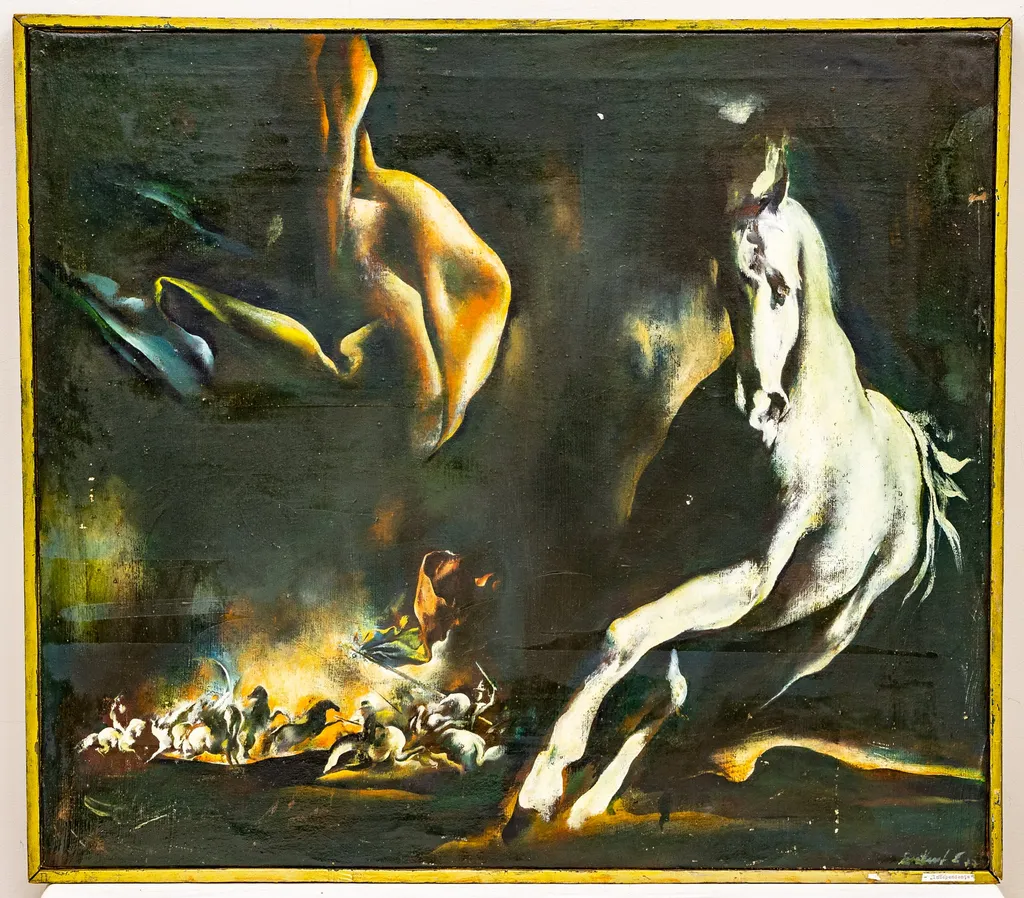
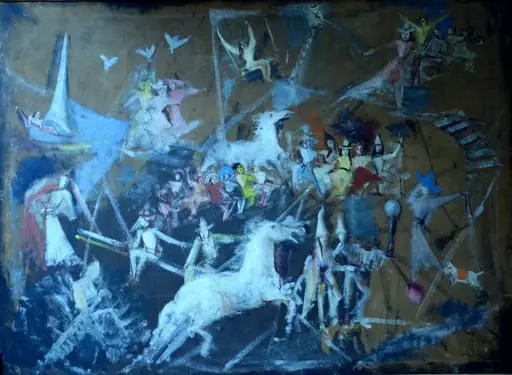
Independența is an unspecified painting by Eugen Bratfanof. It is held in the collection of the Gavrila Simion Eco-Museum Research Institute Tulcea. A single white horse dominates the composition, rearing violently against a dark, smoky backdrop.
About this work
Overview
A single white horse dominates the composition, rearing violently against a dark, smoky backdrop.
A single white horse dominates the composition, rearing violently against a dark, smoky backdrop. Its muscular form is rendered with thick, textured brushwork, emphasizing tension and motion. Below, blurred dogs scatter in panic, their forms suggesting sudden disruption. The stark contrast between the luminous horse and the deep shadows creates a sense of isolated drama, drawing attention to the animal’s presence without narrative context.
Subject & Meaning
The riderless horse suggests absence or loss, evoking themes of autonomy, unrest, or transition. Its wild mane and tensed muscles convey raw energy, while the fleeing dogs imply disturbance in a quiet space. No human figures are present, leaving interpretation open: the scene may symbolize freedom, abandonment, or the force of nature unchained by human control.
Technique & Style
Thick, expressive brushstrokes define the horse’s form, creating a tactile sense of muscle and motion. The background employs dark, layered tones with a faint, diffuse glow near the earth, enhancing depth. Chiaroscuro is used to isolate the horse in light, heightening its emotional weight. The blurred dogs contrast with the horse’s sharp definition, reinforcing movement and chaos.
History & Provenance
The work is titled Independența, suggesting a connection to themes of independence, possibly tied to Romanian national identity. Its origin and artist remain unconfirmed in available records. The painting’s date and exhibition history are undocumented, limiting contextual placement within a specific artistic movement or period.
Context
The imagery aligns with 19th-century Romantic tendencies that favored emotional intensity and symbolic animals. Riderless horses appear in European art as metaphors for lost leadership or untamed spirit. The absence of human figures and the dramatic lighting reflect influences from both Romanticism and early modernist experimentation with mood over narrative.
Legacy
The painting’s minimalism and emotional resonance have made it a subject of quiet study among viewers drawn to symbolic abstraction. While not widely reproduced or critically analyzed, its stark composition continues to evoke contemplation on themes of solitude and natural force, leaving space for personal interpretation.
Artist & collection
Artist
Eugen Bratfanof created sculptures like Pescari, drawings such as Păpușarii, and prints including Io, Mircea voievod and Mihai Viteazul.
Museum
Gavrila Simion Eco-Museum Research Institute Tulcea
Continue through works from the same source collection.
 Frenzy, sketch
 Circul
 Păsări moarte cu cocoș de munte; pandant; Păsări și iepure mort
 Untitled
 The Triumph of Painting
 Der Wagen des Triumphators
 Vânătoare de căprioare
 Visions of the Hereafter: Fall of the Damned into Hell
 La Chute de Phaëton
 Horsemen
 Theodore Meets in the Wood the Spectre of His Ancestor Guido Cavalcanti
 Femeie cu pasăre