Artwork
Mars
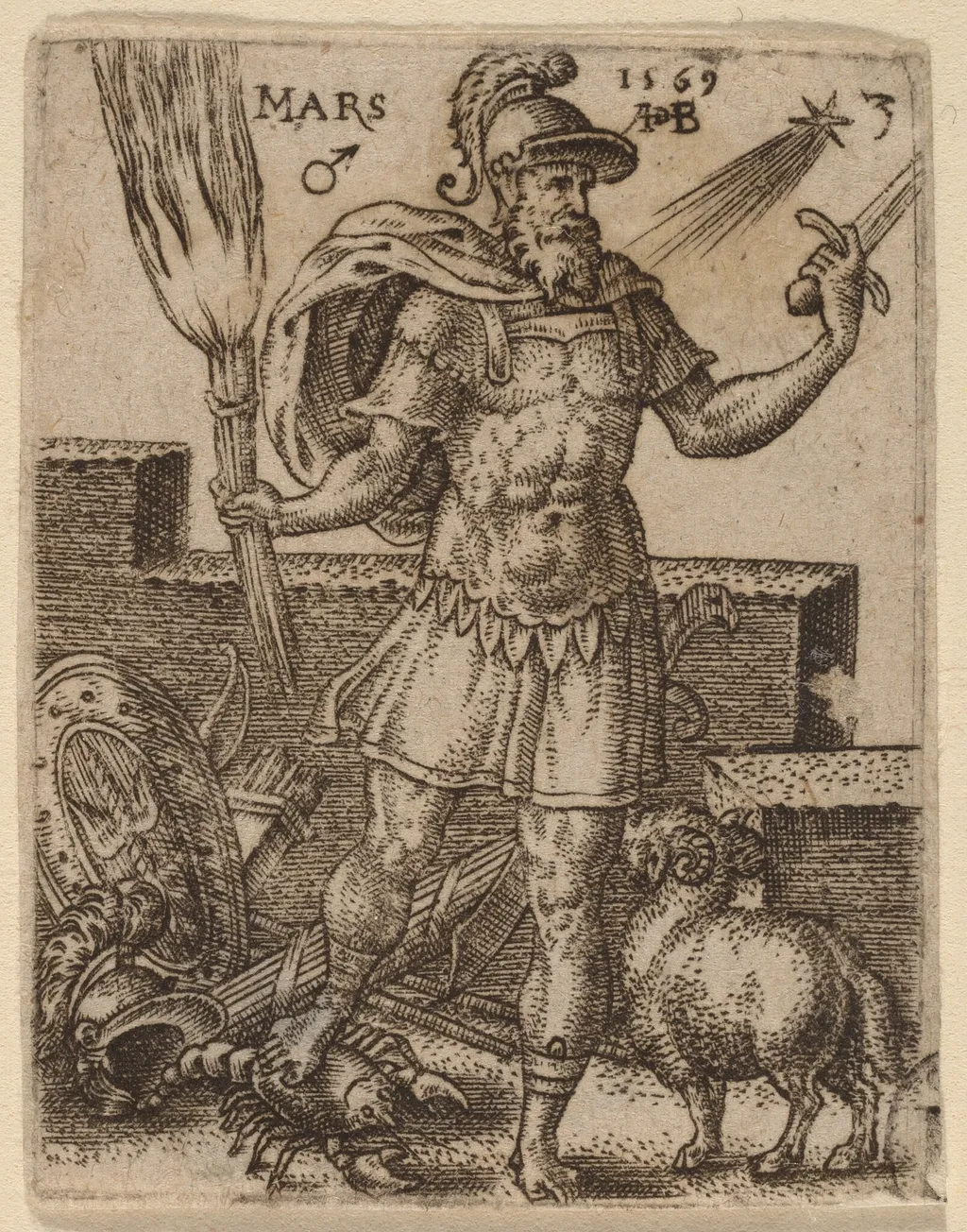
Mars is an ink print by the Renaissance artist Abraham de Bruyn. It dates from 1569 and is held in the collection of the National Gallery of Art.
About this work
Behind him, a small figure lies on the ground, and a building with columns is visible.
This print shows a bearded man in armor holding a spear and a bundle of arrows. He wears a helmet with a plume and stands next to a ram’s head. Behind him, a small figure lies on the ground, and a building with columns is visible.
The word "MARS" is written at the top, and the year "1569" is stamped in the corner. This suggests the man is the Roman god of war.
Look up etching to see how artists like Bruyn made prints like this.
Overview
Mars is a 1569 print by Abraham de Bruyn, executed in etching and engraving on laid paper. The work depicts a central armored figure, identified as the Roman god of war, within a detailed composition.
Subject & Meaning
The print portrays Mars, recognizable by the inscription 'MARS' at the top. The god is shown bearded, in armor, with a spear and arrows, alongside symbols of conflict (a ram’s head) and a subdued figure, conveying themes of warfare and power.
Technique & Style
Created using etching and engraving techniques, the print showcases de Bruyn’s mastery of line work and detail. The interplay of etched and engraved elements contributes to the piece’s texture and visual depth.
History & Provenance
Dated to 1569, the print bears the year in its corner. While specific provenance details are not provided, the work is characteristic of 16th-century European printmaking, reflecting the era’s interest in classical themes.
Context
Mars reflects the Renaissance fascination with classical Roman deities. De Bruyn’s depiction aligns with contemporary artistic trends of reviving and interpreting ancient subjects for a European audience.
Artist & collection