Artwork
Mercury
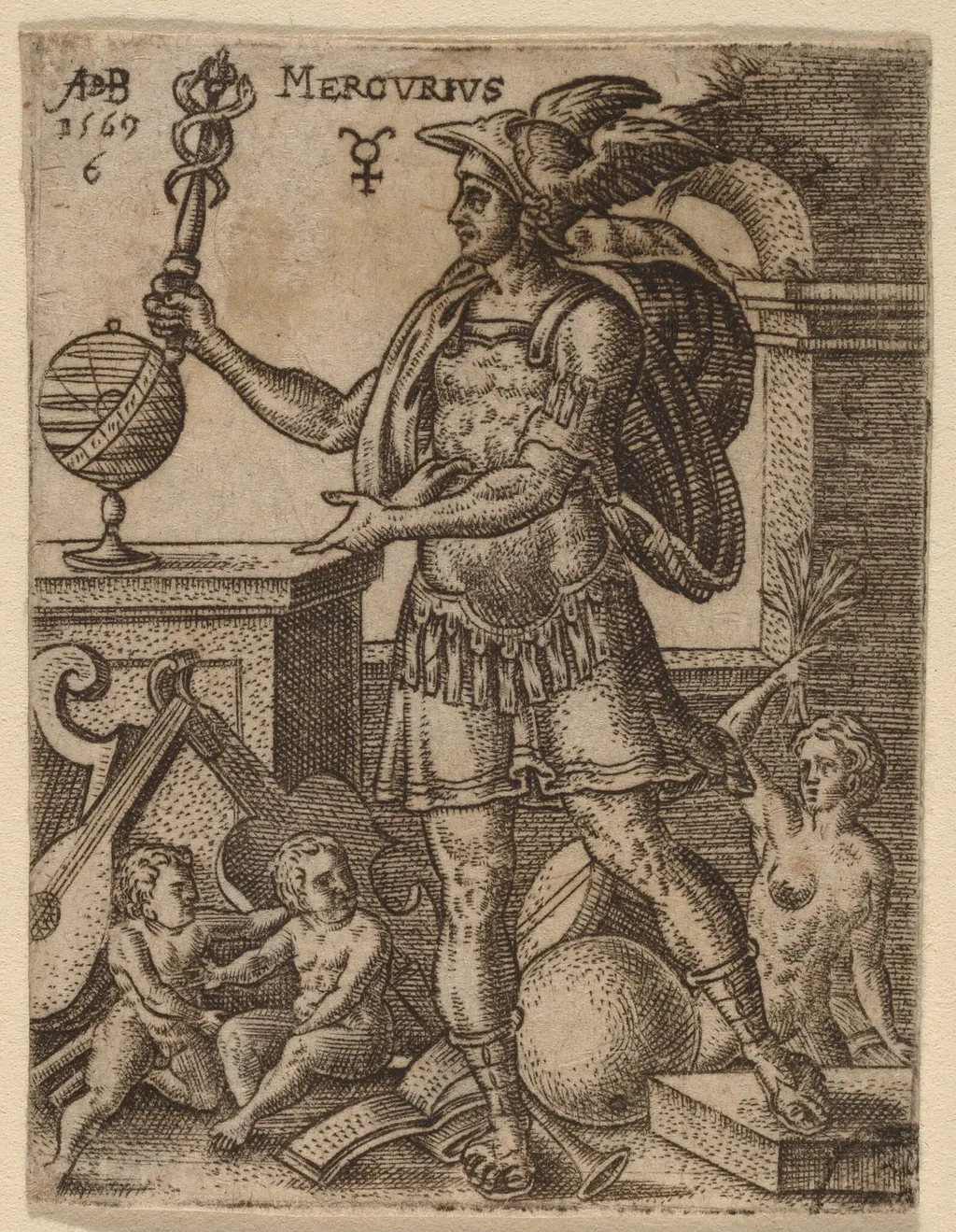
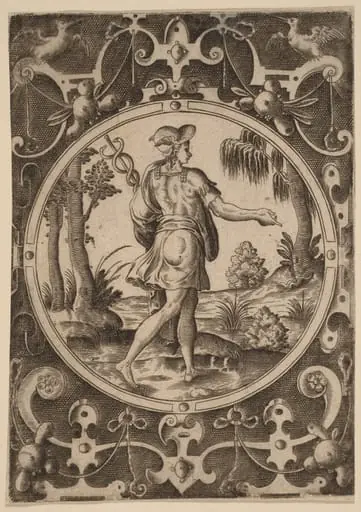
Mercury is an ink print by the Renaissance artist Abraham de Bruyn. It dates from 1569 and is held in the collection of the National Gallery of Art.
About this work
Overview
Abraham de Bruyn’s 1569 print, titled *Mercury*, is an etching and engraving executed on laid paper. The composition centers on a winged male figure, rendered in the attire of a Roman legionary, clutching a staff entwined with two serpents and a small globe. Beneath him lie a infant, a toddler, and a reclined woman, while a building and a palm tree occupy the background.
Subject & Meaning
The central figure represents the Roman deity Mercury, traditionally associated with communication, commerce, and travel.
The central figure represents the Roman deity Mercury, traditionally associated with communication, commerce, and travel. The caduceus—a staff topped with intertwined snakes—along with the globe and winged helmet, serve as conventional attributes that underscore his role as a swift messenger and patron of knowledge and trade. The surrounding figures may allude to humanity’s dependence on his guidance.
Technique & Style
De Bruyn combined intaglio processes, employing both etching and engraving to achieve varied line qualities. The fine, cross‑hatched engraving imparts texture to the drapery and background architecture, while broader etched strokes define the figure’s musculature and the winged elements. The use of laid paper adds a subtle ribbed texture that interacts with the ink, enhancing the print’s tonal depth.
History & Provenance
Created in the late Renaissance, the print reflects the Northern European fascination with classical mythology during the mid‑16th century. While specific ownership records are scarce, de Bruyn’s works were widely circulated among collectors of the period, and *Mercury* likely entered private collections before being acquired by institutions specializing in early prints.
Context
The image aligns with a broader trend of humanist artists reinterpreting ancient deities through contemporary visual language. De Bruyn’s depiction merges classical iconography with the detailed, almost documentary style characteristic of Netherlandish printmakers, illustrating both scholarly interest in antiquity and the technical advancements in print media of his era.
Artist & collection