Artwork
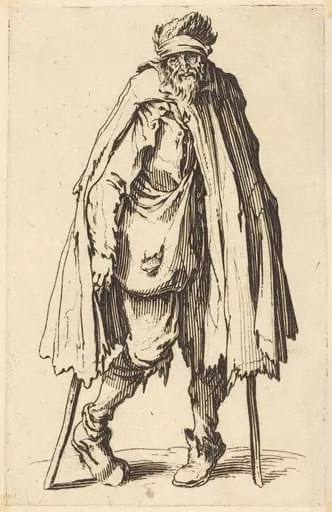
Old Beggar with One Crutch
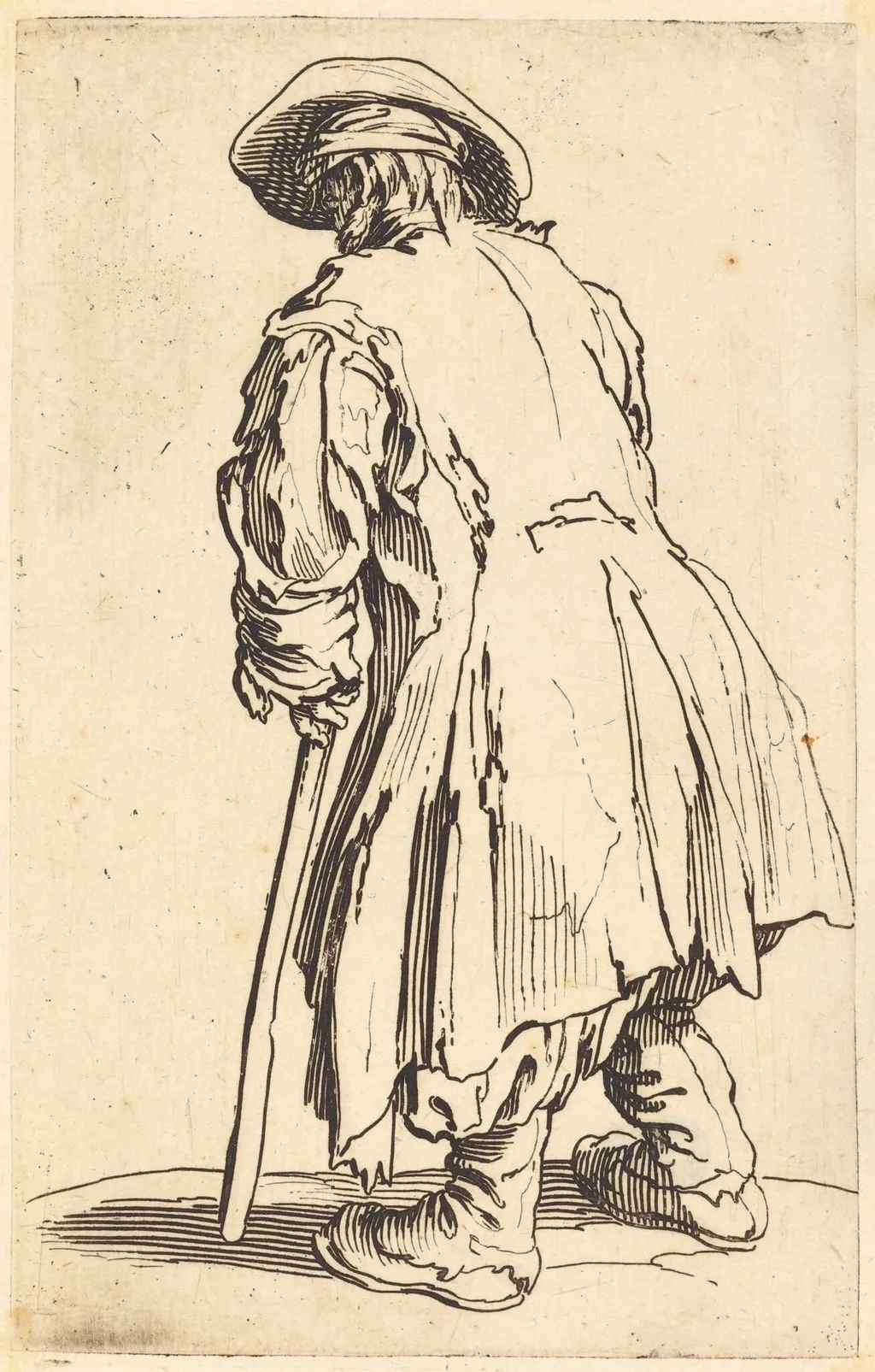
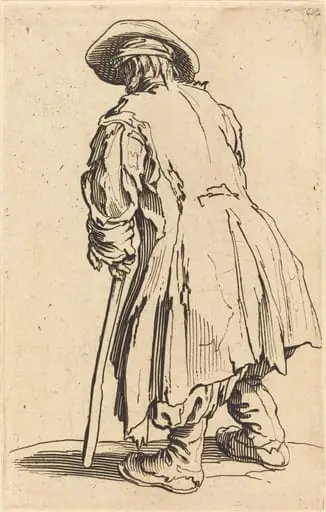
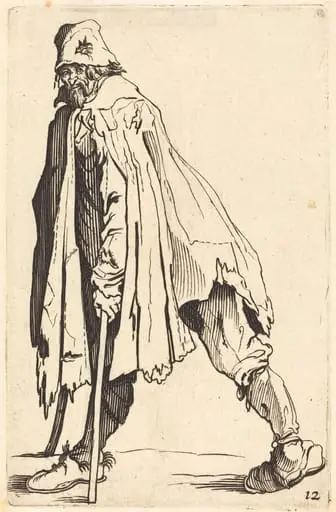
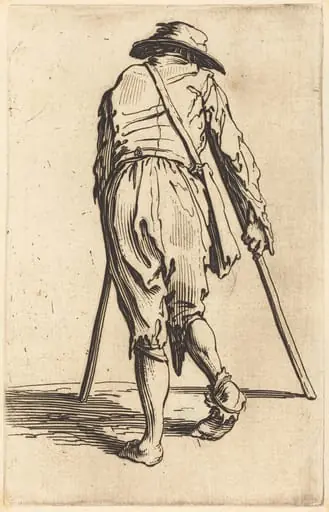
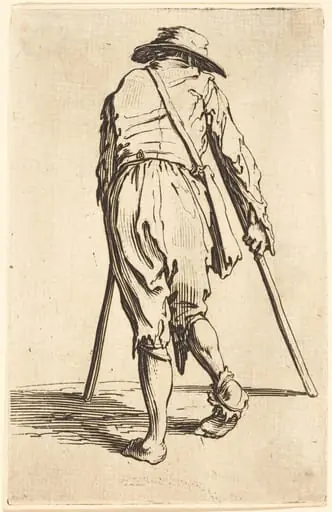
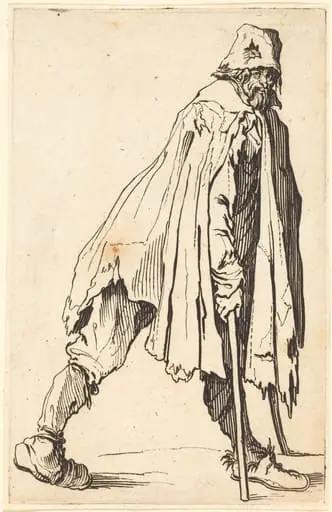
Old Beggar with One Crutch is an ink print by the Baroque artist Jacques Callot. It dates from 1622 and is held in the collection of the National Gallery of Art.
About this work
Overview
As part of a broader series documenting marginalized figures, the work exemplifies Callot’s interest in the everyday lives of the poor.
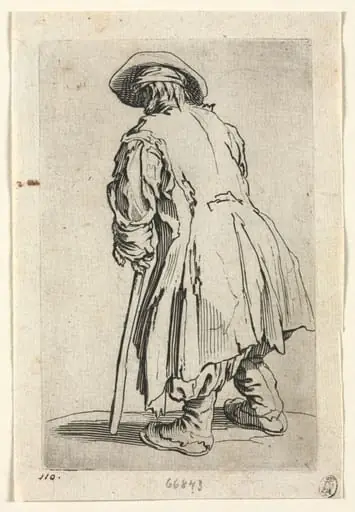
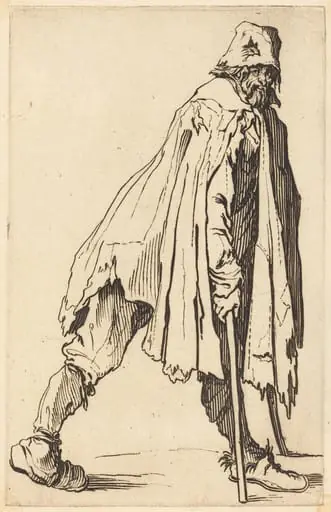
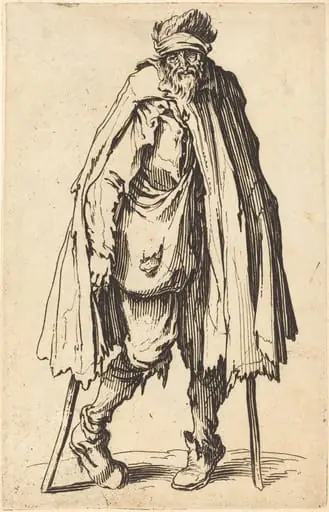
Created around 1622 by Jacques Callot, this etching on laid paper captures a solitary beggar leaning on a single crutch. As part of a broader series documenting marginalized figures, the work exemplifies Callot’s interest in the everyday lives of the poor. His technical mastery of etching allowed for fine, expressive lines that convey both physical strain and social isolation, distinguishing his prints within early 17th-century Northern European printmaking.
Subject & Meaning
The figure is depicted in a moment of physical exertion, bending to retrieve something from the ground, his posture suggesting exhaustion and vulnerability. His tattered clothing and wide-brimmed hat signal poverty, while the lone crutch emphasizes his dependence and isolation. The scene avoids sentimentality, presenting the beggar not as a symbol but as a person caught in the quiet struggle of survival, reflecting Callot’s observational approach to social realism.
Technique & Style
Callot employed etching to achieve sharp, irregular lines that mimic the urgency of a quick sketch. The ink rests in the grooves of a metal plate, producing dense contrasts against the pale paper. His use of uneven, scratchy strokes enhances the texture of worn fabric and rough terrain, lending the image a tactile immediacy. This method allowed for nuanced detail without the polish of engraving, aligning with his interest in raw, unidealized representation.
History & Provenance
The print emerged during Callot’s most prolific period in Nancy, where he produced over 1,400 etchings. While the specific provenance of this individual impression is undocumented, it belongs to a well-known group of works focused on beggars and outcasts, circulated among collectors and artists in Lorraine and beyond. These prints were not mass-produced but were valued for their intimate scale and social observation.
Context
In early 17th-century Europe, war and economic instability left many destitute, and artists increasingly turned to such subjects. Callot’s etchings responded to this reality, documenting figures often ignored in grand historical or religious art. His focus on beggars, soldiers, and clowns reflected a growing interest in the lives of common people, positioning printmaking as a medium for social commentary rather than mere decoration.
Legacy
Callot’s detailed, emotionally resonant depictions of the poor influenced later generations of printmakers, including Rembrandt and Goya. His technical innovations in etching—particularly his use of multiple biting stages to achieve tonal variation—expanded the expressive potential of the medium. This work, though modest in scale, contributed to the elevation of printmaking as a serious artistic form capable of conveying human dignity amid hardship.
Own this work as a print
Artist & collection
Artist
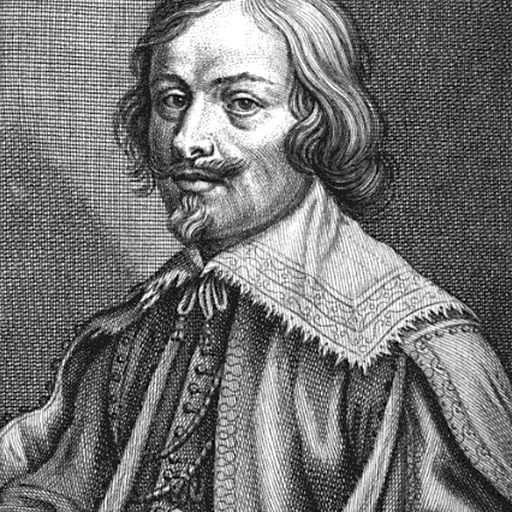
Jacques Callot was a baroque printmaker and draftsman from the Duchy of Lorraine.

 Holy Family at supper
 Restoration of the Aqueduct at Pisa
 Restoration of the Aqueduct at Pisa
 Square in Paris with Many Figures
 Square in Paris with Many Figures
 Horsemen Attacked by Robbers
 HOW WILL A COVERED PART BE CORRECTED?HOW WIKA A COVERED HEART DEED CORRECTED?
![Christ Walking on the Water [second plate], by Jacques Callot](https://artifactworldgallery.com/img/jacques-callot--christ-walking-on-the-water-second-plate--2069f3bfe4cb2126-w320.webp) Christ Walking on the Water [second plate]
Christ Walking on the Water [second plate]