Artwork
The Little Farm
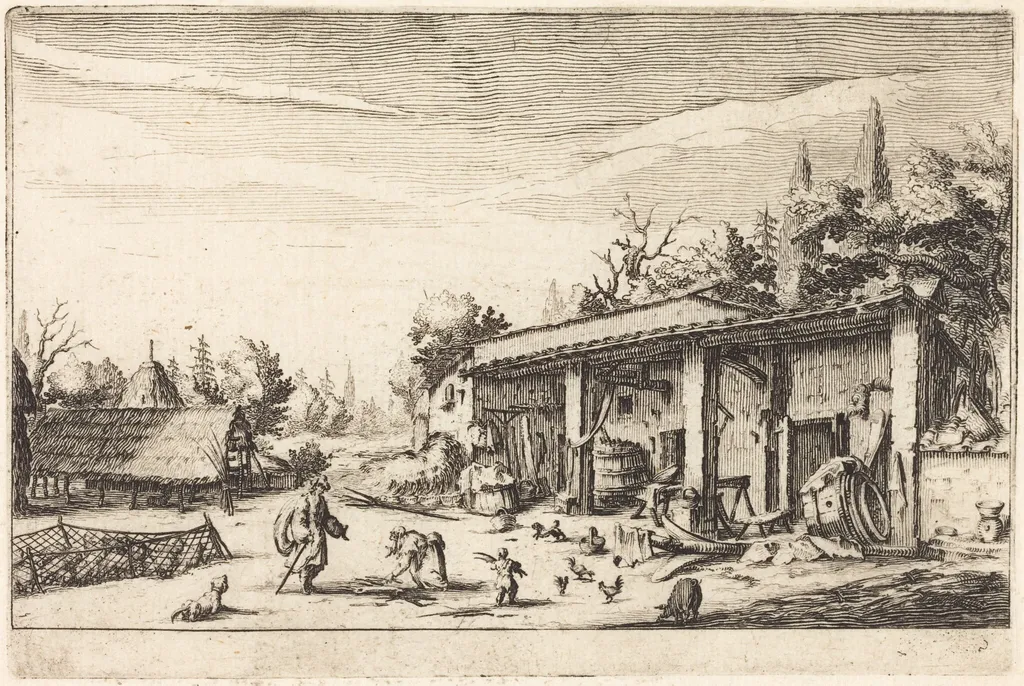
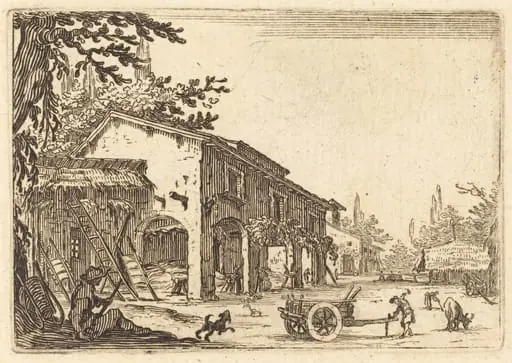
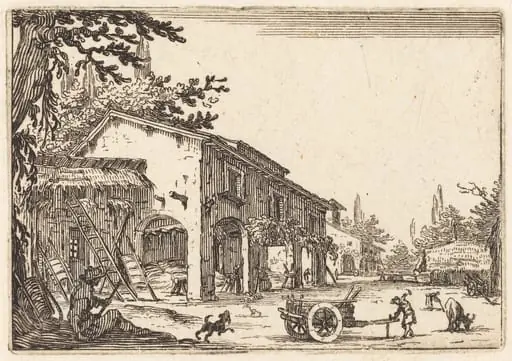
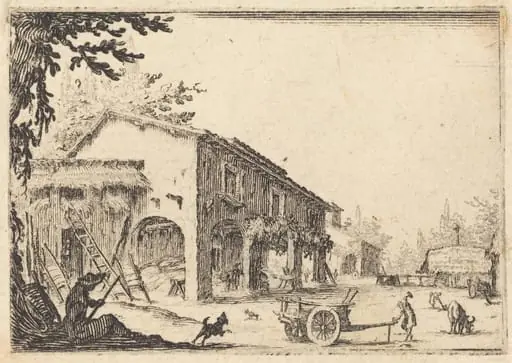
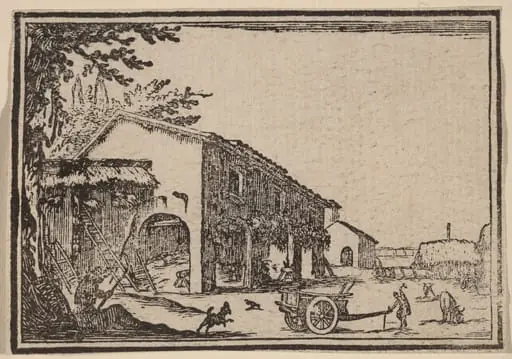
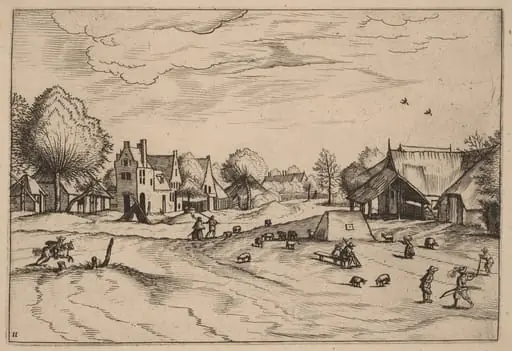
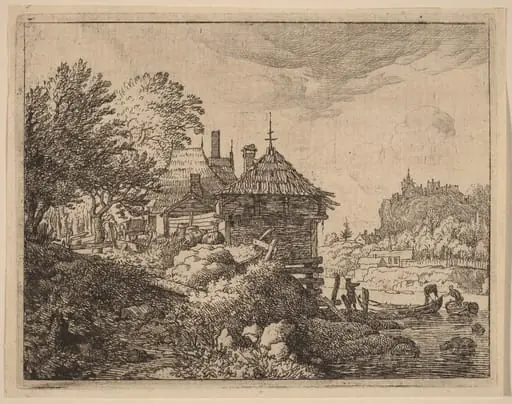
The Little Farm is an ink print by the Baroque artist Jacques Callot. It dates from 1617 and is held in the collection of the National Gallery of Art.
About this work
Overview
As one of over 1,400 prints he produced, this work exemplifies his focus on quiet, everyday moments rather than grand historical or mythological themes.
Created around 1617, *The Little Farm* is an etching on laid paper by Jacques Callot, a prolific draftsman from the Duchy of Lorraine. As one of over 1,400 prints he produced, this work exemplifies his focus on quiet, everyday moments rather than grand historical or mythological themes. The composition captures a rural scene with precision, reflecting Callot’s technical mastery and his interest in documenting ordinary life during the early Baroque period.
Subject & Meaning
The scene portrays a modest farmstead with two buildings flanking a dirt path, inhabited by a man carrying firewood, a woman with a basket, and a cluster of poultry. No dramatic event unfolds; instead, the image conveys the rhythm of daily labor and domestic routine. The absence of idealization suggests an observational approach, valuing the dignity of rural existence without sentimentality or narrative climax.
Technique & Style
Callot employed fine, controlled lines to render textures—rough thatch, feathered birds, gnarled branches—with remarkable clarity. His use of cross-hatching and varying line weight creates subtle gradations of light and shadow, enhancing spatial depth. The etching’s meticulous detail and atmospheric sky reflect Baroque tendencies toward realism, though without theatricality, favoring quiet observation over dramatic effect.
History & Provenance
The print was made during Callot’s early career, likely before his move to Florence, when he was still based in Nancy. It circulated among collectors and artists familiar with Northern European print traditions. While its specific early ownership is unrecorded, its survival in multiple institutional collections indicates its recognition as a representative example of his genre scenes from the period.
Context
In early 17th-century Lorraine, rural life remained central to the regional economy, even as urban centers expanded. Callot’s etchings, including this one, responded to a growing interest in secular, non-religious subjects among educated patrons. His work stood apart from religious or courtly imagery, offering instead a grounded view of peasant existence, aligned with broader Northern European trends in genre depiction.
Legacy
Callot’s detailed etchings influenced later artists in both France and the Netherlands, particularly in the development of landscape and genre printmaking. *The Little Farm* exemplifies his contribution to elevating printmaking as a medium for nuanced social observation. Though not widely exhibited today, it remains a touchstone for understanding how everyday scenes were rendered with technical rigor in the Baroque era.
Artist & collection
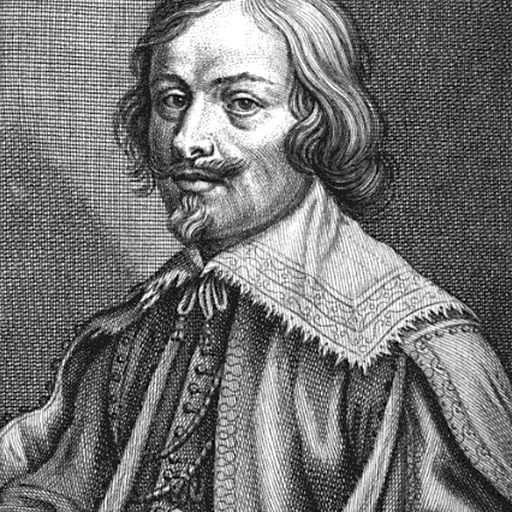
Artist
Jacques Callot was a baroque printmaker and draftsman from the Duchy of Lorraine.

 Holy Family at supper
 Restoration of the Aqueduct at Pisa
 Restoration of the Aqueduct at Pisa
 Square in Paris with Many Figures
 Square in Paris with Many Figures
 Horsemen Attacked by Robbers
 HOW WILL A COVERED PART BE CORRECTED?HOW WIKA A COVERED HEART DEED CORRECTED?
![Christ Walking on the Water [second plate], by Jacques Callot](https://artifactworldgallery.com/img/jacques-callot--christ-walking-on-the-water-second-plate--2069f3bfe4cb2126-w320.webp) Christ Walking on the Water [second plate]
Christ Walking on the Water [second plate]