Artwork
Scenes of Daily Life, Roads and Paths: Road to Poissy (Scènes de la vie quotidienne, Routes et Chemins: Route de Poissy)
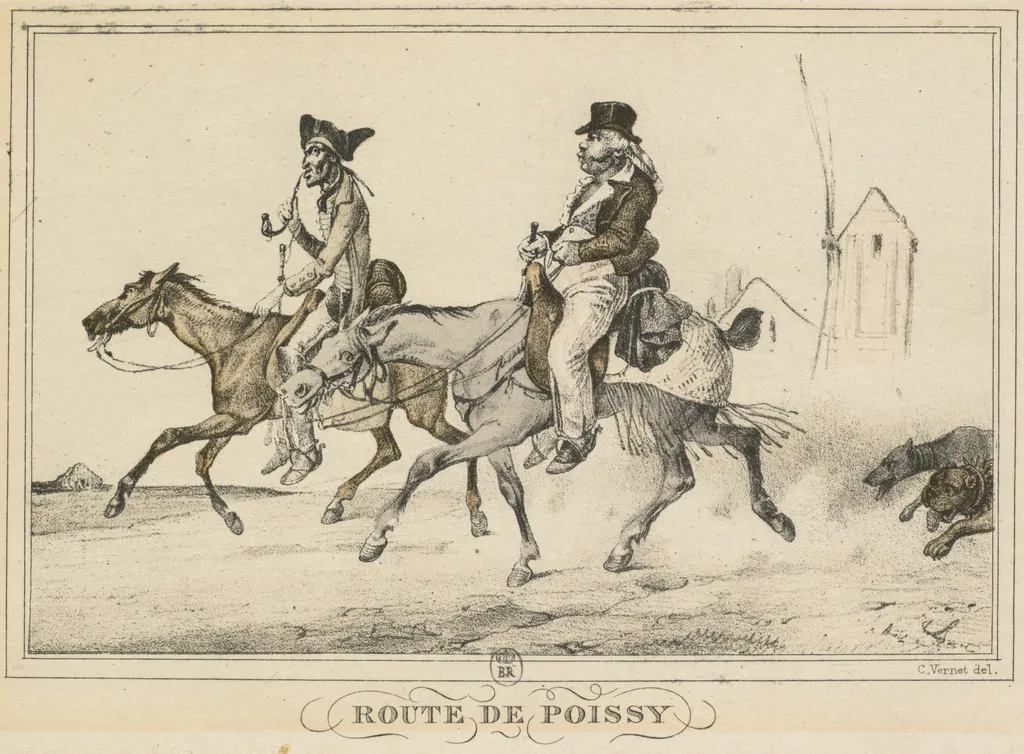
Scenes of Daily Life, Roads and Paths: Road to Poissy (Scènes de la vie quotidienne, Routes et Chemins: Route de Poissy) is a print by the Romanticist artist Carle Vernet. It dates from 1816 and is held in the collection of the Cleveland Museum of Art.
About this work
Overview
Executed with swift, fluid lines, it captures a moment of transit along the road to Poissy, a village northwest of Paris.
Created in 1816 by Carle Vernet, this ink sketch is part of a series documenting ordinary French rural life. Executed with swift, fluid lines, it captures a moment of transit along the road to Poissy, a village northwest of Paris. The work belongs to The Cleveland Museum of Art’s collection and reflects the artist’s interest in unidealized, everyday scenes rather than grand historical or mythological subjects.
Subject & Meaning
The scene depicts two men traveling in a modest cart drawn by two horses—one guiding the reins from the front, the other seated behind. A dog trots beside them, and a small structure appears faintly on the horizon. These elements convey quiet movement and routine, emphasizing the rhythm of daily travel. The absence of drama or ornamentation underscores the artist’s focus on the unremarkable yet authentic rhythms of provincial life.
Technique & Style
Vernet employed loose, spontaneous ink strokes to render the figures, animals, and landscape with immediacy. The sketchlike quality suggests on-site observation, prioritizing motion and gesture over detail. Delicate washes and minimal shading define forms without heavy modeling, aligning with the conventions of preparatory drawing rather than finished illustration. The economy of line enhances the sense of fleeting, transient activity.
History & Provenance
The work was produced during Vernet’s later years, following his established career as a painter of military and equestrian subjects. It was likely made as part of a personal project documenting regional travel routes near Paris. The sketch entered The Cleveland Museum of Art’s collection in the 20th century, preserved as an example of 19th-century French observational drawing rather than a major exhibition piece.
Context
In early 19th-century France, artists increasingly turned from idealized narratives to scenes of ordinary life, influenced by social changes and the rise of Romanticism. Vernet’s focus on rural roads and travelers aligns with this shift, reflecting broader cultural interest in authenticity and the natural world. His sketches, though less celebrated than his paintings, offer insight into how artists engaged with the mundane as worthy of representation.
Legacy
Though not widely exhibited, this sketch exemplifies Vernet’s commitment to documenting the unglamorous aspects of French society. Its informal style anticipates later realist and impressionist approaches to everyday subjects. As a record of travel and labor in pre-industrial France, it contributes to a visual archive of ordinary life that influenced subsequent generations of artists seeking truth over spectacle.
Artist & collection

Artist
Antoine Charles Horace Vernet, better known as Carle Vernet, was a French painter, the youngest child of painter Claude-Joseph Vernet and the father of painter Horace Vernet.

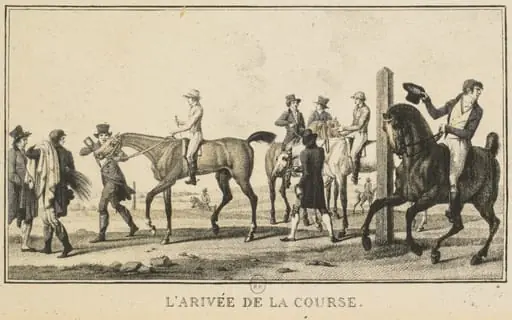 Racing Scenes: A Horse Arriving at the Race (Scènes Hippiques: Cheval arrivant de la chasse)
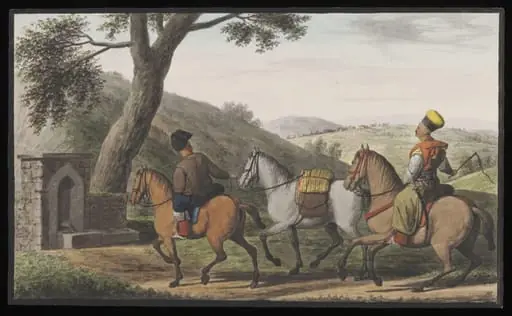 Sürücüler, or men in charge of post horses
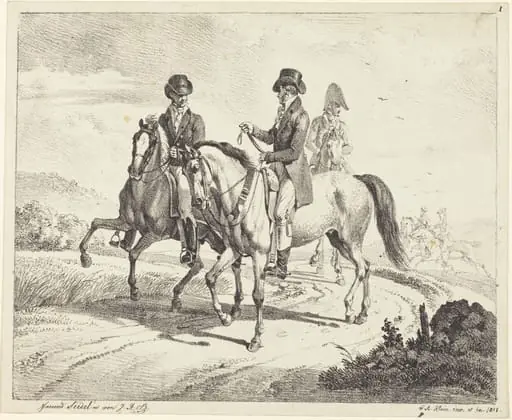 Outing on Horseback
 A Belgian Waggon Conveying Wounded from the Field after the Battle of Waterloo
 The Roller
 Postman or Two Harnessed Horses
 Two Dappled Horses Exercising