Artwork
Construction of Docks
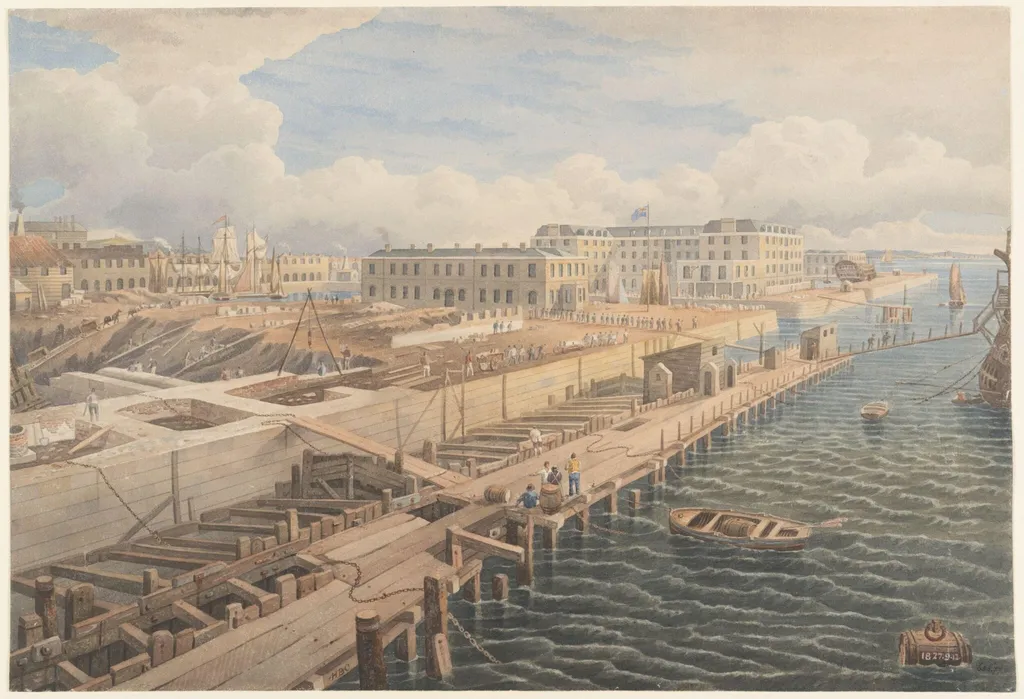
Construction of Docks is a watercolor work on paper by the British Romanticist artist Henry Barlow Carter. It dates from 1827 and is held in the collection of the Victoria and Albert Museum.
About this work
Overview
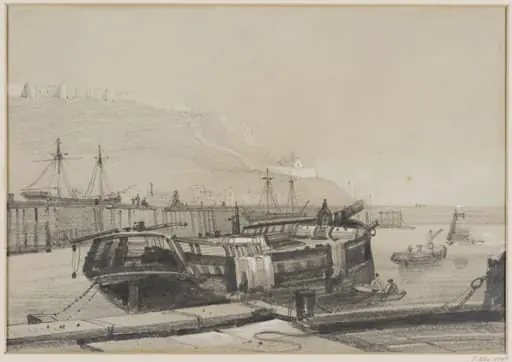
Painted in 1827 by Henry Barlow Carter, this watercolour captures the ongoing development of a working dock. The artist signed and dated the piece, affirming its authorship and temporal context. The composition presents a calm yet industrious scene, where natural elements and human labor coexist under a soft, diffused light.
Subject & Meaning
The scene depicts a dockyard in active construction, with wooden piers extending into the water and vessels moored along their edges. Workers are scattered across the site, engaged in tasks that suggest organized labor. Flagged buildings along the shore imply commercial or administrative functions, reflecting the growing importance of maritime infrastructure in early 19th-century Britain.
Technique & Style
Carter employed delicate watercolour washes to render light reflecting off water and building facades. The palette is restrained, favoring muted tones that unify the natural and built environments. Fine brushwork defines details like rigging and figures, while atmospheric perspective softens the distant elements, enhancing spatial depth without dramatic contrast.
History & Provenance
The work was completed in 1827 and bears the artist’s signature and date, indicating it was likely made as a documentary record or personal study. Its survival suggests it was preserved within private or institutional collections, though its specific ownership history prior to institutional acquisition remains undocumented.
Context
In the 1820s, British port cities were expanding rapidly to support trade and naval needs. This image reflects the era’s emphasis on infrastructure development, where docks were not merely functional but symbols of economic progress. Carter’s focus on order and activity aligns with contemporary interest in documenting industrial change.
Legacy
The painting offers a quiet but precise record of early industrial maritime activity. While not widely exhibited, it contributes to the visual archive of Britain’s 19th-century port evolution. Its preservation allows continued study of how artists engaged with the transformation of urban and coastal landscapes during the Industrial Revolution.
Artist & collection

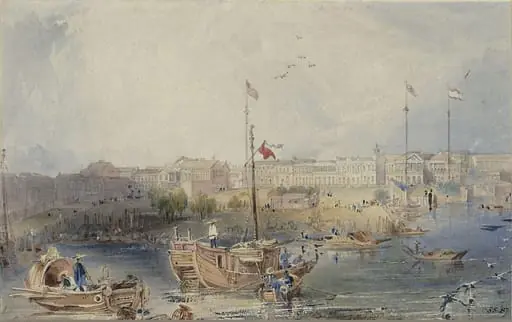 View in Guangzhou (Canton), China
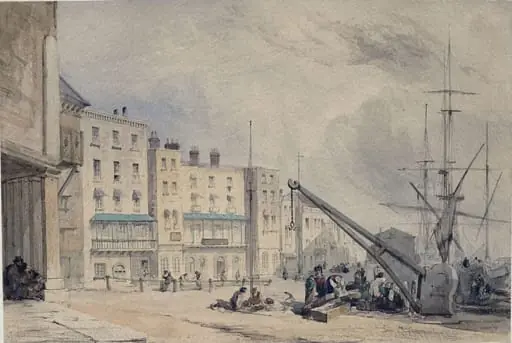 Ramsgate near the Harbour
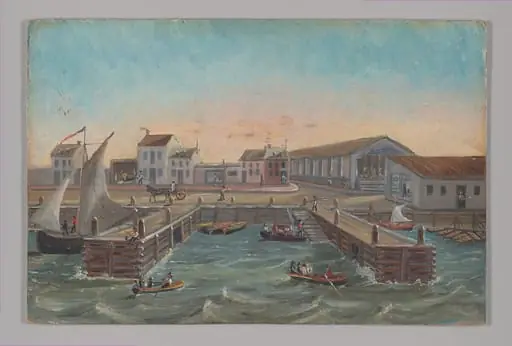 Old Ferry Stairs
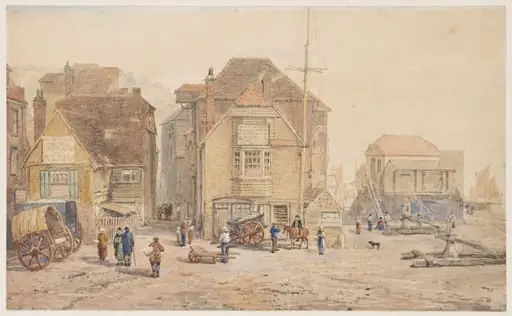 The old fishmarket at Hastings
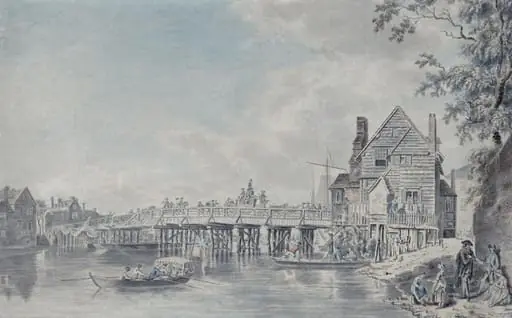 Old bridge at Windsor, coach and horsemen crossing, and a barge passing under
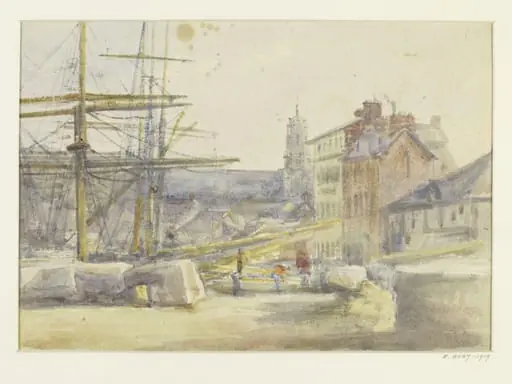 The quayside in a small French port
 View of a Port
 Ryde, Isle of Wight
 On the Thames
 Cheyne Walk, Chelsea, London
 View on the Thames
 The Pool from London Bridge