Artwork
Ramsgate near the Harbour
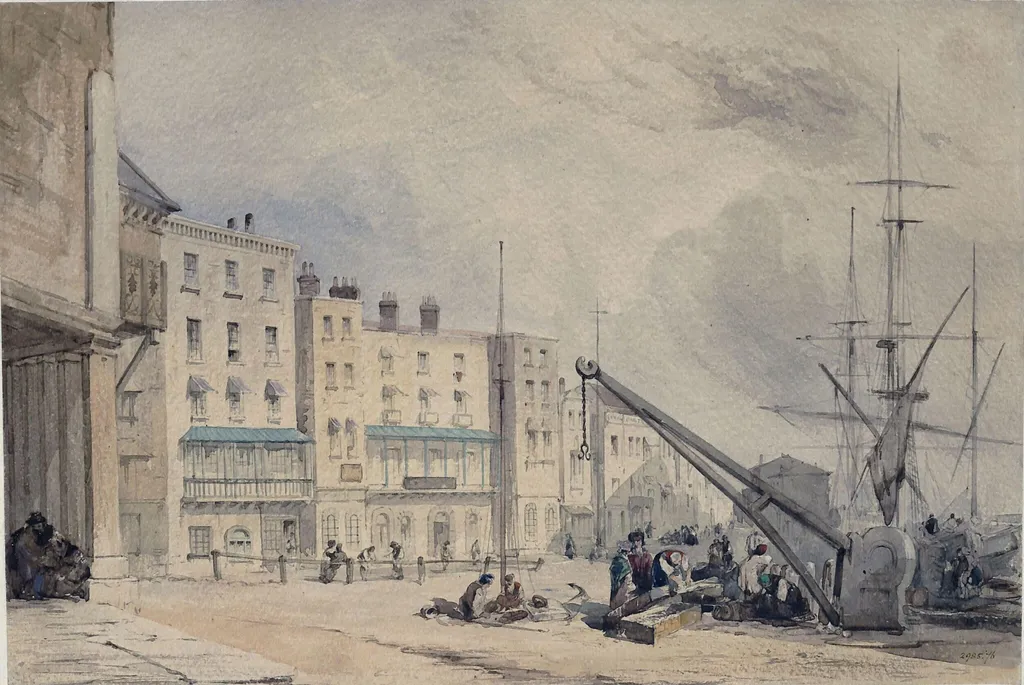
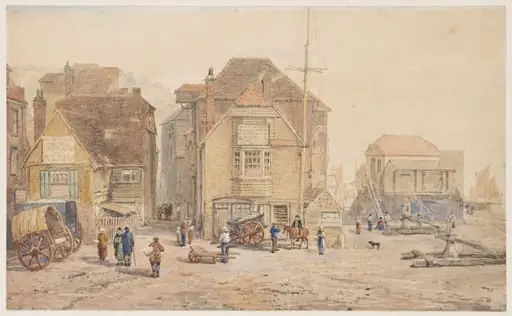
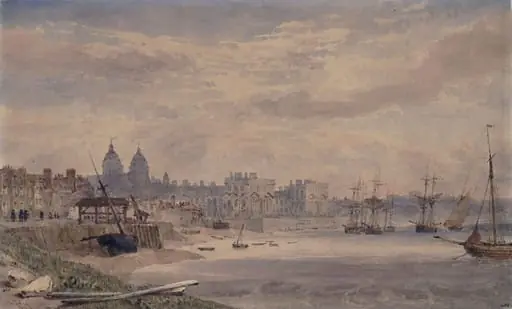
Ramsgate near the Harbour is a watercolor work on paper by the British Romanticist artist James Holland. It dates from 1820 and is held in the collection of the Victoria and Albert Museum.
About this work
Overview
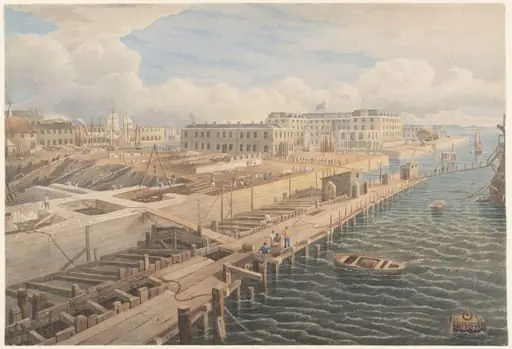
James Holland’s 1820 watercolour captures a quiet moment at Ramsgate Harbour, balancing natural atmosphere with early industrial elements. The scene is rendered in translucent washes that lend a gentle luminosity, softening the functional structures of the port. Though modest in scale, the work conveys the daily rhythm of a coastal trading hub through subtle detail and atmospheric tone.
Subject & Meaning
The painting presents a working harbour with figures engaged in routine tasks—some seated, others moving along the shore. A heavy crane-like mechanism on the right suggests the growing presence of mechanical labor, while the distant ship hints at commerce. The absence of dramatic action invites contemplation of ordinary life, aligning with Romanticism’s interest in authentic, unidealized moments.
Technique & Style
Holland employed watercolour with layered washes to achieve a hazy, diffused light, characteristic of his approach. The cloudy sky and soft edges blur boundaries between land, sea, and sky, creating a sense of quiet movement. Contrasting with the delicate medium, the crane’s metallic forms are rendered with precise, dark lines, grounding the scene in tangible reality.
History & Provenance
Created during Holland’s early career, this work reflects his frequent travels along the southeast coast of England. It likely originated as a study for larger compositions or as a personal record of coastal life. The piece remained in private collections until entering public ownership, where it now serves as a record of early 19th-century maritime activity.
Context
In the 1820s, Ramsgate was transitioning from a fishing village to a modest resort, with infrastructure expanding to support trade and travel. Holland’s depiction avoids romanticized grandeur, instead documenting the coexistence of natural scenery and emerging industry—a common theme among artists observing Britain’s changing landscape during the early Industrial Revolution.
Legacy
Holland’s watercolours contributed to a growing tradition of topographical art that valued observation over embellishment. This work, though not widely exhibited in his lifetime, exemplifies how Romantic-era artists used intimate, everyday scenes to reflect broader societal shifts, influencing later generations focused on realism and place-based documentation.
Own this work as a print
Artist & collection

Artist
James Holland (18 October 1799 – 12 February 1870) was an English painter of flowers, landscapes, architecture, marine subjects, and a book illustrator.