Artwork
The Sucking Fish (Echeneis Naucratis)
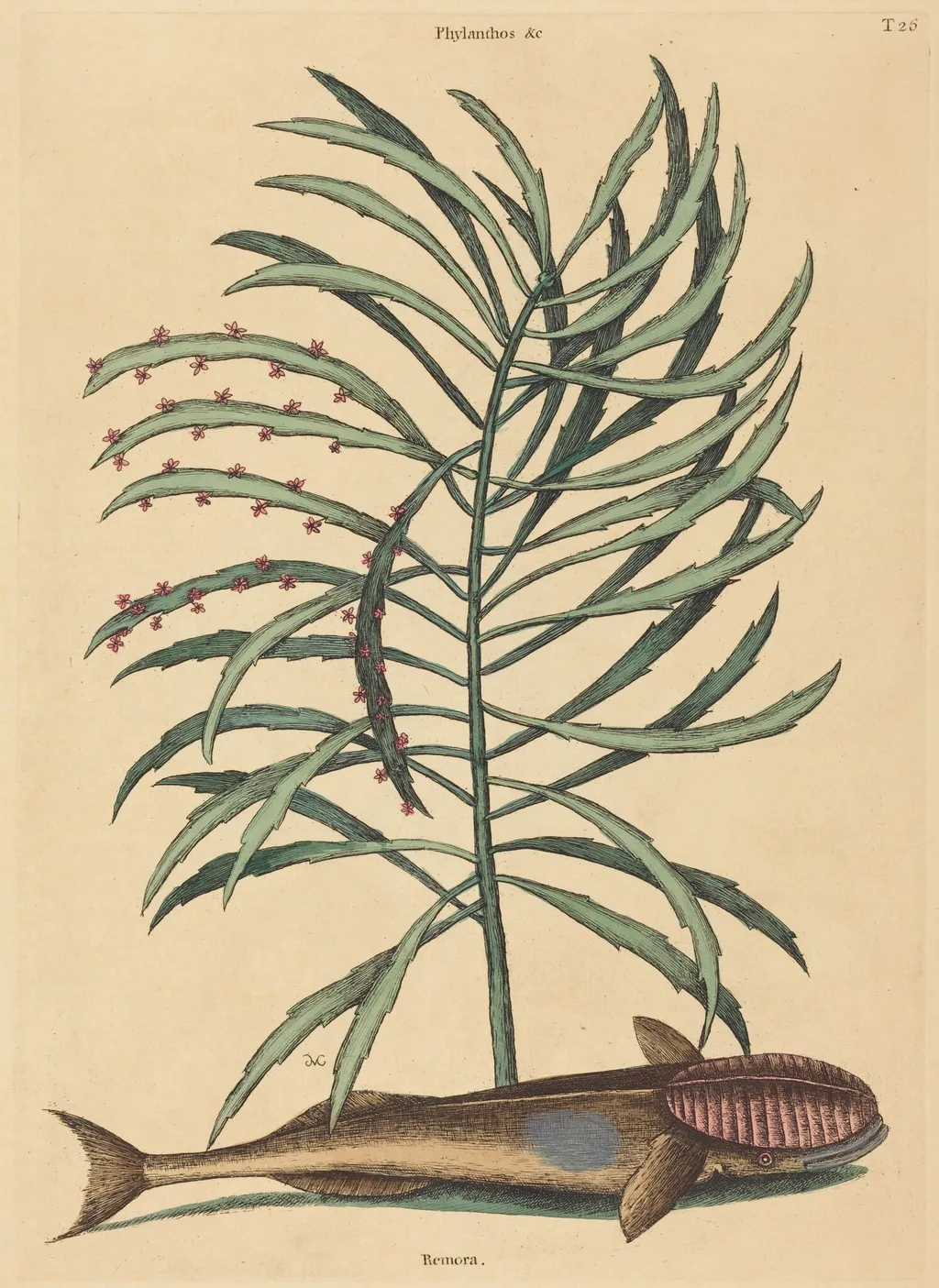
The Sucking Fish (Echeneis Naucratis) is an ink print by the Baroque artist Mark Catesby. It dates from 1737 and is held in the collection of the National Gallery of Art.
About this work
Overview
The image shows a remora attached to the hull of a wooden vessel, its flattened head and elongated, striped body rendered in brown tones.
Created in 1737, *The Sucking Fish (Echeneis naucratis)* is a hand‑colored etching and engraving on laid paper. The image shows a remora attached to the hull of a wooden vessel, its flattened head and elongated, striped body rendered in brown tones. The composition combines naturalistic detail with a glimpse of the ship’s rough planking, illustrating the fish’s characteristic habit of clinging to larger marine objects.
Subject & Meaning
The print depicts the remora, a marine fish known for its suction disc that allows it to adhere to hosts such as sharks, turtles, or, in this case, a ship. By portraying the animal on a vessel, Catesby emphasizes the creature’s opportunistic lifestyle and its role within the broader marine ecosystem, offering viewers a concrete example of a species unfamiliar to European audiences of the period.
Technique & Style
Catesby employed a combination of etching and engraving to achieve fine line work and tonal variation, then applied hand‑applied watercolor to enhance the fish’s coloration and the wood’s texture. The use of laid paper provides a subtle ribbed surface that interacts with the ink, while the hand‑coloring adds a modest three‑dimensional quality, reflecting early eighteenth‑century printmaking practices.
History & Provenance
The image forms part of Catesby’s multi‑volume *Natural History of Carolina, Florida and the Bahama Islands*, a series issued between 1729 and 1747 that contained 220 illustrated plates. Produced during Catesby’s extended fieldwork in the American colonies, the plate was circulated among European naturalists and collectors, contributing to the scientific knowledge exchange of the Enlightenment era.
Context
Catesby’s work emerged at a time when European scholars sought systematic documentation of New World flora and fauna. His illustrations combined artistic observation with empirical detail, aligning with the period’s taxonomic ambitions. The inclusion of a marine species attached to a ship also reflects contemporary interest in the practical implications of natural history for navigation and trade.
Artist & collection

Artist
Mark Catesby (24 March 1683 – 23 December 1749) was an English naturalist who studied the flora and fauna of the New World.