Artwork
The Muray (Muraena helena)
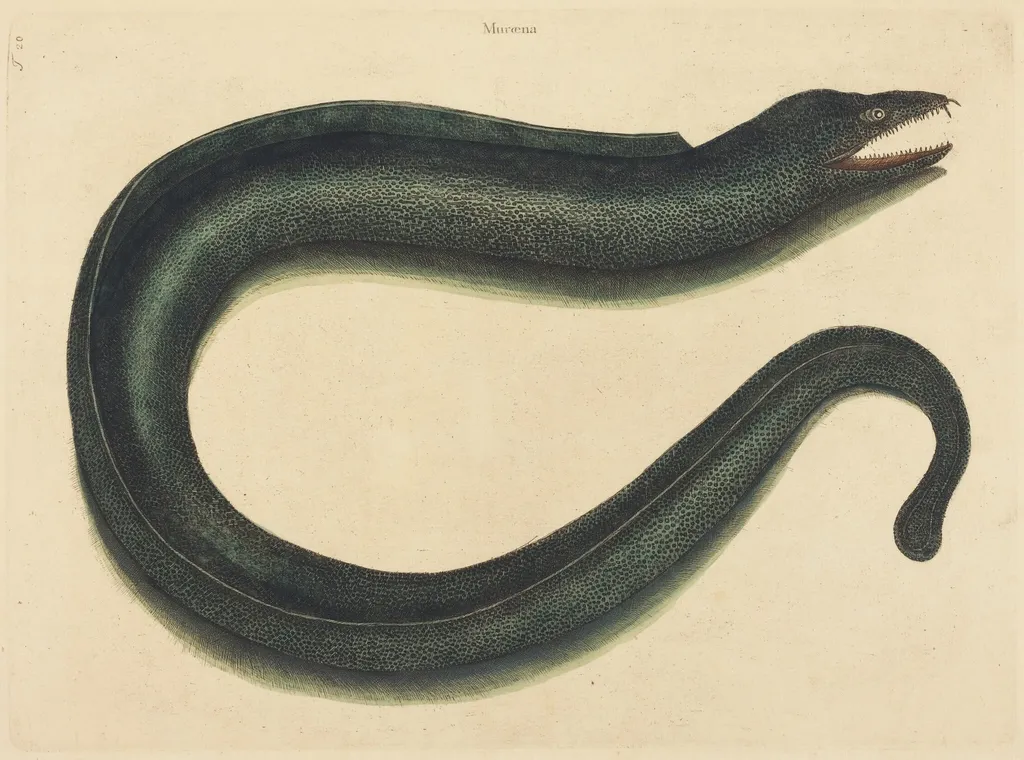
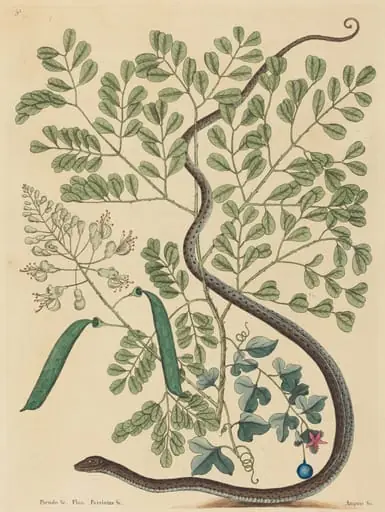
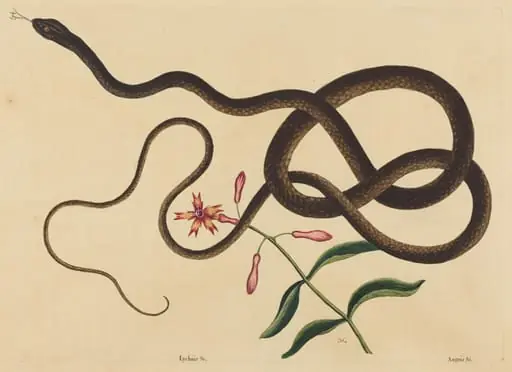
The Muray (Muraena helena) is an ink print by the Romanticist artist Mark Catesby. It is held in the collection of the National Gallery of Art.
About this work
Overview
Created in 1754, *The Muray (Muraena helena)* is a hand‑colored etching and engraving on laid paper. The print portrays a coiled moray eel, rendered with fine linear detail and subtle shading that emphasize the animal’s textured skin and open mouth. It forms one of the 220 illustrative plates that accompany Mark Catesby’s natural history volumes.
Subject & Meaning
The image presents a single European moray eel (Muraena helena) in a relaxed, circular pose. The eel’s dark, scale‑like surface and exposed teeth are highlighted, offering a realistic study of its anatomy for viewers unfamiliar with marine fauna.
Technique & Style
Catesby employed traditional intaglio processes: the design was incised into a copper plate by etching, then further refined through engraving to achieve precise line work. After printing on laid paper, the image received hand‑applied color, a common practice for natural history illustrations of the period.
History & Provenance
Mark Catesby, an English naturalist who explored the Atlantic coast of North America, compiled his observations in *Natural History of Carolina, Florida and the Bahama Islands* (1729–1747). The eel plate appears in this publication, which was the first illustrated survey of North American wildlife.
Context
The print belongs to the Enlightenment era’s drive to catalog the natural world. Catesby’s work combined scientific observation with artistic skill, providing European audiences with visual access to species previously unknown outside their native habitats.
Artist & collection

Artist
Mark Catesby (24 March 1683 – 23 December 1749) was an English naturalist who studied the flora and fauna of the New World.