Artwork
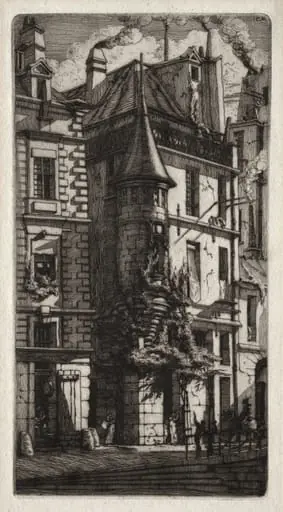
Etchings of Paris: Tourelle, rue de l'Ecole de Médicine
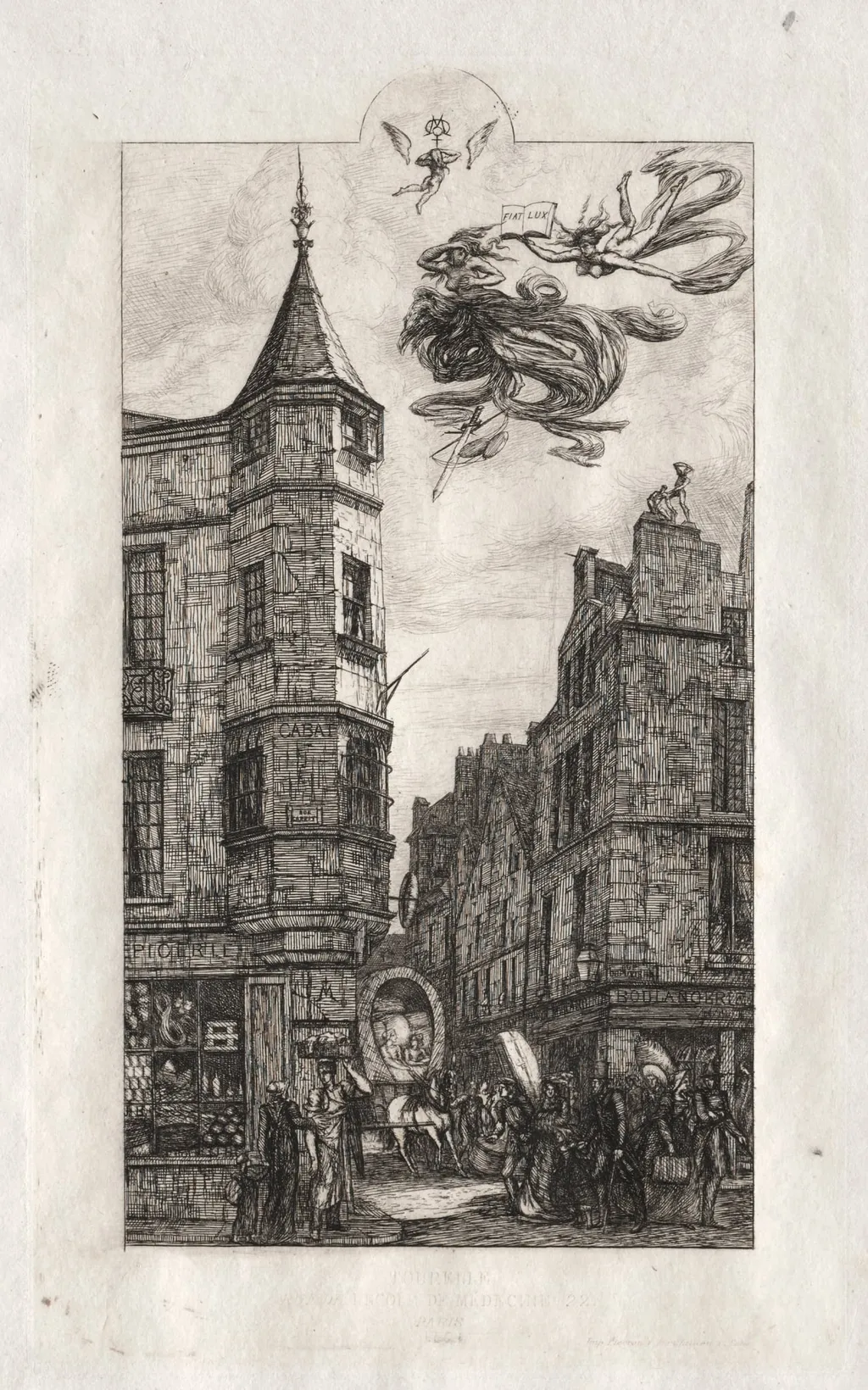
Etchings of Paris: Tourelle, rue de l'Ecole de Médicine is a print by the Impressionist artist Charles Meryon. It dates from 1861 and is held in the collection of the Cleveland Museum of Art.
About this work
Overview
Meryon, who turned to etching due to his color blindness, focused on architectural detail and atmospheric texture rather than color.
Created in 1861, this etching by Charles Meryon captures a quiet corner of Paris near the École de Médecine. Meryon, who turned to etching due to his color blindness, focused on architectural detail and atmospheric texture rather than color. The work belongs to a larger series documenting the city’s evolving urban fabric, rendered with precise line work and a mood that blends observation with poetic invention.
Subject & Meaning
The scene depicts a typical Parisian street intersection, alive with daily movement: a horse-drawn carriage passes beneath an arch, pedestrians tread the cobblestones, and steam rises into the air. Above, a winged figure bearing the Latin phrase 'Fiat Lux' hovers—an allegorical intrusion that suggests enlightenment or divine presence amid the mundane. The juxtaposition of the earthly and the ethereal invites contemplation on the spiritual undercurrents of urban life.
Technique & Style
Meryon employed fine, controlled etching lines to render textures with remarkable clarity: the roughness of brickwork, the drape of fabric, and the swirling motion of steam or smoke. His use of cross-hatching and varying line density creates depth without color, emphasizing light and shadow. The composition balances realism with surreal elements, as the floating figure disrupts the scene’s naturalism, revealing a personal, introspective vision.
History & Provenance
Meryon produced this print during a period of intense creative output, shortly before his mental health deteriorated significantly. Though his mother was a dancer at the Paris Opera, he lived largely in isolation, finding solace in the city’s architecture. The etching was likely made for a small circle of collectors and fellow artists, and it entered institutional collections in the decades following his death, valued for its unique interpretation of Paris.
Context
In the mid-19th century, Paris underwent major urban renewal under Haussmann, displacing older neighborhoods. Meryon’s etchings, including this one, preserved the city’s medieval and pre-modern structures before they vanished. Unlike contemporaries who celebrated modernity, he focused on decay, solitude, and the lingering presence of the past, offering a counter-narrative to official visions of progress.
Legacy
Meryon’s etchings influenced later generations of printmakers drawn to atmospheric realism and psychological depth. Though little known during his lifetime, his work gained recognition in the late 19th and early 20th centuries for its emotional resonance and technical mastery. Today, his images remain important records of Paris’s architectural transformation, valued for their quiet, haunting vision rather than their popularity.
Artist & collection
Artist
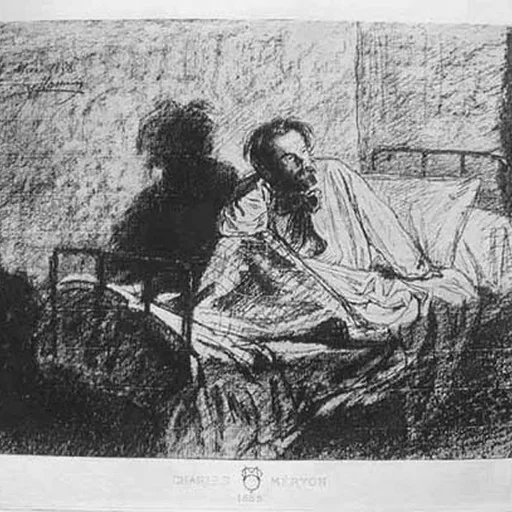
Charles Meryon (sometimes Méryon, 23 November 1821 – 14 February 1868) was a French artist who worked almost entirely in etching, as he had colour blindness.

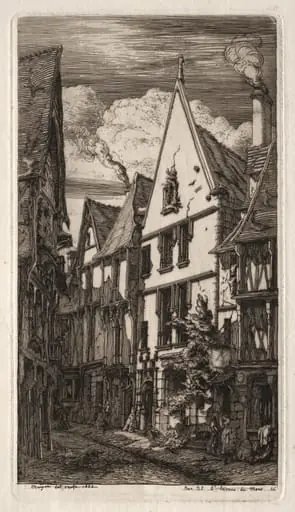 Etchings of Paris: à Bourges
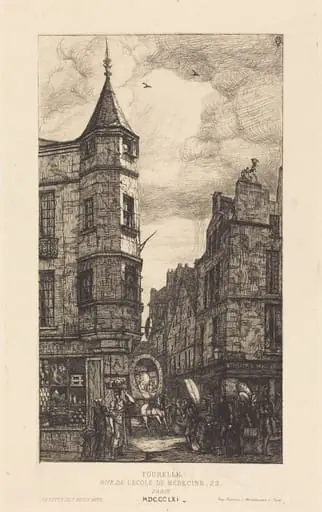 Tourelle, Rue de l'École de Médecine, 22, Paris
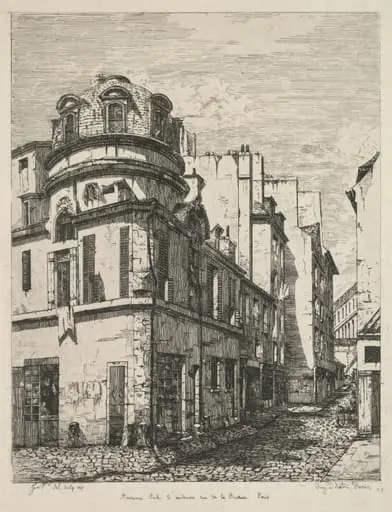 Eaux-Fortes sur le Vieux Paris: Ancienne école de médecine rue de la Bûcherie (Etchings of Old Paris: Former Medical School, rue de la Bucherie)
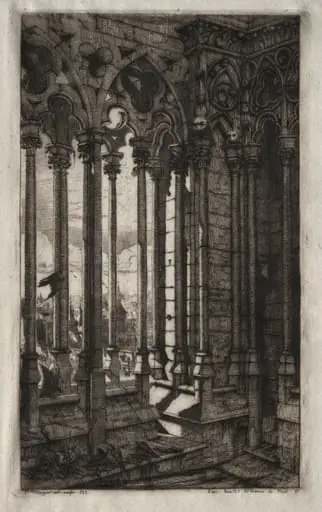 The Etchings of Paris: The Gallery of Notre Dame
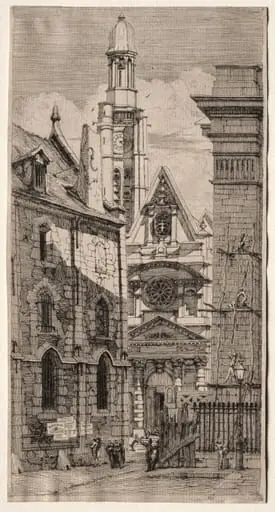 Etchings of Paris: Church of St. Stephen of the Mount
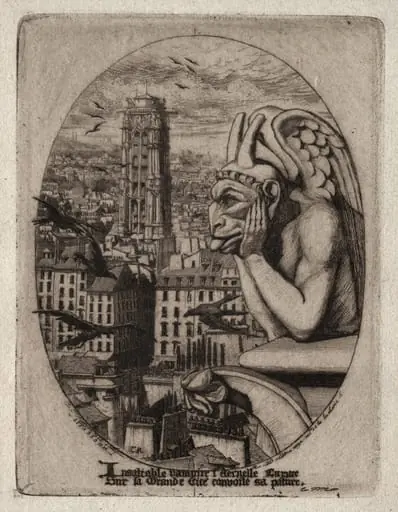 Etchings of Paris: The Gargoyle
 Etchings of Paris: House with a Turret, Weavers' Street