Artwork
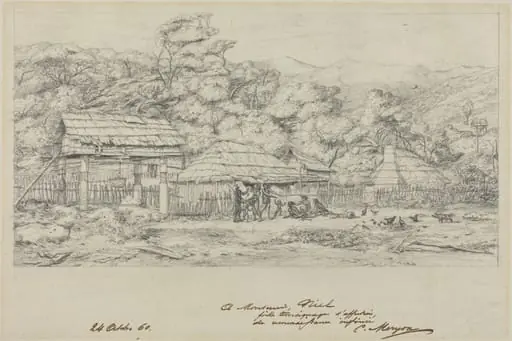
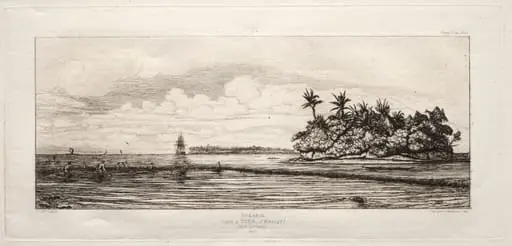
Seine Fishing off Charcoal Burners' Point, Akaroa, Banks' Peninsula, 1845
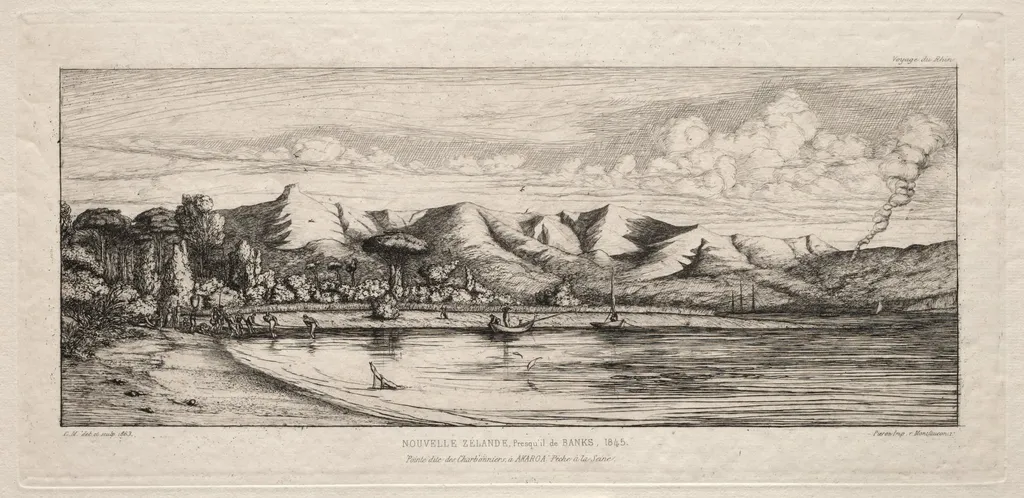
Seine Fishing off Charcoal Burners' Point, Akaroa, Banks' Peninsula, 1845 is a print by the Impressionist artist Charles Meryon. It dates from 1863 and is held in the collection of the Cleveland Museum of Art.
About this work
On the shore, there’s a group of people near trees, and a plume of smoke rises from the right side of the image.
This black-and-white print shows a coastal scene with a small bay and a mountain range in the background. The water is dotted with boats, some with people fishing or rowing. On the shore, there’s a group of people near trees, and a plume of smoke rises from the right side of the image.
The title says this is a spot in New Zealand, but the artist was French. The print looks like it was made in 1863, though it depicts an earlier time.
If you like this style, check out Realism next.
Overview
Created in 1863, this etching by Charles Meryon captures a coastal scene in Akaroa, New Zealand, though it portrays an earlier moment in the settlement’s history. Though Meryon was French and best known for his depictions of Paris, he spent time in New Zealand during his naval service. The print is rendered in monochrome, emphasizing tonal contrasts and delicate line work, characteristic of his etching technique.
Subject & Meaning
The scene shows fishermen in small boats on a sheltered bay, with figures on the shore near scattered trees and a plume of smoke suggesting domestic activity. The composition reflects daily life in a remote colonial outpost, devoid of overt drama or idealization. Meryon’s focus on quiet labor and natural topography suggests an interest in the ordinary rhythms of place, rather than narrative spectacle.
Technique & Style
Meryon employed fine, controlled etching lines to render texture in water, rock, and foliage, using subtle gradations of ink to suggest depth and atmosphere. His approach is precise yet restrained, avoiding theatrical lighting or exaggerated forms. The absence of color aligns with his known sensitivity to hue, and the composition reflects a topographical awareness common in 19th-century maritime documentation.
History & Provenance
Meryon produced this work after serving in the French navy, during a period he spent in New Zealand between 1840 and 1845. Though the scene depicts the early 1840s, the print was made nearly two decades later in France. It remained part of his personal oeuvre, later included in collections of his travel-related works, and is now held in institutional archives as evidence of his brief but significant time abroad.
Context
This print emerged during a period of European exploration and colonial expansion in the Pacific. Akaroa, settled by French colonists in the 1840s, was a small outpost with limited infrastructure. Meryon’s depiction, though not overtly political, quietly documents the presence of foreign settlers and their adaptation to a new landscape, contrasting with more romanticized portrayals of the region.
Legacy
Though Meryon is primarily remembered for his Parisian etchings, this work contributes to a lesser-known body of travel-based prints that reveal his adaptability as a draftsman. It stands as a rare visual record of early colonial New Zealand by a European artist of note, offering insight into how distant landscapes were observed and recorded by those passing through them.
Artist & collection
Artist
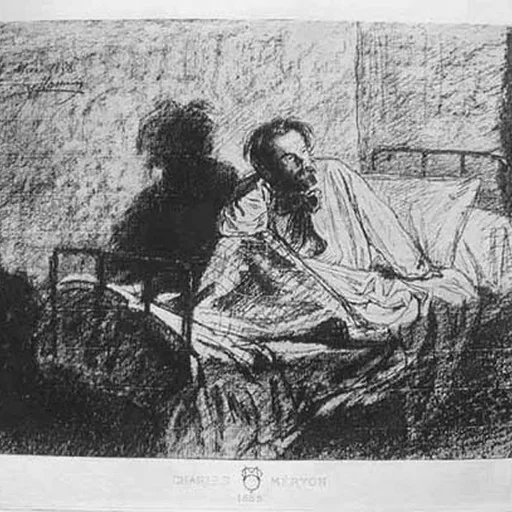
Charles Meryon (sometimes Méryon, 23 November 1821 – 14 February 1868) was a French artist who worked almost entirely in etching, as he had colour blindness.