Artwork
Cowherd
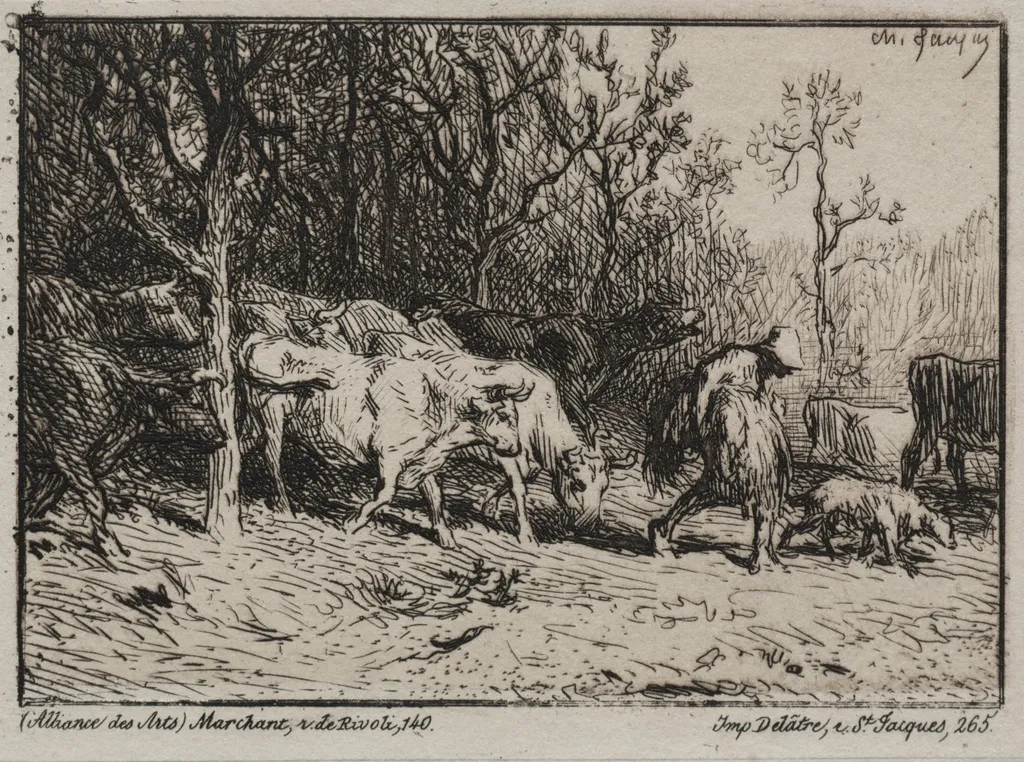
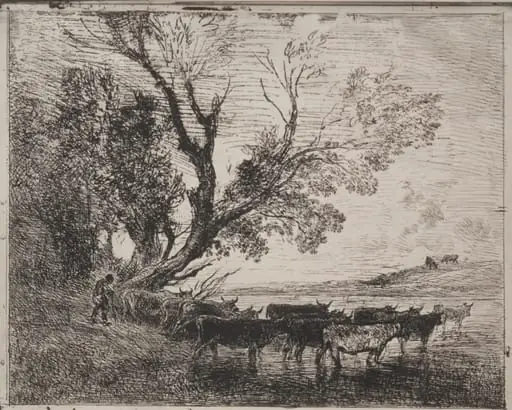
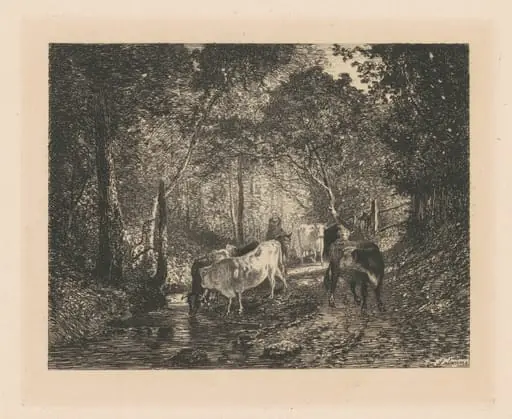
Cowherd is a print by the Impressionist artist Charles Jacque. It dates from 1855 and is held in the collection of the Cleveland Museum of Art.
About this work
Overview
Created around 1855 by Charles-Émile Jacque, *Cowherd* is a print that captures a quiet rural moment in the French countryside. Jacque, linked to the Barbizon School, focused on everyday life in the fields and forests. This work exemplifies the group’s commitment to observing nature and labor without idealization. It resides today in the Cleveland Museum of Art’s collection.
Subject & Meaning
The work conveys dignity in ordinary rural existence, aligning with the Barbizon ethos of honoring peasant life through understated observation.
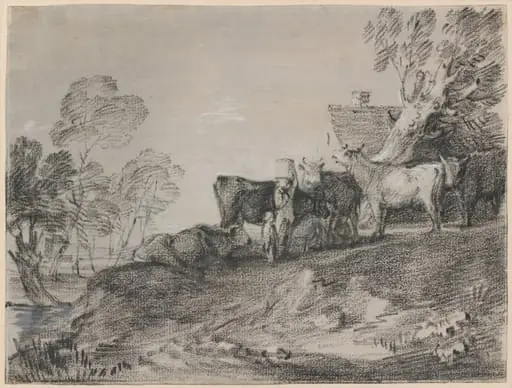
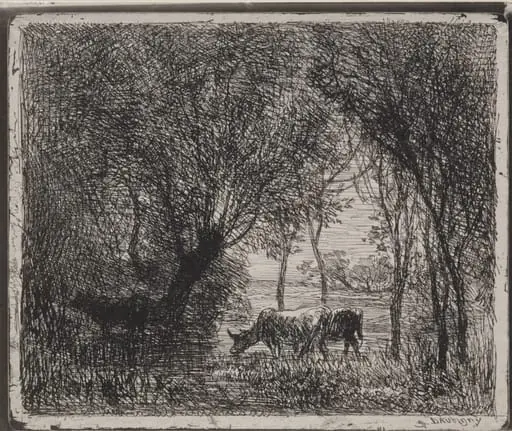
The scene depicts three cows standing beneath a dense canopy of trees, with no human figure present—only the implied presence of a herder. The absence of people shifts focus to the animals and their environment, suggesting a quiet harmony between livestock and woodland. The work conveys dignity in ordinary rural existence, aligning with the Barbizon ethos of honoring peasant life through understated observation.
Technique & Style
Jacque employed etching and drypoint to render the scene with varied line weight and textured surfaces. Thick, irregular strokes define the tangled underbrush, while uneven light is suggested through areas of deep shadow and sparse ink. The rough, scratched quality of the lines mimics the uneven ground and dense foliage, creating a tactile, almost haptic sense of the landscape’s physicality.
History & Provenance
Produced in the mid-1850s, *Cowherd* emerged during Jacque’s active years alongside Jean-François Millet, when the Barbizon artists were redefining landscape art through direct observation. The print entered the Cleveland Museum of Art’s collection in the 20th century, where it remains as part of a broader effort to preserve 19th-century French graphic art tied to rural realism.
Context
In mid-19th-century France, urbanization and industrialization prompted artists to turn toward the countryside as a site of authenticity. The Barbizon School rejected academic idealism, favoring scenes of labor and nature as they appeared. *Cowherd* fits within this movement, offering a quiet counterpoint to grand historical or mythological subjects then dominant in official salons.
Legacy
Jacque’s prints, including *Cowherd*, helped establish etching as a legitimate medium for serious artistic expression beyond reproduction. His emphasis on texture and naturalism influenced later generations of realist artists and printmakers. Though less widely known than Millet, Jacque’s work contributed significantly to the visual language of rural France in the 19th century.
Artist & collection
Artist
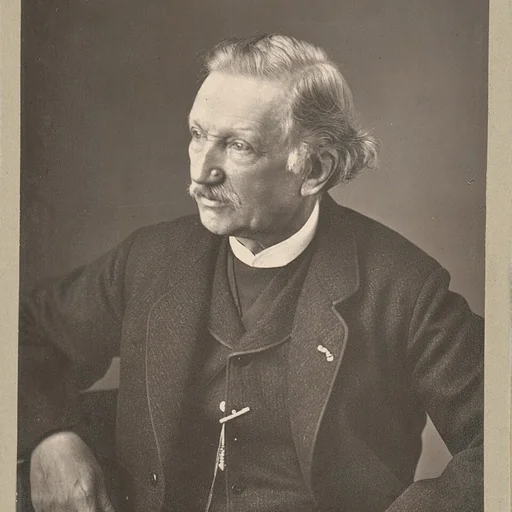
Charles-Émile Jacque (23 May 1813 – 7 May 1894) was a French painter of Pastoralism and engraver who was, with Jean-François Millet, part of the Barbizon School. He first learned to engrave maps when he spent seven years in the French Army.