Artwork
The Truffle Gatherers
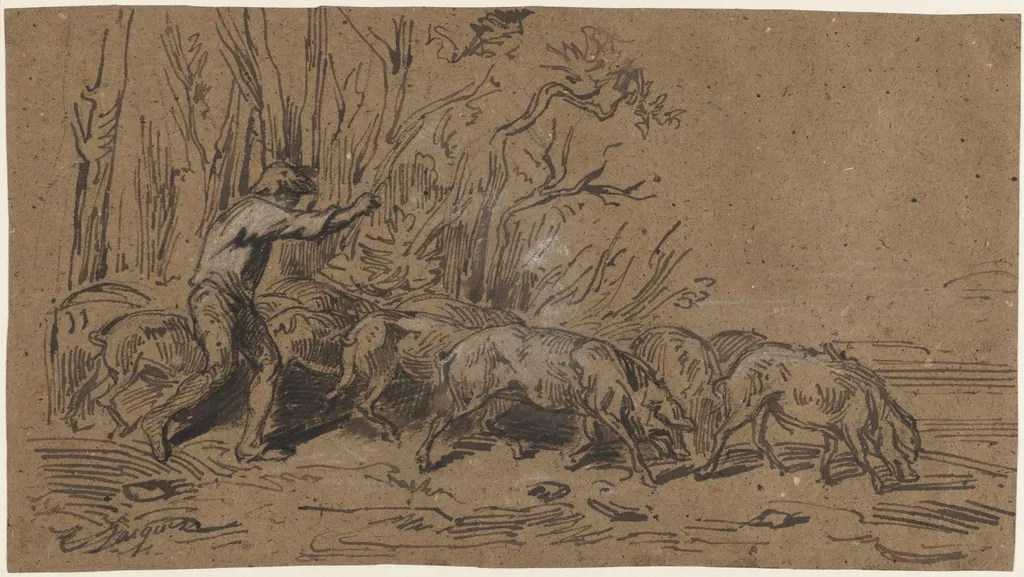
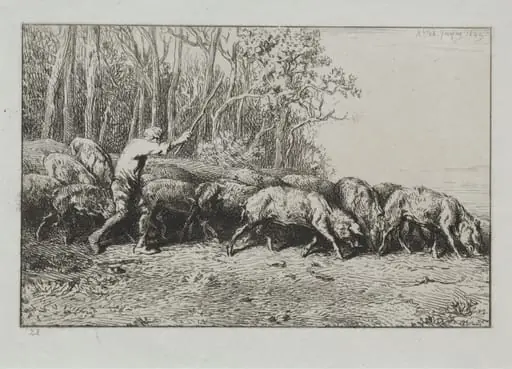
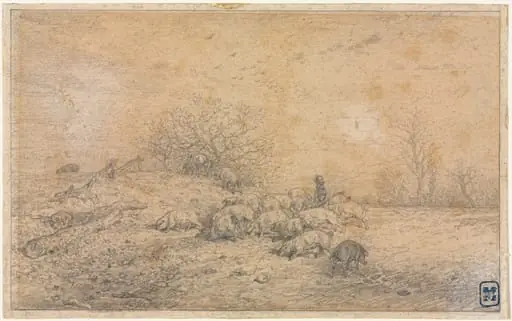
The Truffle Gatherers is a drawing by the Romanticist artist Charles Jacque. It dates from 1849 and is held in the collection of the Cleveland Museum of Art.
About this work
Overview
Created around 1849 by Charles-Émile Jacque, *The Truffle Gatherers* is a charcoal or pencil drawing that captures a quiet moment of rural labor. Jacque, linked to the Barbizon School, focused on the everyday lives of those working the land. This work stands apart from idealized pastoral imagery, presenting instead a subdued, unromanticized view of subsistence foraging in the French countryside.
Subject & Meaning
Jacque’s choice of subject underscores the quiet hardship of rural existence, contrasting with romanticized depictions of peasant life common in his era.
Two young boys, dressed in simple clothing and round hats, dig beneath trees with sticks, searching for truffles. One carries a nearly empty basket, suggesting minimal收获. Their postures convey exhaustion rather than contentment, reflecting the physical toll of seasonal labor. Jacque’s choice of subject underscores the quiet hardship of rural existence, contrasting with romanticized depictions of peasant life common in his era.
Technique & Style
Jacque employed delicate linear strokes to define form and texture, using subtle tonal variations to suggest the dappled light filtering through dense foliage. The figures are rendered with restrained detail, emphasizing their integration into the landscape. The absence of dramatic contrast or embellishment aligns with the Barbizon emphasis on naturalism, grounding the scene in observed reality rather than theatrical effect.
History & Provenance
The drawing was made in the late 1840s, a period of social and economic transition in rural France. Jacque produced it alongside his more famous oil paintings and engravings, often exploring similar themes. It entered the collection of the Cleveland Museum of Art in the 20th century, where it remains as part of a broader effort to document 19th-century French realist drawing practices.
Context
During the 1840s, traditional agrarian life in France was being reshaped by urbanization and industrialization. Artists like Jacque and Millet turned to the countryside not for nostalgia, but to document labor that was increasingly marginalized. *The Truffle Gatherers* reflects this shift, portraying work that was essential yet invisible in mainstream narratives of progress.
Legacy
Though less widely known than his contemporaries, Jacque’s drawings like this one contributed to a broader redefinition of artistic subject matter. By focusing on the quiet dignity and fatigue of rural labor, he helped lay groundwork for later realist movements. The work endures as a modest but significant record of a vanishing way of life, preserved through careful observation rather than sentiment.
Artist & collection
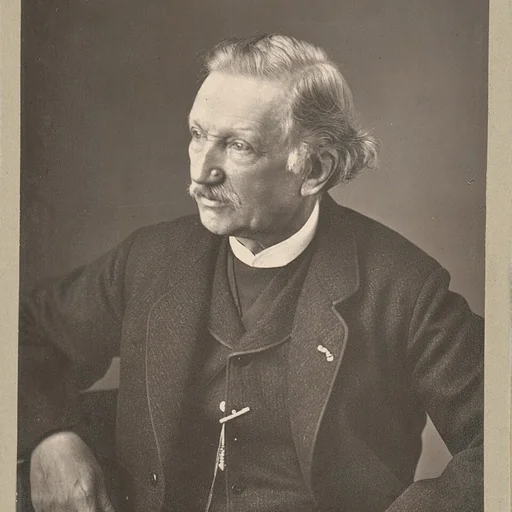
Artist
Charles-Émile Jacque (23 May 1813 – 7 May 1894) was a French painter of Pastoralism and engraver who was, with Jean-François Millet, part of the Barbizon School. He first learned to engrave maps when he spent seven years in the French Army.