Artwork
Hilly Landscape with Ships
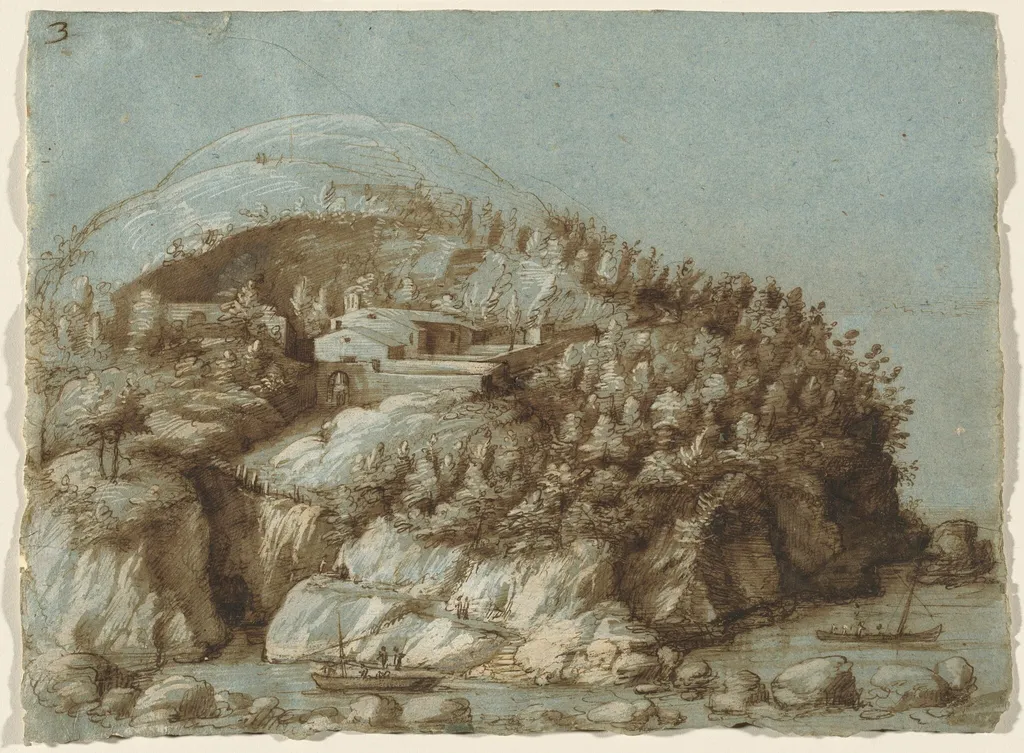
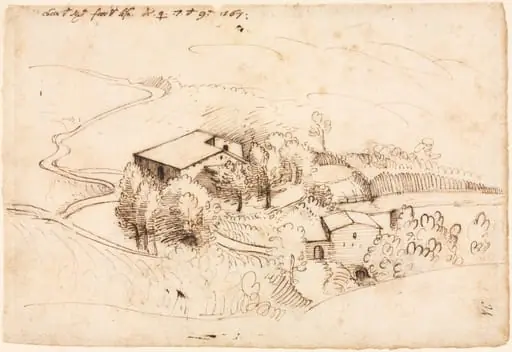
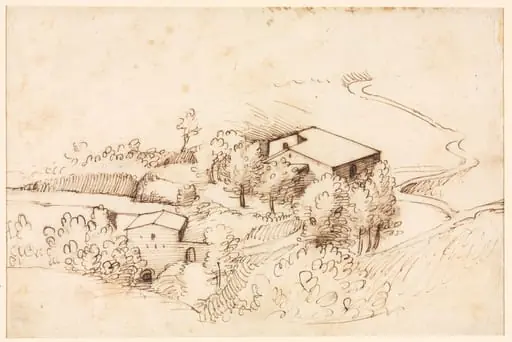
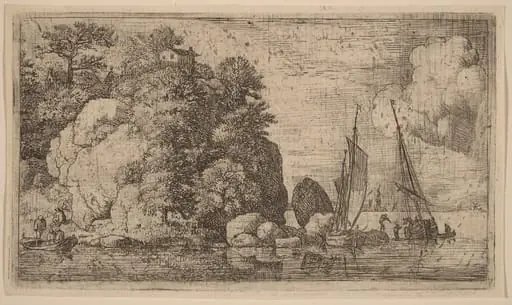
Hilly Landscape with Ships is an ink drawing by the Renaissance artist Gherardo Cibo. It dates from 1570 and is held in the collection of the National Gallery of Art.
About this work
Overview
Executed in pen and brown ink with wash, it is enhanced with white gouache on blue laid paper, a choice that lends subtle contrast and luminosity.
Created around 1570 by Gherardo Cibo, this drawing captures a modest coastal hillside with vessels near the shore. Executed in pen and brown ink with wash, it is enhanced with white gouache on blue laid paper, a choice that lends subtle contrast and luminosity. The work belongs to a body of landscape studies Cibo produced alongside his botanical illustrations, reflecting his dual engagement with natural observation and artistic practice.
Subject & Meaning
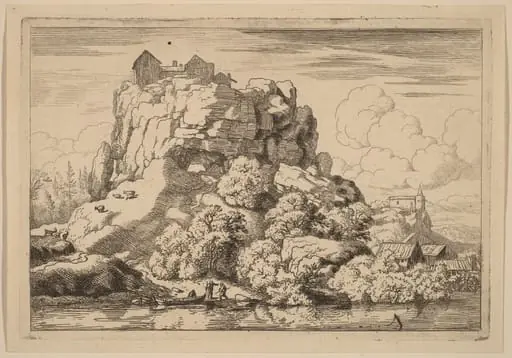
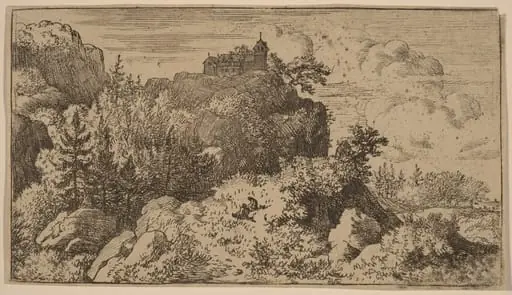
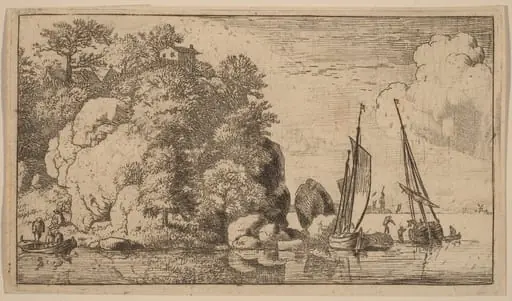
The scene presents a quiet, unidealized stretch of coastline: rocky terrain, sparse vegetation, a solitary structure on the slope, and a few small boats. There is no narrative or human activity, suggesting the drawing served as a field record rather than a commissioned piece. Its focus on ordinary topography and maritime elements aligns with Cibo’s interest in documenting the natural world with precision and restraint.
Technique & Style
Cibo employed rapid, fluid pen strokes to suggest texture—rock surfaces, tangled brush, and water ripples—while brown washes establish tonal depth. White gouache highlights add luminosity to foliage and wave crests, enhancing the illusion of light without overrefinement. The blue paper grounds the composition, subtly reinforcing atmospheric tone. The sketchlike quality implies immediacy, as if drawn on-site during a journey or study trip.
History & Provenance
Cibo, born into a wealthy Genoese family with ties to the court of the Duke of Urbino, had access to materials and intellectual networks that supported his interdisciplinary pursuits. While specific ownership history of this drawing is unrecorded, it likely remained within private collections of scholars or patrons familiar with his botanical and topographical work. Its survival reflects its value as a personal study rather than a public artwork.
Context
In late 16th-century Italy, landscape drawing was gaining traction as a field of scientific and aesthetic inquiry. Cibo’s work aligns with contemporaries who combined empirical observation with artistic skill, particularly in regions where natural history and cartography intersected. His drawings, including this one, contributed to a growing tradition of visual documentation that preceded modern ecological and geographical recording.
Legacy
Though not widely exhibited in his lifetime, Cibo’s landscape sketches are now recognized for their quiet precision and integration of scientific observation into artistic form. This drawing exemplifies how Renaissance artists used drawing not merely for preparation, but as an independent mode of understanding nature. His approach influenced later generations interested in the intersection of art, botany, and environmental study.
Artist & collection

Artist
Gherardo Cibo, also known by the alias of Ulisse Severini da Cingoli (1512 − 30 January 1600), was an artist and a herbalist from Italy.

![Village atop a River Cliff [recto], by Master of the Blue Landscapes](https://artifactworldgallery.com/img/master-of-the-blue-landscapes--village-atop-a-river-cliff-recto--7884484b10704852-w320.webp)