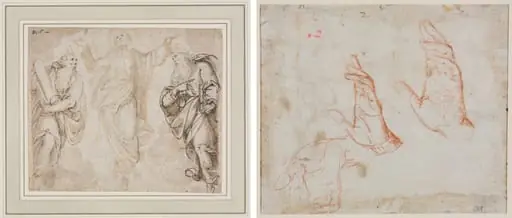
Artwork
Study of Two Putti and a Draped Arm [verso]
![Study of Two Putti and a Draped Arm [verso], by Giovanni Battista Cipriani, chalk, 1756](https://artifactworldgallery.com/img/giovanni-battista-cipriani--study-of-two-putti-and-a-draped-arm-verso--47f39e682d8c982d-w1024.webp)
Study of Two Putti and a Draped Arm [verso] is a chalk drawing by the Baroque artist Giovanni Battista Cipriani. It dates from 1756 and is held in the collection of the National Gallery of Art.
About this work
Overview
Giovanni Battista Cipriani produced a preparatory drawing in 1756 titled *Study of Two Putti and a Draped Arm*. Executed with black chalk on laid paper, the sheet measures a modest size and serves as a compositional sketch for a larger print project. The work exemplifies Cipriani’s routine of generating detailed designs before they were transferred to the engraving stage.
Subject & Meaning
The composition features two youthful, chubby figures—commonly identified as putti—positioned beside a partially concealed arm wrapped in drapery. The arrangement suggests a narrative moment, perhaps a mythological or allegorical scene, where the cherubic figures interact with the concealed limb, creating a sense of playful mystery typical of decorative motifs in the period.
Technique & Style
Cipriani employed a refined black chalk application, varying pressure to achieve both delicate line work and richer tonal areas. The laid paper surface, with its subtle texture, enhances the drawing’s depth, allowing the artist to model form through hatching and cross‑hatching. This method aligns with the academic drawing practices of mid‑18th‑century Italy and England.
History & Provenance
After relocating to England in 1755, Cipriani quickly entered the British artistic market, supplying designs for prints that were often executed by his collaborator Francesco Bartolozzi. While the present sheet’s early ownership is not fully documented, it likely remained within the artist’s studio inventory before entering a private collection in the 19th century.
Context
Created during the late Baroque era, the drawing reflects the period’s interest in dynamic composition and expressive gestures, even as the style was transitioning toward Rococo elegance. The use of preparatory studies like this one was a common step for artists who intended to produce engravings for the burgeoning print market of mid‑18th‑century England.
Artist & collection
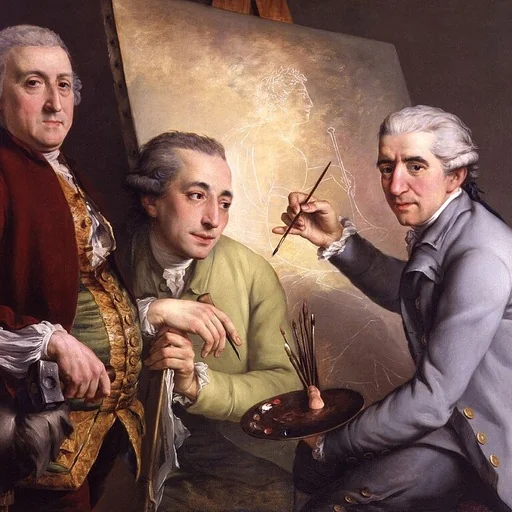
Artist
Giovanni Battista Cipriani (1727 – 14 December 1785) was an Italian painter and engraver, who lived in England from 1755.

![Reclining Woman [verso], by Giovanni Battista Cipriani](https://artifactworldgallery.com/img/giovanni-battista-cipriani--reclining-woman-verso--00754221290578f9-w320.webp)
![A Turk [recto], by Giovanni Battista Cipriani](https://artifactworldgallery.com/img/giovanni-battista-cipriani--a-turk-recto--12cde5f9bac9a966-w320.webp)
![Mythological Composition with Chronos and Harpies [recto], by Giovanni Battista Cipriani](https://artifactworldgallery.com/img/giovanni-battista-cipriani--mythological-composition-with-chronos-and-harpies-recto--23e4197a1ba0ae7e-w320.webp)
![Figure Studies [recto], by Giovanni Battista Cipriani](https://artifactworldgallery.com/img/giovanni-battista-cipriani--figure-studies-recto--32b47b1a71716a78-w320.webp)
![Hand Studies [verso], by Allan Ramsay](https://artifactworldgallery.com/img/allan-ramsay--hand-studies-verso--f6c634d33f170fe2-w320.webp)
![Study of a Foot [verso], by Benjamin Haydon](https://artifactworldgallery.com/img/benjamin-haydon--study-of-a-foot-verso--1953df802be24b7d-w320.webp)
![Studies of Figures for an Adoration of the Magi [verso], by Donato Creti](https://artifactworldgallery.com/img/donato-creti--studies-of-figures-for-an-adoration-of-the-magi-verso--a4ea202b1ff86cc6-w320.webp)